
Reviewed · SLUM AND COMMUNITY TOURS
Private Dharavi Slum and Sightseeing Tour
Mumbai rewards curiosity. This nine-hour private tour pairs a guided walk through Dharavi with temples, markets, waterfront views, and major landmarks, giving you a broad first look at a city that can feel hard to read on your own. I like the access to Dharavi’s homes and working businesses, and I like having a private car and guide to connect far-flung parts of Mumbai.
The strongest parts are the human stories and the range of sights. Guides such as Chetan and Sabina have earned special praise for their history, energy, and care. The main drawback is the pace: twelve stops in one day can feel rushed, and Mumbai traffic can turn a tidy schedule into a long day.
In This Review
- Key points to know before booking
- Why Dharavi gives this Mumbai tour its purpose
- Dhobi Ghat and the working side of Mumbai
- Jain Temple, Banganga, and a quieter side of Malabar Hill
- Haji Ali Mosque and the limits of a quick stop
- Crawford Market, CST, and Mumbai’s grand public spaces
- Gateway of India and the story behind the view
- Chor Bazaar, local tastes, and the fun of looking around
- Marine Drive and Sassoon Dock by the water
- What a private nine-hour day feels like
- Is $87.23 per person a fair price?
- Who should book this Mumbai experience?
- Should you book the Dharavi and Mumbai tour?
- FAQ
- How long does the private Mumbai tour last?
- Is hotel pickup and drop-off included?
- Is this a private tour?
- Who provides the guide and driver?
- How long is the Dharavi visit?
- Is food included in the price?
- Is water provided?
- Can most people participate?
- What is the cancellation policy?
Key points to know before booking
- Dharavi is the heart of the experience: Expect about two hours learning about local homes, work, and small industries rather than simply viewing the area from a vehicle.
- A private car saves time: Hotel or residence pickup, a driver, and return transport make it much easier to link Dharavi with Malabar Hill, South Mumbai, and the waterfront.
- The day covers a lot: Dhobi Ghat, Haji Ali Mosque, Crawford Market, CST, the Gateway of India, Chor Bazaar, Marine Drive, and Sassoon Dock are all included.
- The pace is energetic: Short visits of 10 to 30 minutes at several stops give you a wide sample of Mumbai, but not much time for a slow, detailed visit.
- The price is strongest for small private groups: At $87.23 per person, the value depends on how many people share the booking and how much you value a dedicated guide and car.
- Come ready for real city conditions: Mumbai can be crowded, noisy, and chaotic. That is part of the setting, but it can also make the day tiring.
Why Dharavi gives this Mumbai tour its purpose
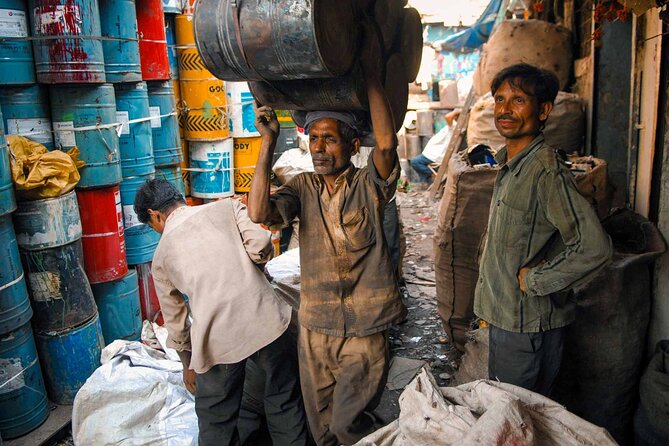
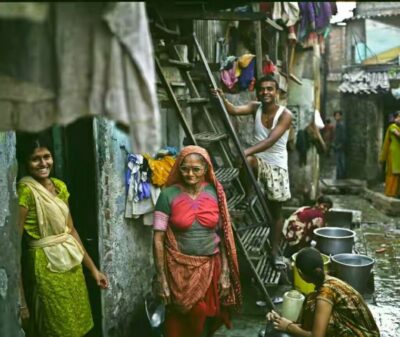
Many city tours treat Dharavi as a photo stop. This one gives it the largest block of time, about two hours, and focuses on the people and businesses that keep the settlement working.
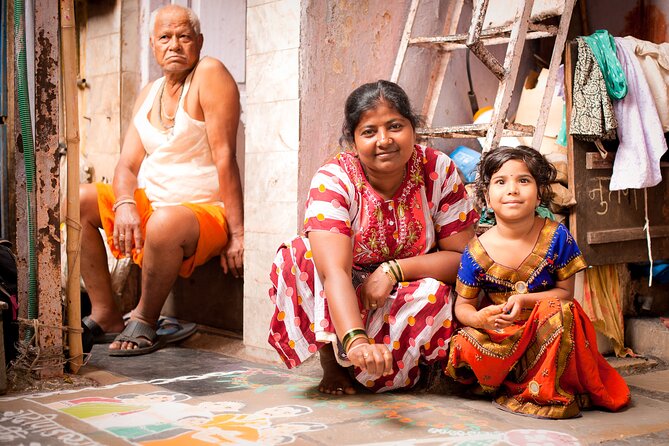
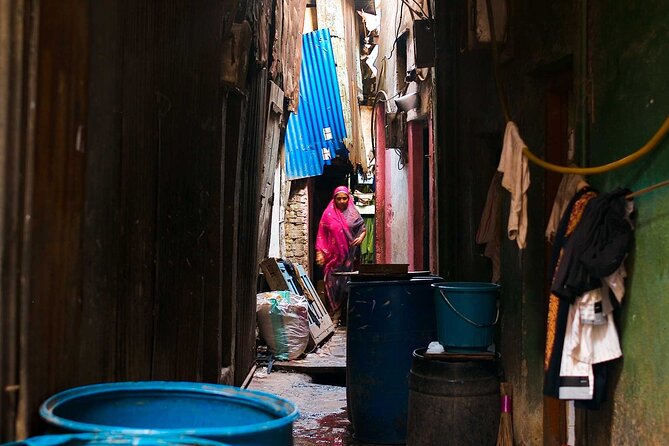
You learn about the industries based there and see how homes and workplaces exist side by side. That matters because Dharavi is not simply a place to look at. It is a living community, and a good guide helps you understand its economy and daily routines without reducing residents to a spectacle.
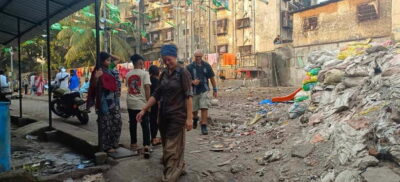
I would approach the walking portion with respect and modest expectations. The point is not to collect dramatic images. The point is to listen, observe, and understand a part of Mumbai that is difficult to visit independently. The tour’s local guide is especially useful here, since context matters more than scenery.
This is also where the private format helps. You can ask questions as they come up, and your guide can explain details in a way that fits your interests. The experience is educational, but it is not a classroom lecture. It is a close look at work, housing, and community life in one of the world’s largest informal settlements.
More Sightseeing Tours in Mumbai
- Mumbai: Full-Day Sightseeing Tour of Mumbai
★ 4.9 · 1,822 reviews - Private Mumbai Sightseeing Tour (Traveller’s Choice Award Winner)
★ 5.0 · 1,565 reviews - Highlights of Mumbai Sightseeing Tour: TRAVELLERS CHOICE AWARDED
★ 5.0 · 915 reviews
Dhobi Ghat and the working side of Mumbai
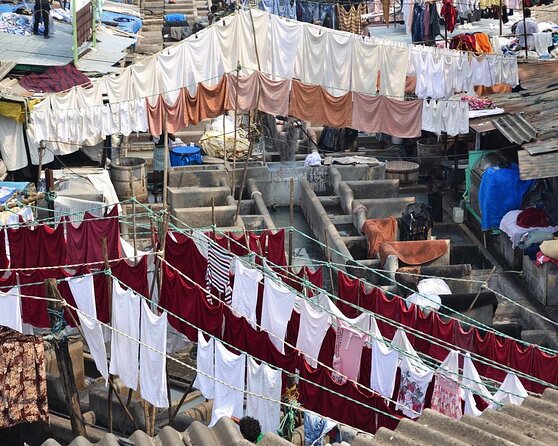
The stop at Dhobi Ghat lasts only about 10 minutes, but it adds an important link to the Dharavi visit. This is known for its outdoor laundry, where dhobiwallahs wash sheets connected with Mumbai hospitals and hotels.
You should treat this as a quick viewing stop, not a full tour. The short time is enough to see the scale and activity of the laundry area, but you will not have a long chance to study the process. Still, it helps show how much of Mumbai’s daily work takes place in public view.
Together, Dharavi and Dhobi Ghat shift the day away from a standard monument tour. You see homes, workshops, laundry, transport, markets, religious sites, and public spaces. That mix is one of the tour’s biggest strengths.
Jain Temple, Banganga, and a quieter side of Malabar Hill
The Jain Temple offers a sharp change of mood. The visit lasts about 20 minutes, and the temple is known for detailed decoration and its connection to Jainism, a faith centered on peace and non-violence.
You will need to keep the visit brief, but it gives you a chance to see how Mumbai’s religious traditions shape the city. I like this kind of contrast after the movement of Dharavi and Dhobi Ghat. A private guide can also explain why the temple matters rather than leaving you to admire its design without context.
At Kamala Nehru Park, another 20-minute stop brings you to Malabar Hill. The main attraction is the wide view over Marine Drive and the Arabian Sea. It is one of the few points in the day where you can pause above the city and take in its shape.
The view is valuable because Mumbai is easy to experience at street level only. From the park, you get a clearer sense of the curving shoreline, dense development, and the long sweep of Marine Drive. Do not expect a long park visit. This is a viewpoint stop.
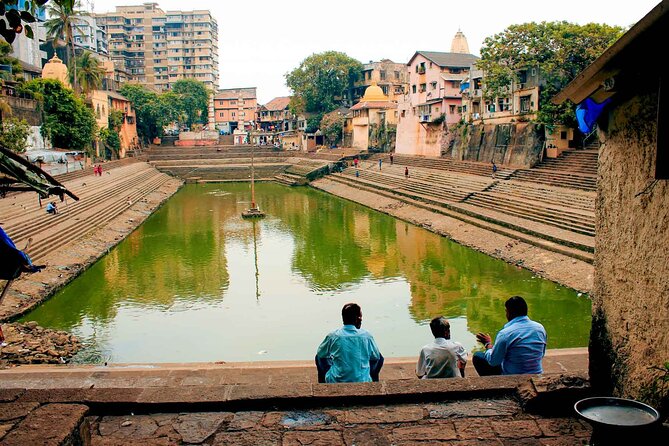
Nearby Banganga offers a more historic religious setting. The 12th-century tank is surrounded by Hindu temples and is believed to have healing water, with local tradition linking its spring to the Ganges.
The 20-minute visit is enough to see the tank and its temple setting. I would listen closely to the guide here, since the importance of Banganga comes from belief, tradition, and continuity as much as from its physical appearance.
Haji Ali Mosque and the limits of a quick stop
Haji Ali Mosque is one of the day’s most memorable locations. It sits at the end of a causeway surrounded by water and contains the tomb of Saint Haji Ali, a wealthy man who gave up his worldly life and went to Mecca.
The planned visit lasts about 30 minutes. That gives you time to take in the unusual setting and the approach across the causeway, but the experience can be affected by conditions around the site. The tour information does not promise a particular amount of time inside the mosque, so you should see this as a location visit rather than a lengthy religious tour.
The water-bound setting makes Haji Ali different from the other religious stops. It also shows how Mumbai’s landmarks often sit right beside heavy traffic and dense urban life. That mixture is typical of the city: sacred places, working streets, and the sea all pressed close together.
A completely different kind of day out:
- Dharavi slum tour in Mumbai by Female tour guides of the slum
★ 5.0 · 1,976 reviews - Elephanta Caves & Island Guided Private Tour
★ 5.0 · 1,327 reviews - Group Guided Walking Tour in Fort and Colaba
★ 5.0 · 1,073 reviews - Mumbai: Elephanta Caves Half-Day Guided Tour with Expert
★ 4.8 · 1,032 reviews
Crawford Market, CST, and Mumbai’s grand public spaces
Crawford Market brings you into one of Mumbai’s large wholesale markets. It handles fruit, vegetables, and meat, and its building has the distinction of being the first in India to receive electricity.
The visit lasts about 30 minutes. That is enough for a taste of the market’s scale and trade, but not enough to explore every section. You might find the experience crowded and noisy, so keep your belongings secure and stay close to the guide.
This is a useful stop for understanding Mumbai as a working city rather than only a historic one. You may also have the chance to sample local sweets or see foods used in everyday cooking, although food is not included in the tour price.
Chhatrapati Shivaji Terminus, commonly called CST, is another short stop of about 20 minutes. It is one of India’s busiest railway stations and Mumbai’s only UNESCO World Heritage Site. Its Victorian Gothic design gives it a grand exterior, while the surrounding rail traffic shows the city at full speed.
The tour also points out CST’s connection with the final song from the film Slumdog Millionaire. That bit of popular culture may interest film fans, but the station is worth seeing for its architecture and role in Mumbai life.
You should not expect to tour the station in depth. The schedule is designed to let you see the building and feel the rush of the setting before moving on.
Gateway of India and the story behind the view
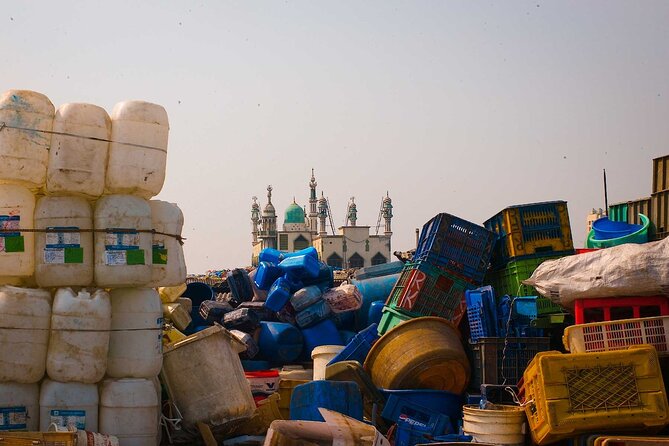
The Gateway of India is one of Mumbai’s essential landmarks. Built in 1911, it later became the place where British troops marched out in 1948, marking the end of British rule.
The stop lasts about 20 minutes. That is enough to view the arch, take photographs, and hear the basic story, but the area can be crowded. Your guide and driver also help by getting you in and out without forcing you to handle Mumbai’s transport system between every stop.
I appreciate the historical contrast here. The Gateway was built to celebrate imperial power, yet it is now one of the city’s most recognizable public meeting points. It works best when you consider both sides of that story.
Chor Bazaar, local tastes, and the fun of looking around
Chor Bazaar, or the Thieves Market, gets about 45 minutes, making it one of the longer stops after Dharavi. It is known as one of India’s largest flea markets and sells a wide range of goods.
The name gives the market a slightly mischievous reputation, but you should not assume every item is stolen. The useful approach is to browse with curiosity and ask your guide about what you are seeing. The market is a place for objects, snacks, pickles, chutneys, and small purchases rather than a carefully arranged shopping center.
You may taste local sweets and buy homemade pickles or chutneys, but food is not included, so bring some spending money if these tempt you. The 45-minute stop is still fairly short if you enjoy shopping. I would decide in advance if you want to browse, eat, or simply observe, because you may not have time for all three.
Marine Drive and Sassoon Dock by the water
Marine Drive is the city’s famous waterfront curve, often called the Queen’s Necklace because of the way its lights appear after dark. The tour allows about 25 minutes for a stroll.
This is a simple stop, but it gives you one of Mumbai’s clearest public views. You can feel the scale of the shoreline and see why Marine Drive is tied so closely to the city’s identity. If you prefer slow walks and long pauses, the fixed schedule may feel too brief.
Sassoon Dock closes the sightseeing loop with another working waterfront. For about 30 minutes, you can watch local fishermen bring in their catch at this active port.
That final stop is a good choice because it keeps the focus on ordinary work. After monuments, markets, and religious sites, Sassoon Dock shows Mumbai’s connection with the sea and its fishing economy. Conditions may be lively and crowded, so practical shoes and a willingness to move with the group will help.
What a private nine-hour day feels like
The tour is marketed as approximately nine hours, with twelve stops ranging from 10 to 45 minutes. That tells you exactly what kind of experience this is: a broad city sampler, not a series of long museum visits.
Some stops are very short. Dhobi Ghat gets about 10 minutes, while the Jain Temple, Kamala Nehru Park, Banganga, CST, and the Gateway of India receive about 20 minutes each. The advantage is variety. The cost is that you will often just begin to settle into a place before it is time to leave.
Mumbai traffic is another factor. The route covers separated parts of the city, from Dharavi and Malabar Hill to South Mumbai and the waterfront. A clean, air-conditioned car was specifically praised in one account, and private transport is a real benefit here. It gives you a place to rest between stops and removes much of the uncertainty of arranging each transfer yourself.
The guide and driver remain with you for the full tour. That is more useful than it may sound. You can ask for explanations, keep the day moving, and avoid losing time between places. Guides Chetan and Sabina were singled out for strong storytelling, energy, and care, though your assigned guide may be someone else.
Water or a cold drink is included. Food is not, so plan to pay for anything you eat at Chor Bazaar or elsewhere. A private tour also means only your own group participates, which can make the Dharavi walk feel more respectful and focused than a large coach outing.
Is $87.23 per person a fair price?
At $87.23 per person, this is not the cheapest way to see Mumbai. You are paying for a full private day, hotel or residence pickup and drop-off, a guide, a driver, transport between distant areas, and a concentrated introduction to Dharavi.
The value improves if two or more people share the booking. You get the privacy of setting the day around your group, though the supplied information does not promise unlimited customization or a different route. The price is also easier to justify if this is your first time in Mumbai and you want one organized day to get your bearings.
It is less attractive if you prefer to spend an entire morning at one market, temple, or museum. You are paying for range and convenience, not depth at every stop.
The tour has a strong public record, with a five-star rating from 75 reviews and 100 percent recommending it. One person rated the experience four stars because the day felt chaotic, but also treated that chaos as part of Mumbai’s character. That is a fair warning: do not book this expecting a quiet, polished sightseeing day.
Who should book this Mumbai experience?
I would recommend it to a first-time visitor who wants to see how Mumbai works as well as what it looks like. It suits you if you value local explanation, want to visit Dharavi with a guide, and would rather ride between districts than work out every taxi or train connection.
It also fits a port arrival or a short stay, since hotel or residence transfers are included and the route covers a wide range of major sights. The private format is useful for couples, families, and small groups that want to ask questions without following strangers.
I would think twice if you dislike early starts, long car rides, crowded markets, or quick photo stops. The day is full. One account called it Mumbai madness at its best and advised having the stamina for it. That is accurate advice.
Dress respectfully for religious sites, keep your belongings secure in crowded areas, and bring water beyond the supplied drink if you need more during a nine-hour day. At Dharavi, follow the guide’s instructions about photography and remember that people live and work there.
Should you book the Dharavi and Mumbai tour?
Book it if you want a wide, human-focused introduction to Mumbai and accept that you will see many places quickly. Dharavi is the reason to choose this tour, while the private car, return transfers, and strong guides make the rest of the day practical.
Skip it if your priority is a slow visit to a few landmarks or if you want to explore entirely at your own pace. For most first-time visitors with one busy day available, the $87.23 price is reasonable for the amount of ground covered, especially when shared by a private group.
Free cancellation is available up to 24 hours before the start time. Changes or cancellations made within 24 hours are not accepted for a refund, so keep that deadline in mind before you commit.
FAQ
How long does the private Mumbai tour last?
The tour lasts approximately nine hours.
Is hotel pickup and drop-off included?
Yes. Pickup and drop-off from your hotel or residence are included.
Is this a private tour?
Yes. Only your own group participates in the activity.
Who provides the guide and driver?
Reality Tours & Travel Pvt Ltd provides a local English-speaking guide and driver for the full tour.
How long is the Dharavi visit?
The Dharavi walking tour lasts about two hours.
Is food included in the price?
No. Food is not included, although you may have chances to buy local sweets, pickles, chutneys, or other food during the day.
Is water provided?
Yes. Water or a cold drink is included.
Can most people participate?
Yes. The tour information says most people can participate.
What is the cancellation policy?
You can cancel up to 24 hours before the start time for a full refund. Cancellations or changes made less than 24 hours before the start time are not accepted for a refund.
More Community Tours in Mumbai
- Mumbai: Dharavi Slum, DhobiGhat, and Dabbawallas Tour
★ 4.9 · 689 reviews - Dharavi Slum Tour
★ 5.0 · 625 reviews - Dharavi Slum tour in Mumbai by local resident
★ 5.0 · 572 reviews - Mumbai: Dharavi Slum Slumdog Millionaire Tour with a Local
★ 4.9 · 529 reviews
Just added in Mumbai
- Mumbai Airport to Mumbai Hotels : Private Transfers★ 5.0 · 13 reviews
- Mumbai Sightseeing Tour★ 5.0 · 11 reviews
- Mumbai Spice Markets and Bazaars Tour with Guide and Transport★ 5.0 · 42 reviews
- Mumbai 800 Year Worli Village: Talking Goddess, Old Fort & more★ 5.0 · 94 reviews
- Customize private tour with pickup★ 5.0 · 95 reviews
- Gufran’s Slum Home Tour in the Mumbai Slums★ 5.0 · 19 reviews
- Private Guided Bandra Half Day City Tour in AC Vehicle★ 5.0 · 72 reviews
- The Famous Bollywood Tour of Mumbai★ 5.0 · 97 reviews
Slum and Community Tours, compared.

Dharavi slum tour in Mumbai by Female tour guides of the slum
Read our review →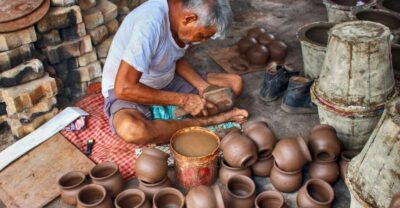

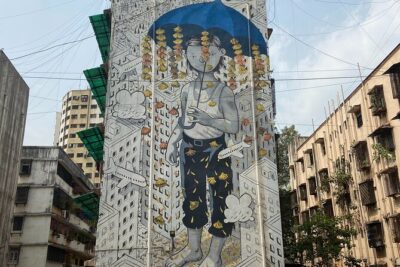
Dharavi Slum Slumdog Millionaire Tour with a Local
Read our review →
Mumbai Slum Tour – Visit Dharavi Slum with Local Guide
Read our review →
Dhobi Ghat Laundry and Dharavi Slum Tour with Local
Read our review →Browse the lists this tour appears in