
Reviewed · SLUM AND COMMUNITY TOURS
Private City Tour with Dharavi Slum Dhobighat and Dabbawalla
Mumbai packs a whole country into one city. This private six-to-seven-hour outing links grand colonial buildings, seaside views, working neighborhoods, Dhobi Ghat, and Dharavi in one long day. I like the private format, which keeps the day focused on your group, and I like the guide-led approach, especially with guides such as Sid and Siddhi praised for warmth, clear explanations, and flexibility.
I also like the wide range of stops. You move from the Gateway of India and Chhatrapati Shivaji Terminus to Banganga, Marine Drive, an open-air laundry, and Dharavi’s small-scale industries. The main drawback is pace: with so many stops, most sights receive only about 20 minutes, and the day may feel crowded with information if you prefer slow museum visits or long meals.
In This Review
- Key points to know before booking
- Starting at the Gateway of India in Colaba
- Colonial Mumbai around the university and High Court
- Chhatrapati Shivaji Terminus and Crawford Market
- Marine Drive, Churchgate, and the city’s public life
- Gandhi’s Mumbai at Mani Bhavan
- Malabar Hill, Hanging Gardens, and Banganga Tank
- Antilia and Mumbai’s sharp economic contrasts
- Seeing the work at Mahalaxmi Dhobi Ghat
- Two hours inside Dharavi
- How the private format changes the day
- Is $75.69 per person fair value?
- Who will enjoy this Mumbai tour?
- Should you book it?
- FAQ
- How long does the private Mumbai tour last?
- What time does the tour start?
- Where does the tour begin?
- Where does the tour end?
- Is this a private tour?
- How much time is spent in Dharavi?
- Can I cancel for a full refund?
Key points to know before booking
- Dharavi receives the most time: You have about two hours here, enough for a more thoughtful look at daily work and neighborhood life.
- The tour is private: Only your group participates, making it easier to ask questions or request changes.
- Sid and Siddhi receive the strongest praise: Their warmth, flexibility, and clear explanations are central to the experience.
- Mumbai’s major contrasts appear in one route: Colonial architecture, religious history, luxury homes, railway culture, laundry work, and small businesses all feature.
- The listed meeting point is Regal Cinema: The tour begins at 9:30 a.m. in Colaba and ends in Kumbhar Wada, Dharavi.
- The price is $75.69 per person: For a full private day with a guide, that can be fair value, but confirm transport and other inclusions before paying.
Starting at the Gateway of India in Colaba
The tour begins at 9:30 a.m. near Regal Cinema in Apollo Bandar, close to the Gateway of India. This is a useful starting point because the monument places you immediately in Mumbai’s old harbor district, where imperial architecture, modern tourism, and working waterfront life meet.
You receive about 20 minutes at the Gateway. That is enough for photographs and a short explanation, but not for a long visit. The arch was built in the early 20th century to mark the visit of King-Emperor George V, the first British monarch to visit India. Its setting also makes it an easy place for your guide to explain Mumbai’s role as a port and major commercial city.
The timing matters here. The Gateway is one of Mumbai’s most familiar sights, so a brief stop works if you want orientation rather than an extended architectural study. If you hope to visit nearby attractions inside, you should ask how much free time is available, since the published schedule treats this as an outside stop.
More Sightseeing Tours in Mumbai
- Mumbai: Full-Day Sightseeing Tour of Mumbai
★ 4.9 · 1,822 reviews - Private Mumbai Sightseeing Tour (Traveller’s Choice Award Winner)
★ 5.0 · 1,565 reviews - Highlights of Mumbai Sightseeing Tour: TRAVELLERS CHOICE AWARDED
★ 5.0 · 915 reviews
Colonial Mumbai around the university and High Court
The next section moves through the grand civic quarter near the University of Mumbai and the High Court’s principal bench in Bombay. These buildings help explain why South Mumbai can feel so different from the city’s newer districts.
The University of Mumbai Library receives around 20 minutes. Its collegiate and public research role gives your guide a chance to discuss the city’s educational life, while the building itself adds another example of Mumbai’s formal architectural heritage. The High Court stop is shorter, about 10 minutes, so expect an exterior look and commentary rather than a lengthy visit.
I find these brief architectural stops useful because they break up the more famous attractions. They also give you context for the city’s civic institutions. Still, the schedule is tight. If historic buildings are your main interest, you may want to tell your guide early so the private format can work in a little more explanation where possible.
Chhatrapati Shivaji Terminus and Crawford Market
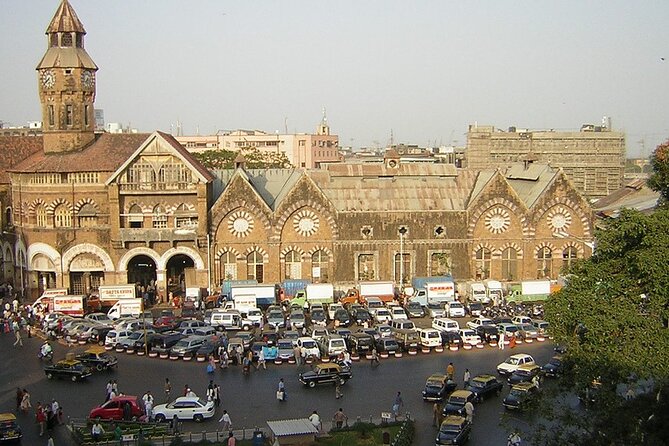
Chhatrapati Shivaji Terminus is one of the day’s strongest architectural stops. You have about 20 minutes to see this UNESCO World Heritage Site and hear about its design by Frederick William Stevens, a British-born architectural engineer.
The terminus is not simply a pretty railway building. It remains tied to the everyday movement of Mumbai, which makes the stop more meaningful than a purely decorative monument. Your guide can help you read the building’s mix of British and Indian design influences, then connect the station to the city’s huge commuter network.
Crawford Market follows with another 20-minute visit. The market building was completed in 1869 and donated to the city by Cowasji Jehangir. Even with limited time, you can get a sense of why this remains one of South Mumbai’s best-known markets.
Do not expect a long shopping session here. The market stop works better as a quick look at Mumbai’s trading culture than as a chance to browse every aisle. One useful feature of the private tour is that you can ask questions without waiting for a large group to gather around the guide.
Marine Drive, Churchgate, and the city’s public life
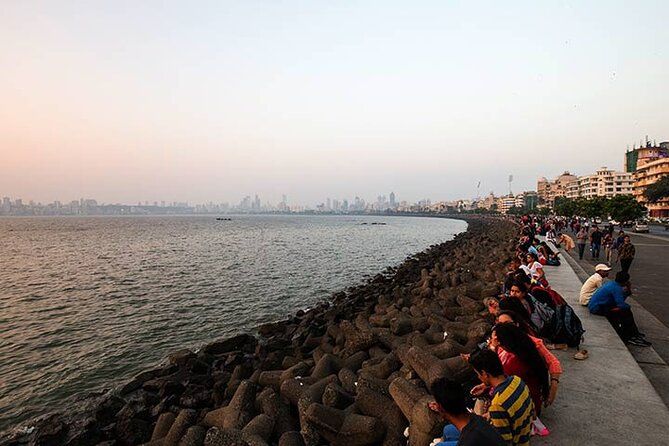
Marine Drive offers a change of pace. The three-kilometer promenade curves along Netaji Subhash Chandra Bose Road, giving you an open view after several dense urban stops. You have about 20 minutes, enough for photographs and a short walk.
The road and promenade are built around a broad, C-shaped route. The view is one of Mumbai’s most recognizable, but its real value is seeing how the waterfront functions as shared public space. It is not a private resort or gated attraction. It is part of the city’s daily rhythm.
Churchgate Railway Station receives another 20 minutes. The area is close to the Oval Maidan, a large open ground associated with casual cricket, and Brabourne Stadium, which hosts formal matches. Nearby neo-Gothic architecture adds another layer to the district.
These stops are especially helpful if this is your first day in Mumbai. You see how transport, sport, architecture, and the sea all sit close together. The limitation is that the tour cannot give each district a full exploration. Think of this portion as a guided introduction, not a walking tour of every street.
A completely different kind of day out:
- Dharavi slum tour in Mumbai by Female tour guides of the slum
★ 5.0 · 1,976 reviews - Elephanta Caves & Island Guided Private Tour
★ 5.0 · 1,327 reviews - Group Guided Walking Tour in Fort and Colaba
★ 5.0 · 1,073 reviews - Mumbai: Elephanta Caves Half-Day Guided Tour with Expert
★ 4.8 · 1,032 reviews
Gandhi’s Mumbai at Mani Bhavan
Mani Bhavan is one of the more focused historical stops. The building on Laburnum Road in the Gamdevi area is now a museum dedicated to Gandhi. It served as a base for his political activity in Mumbai between 1917 and 1934.
You have about 20 minutes here. That is a short visit for a museum, so your experience will depend on how the schedule is handled and whether the guide concentrates on the most important rooms and displays. The stop is worthwhile because it moves the day beyond buildings and scenery into India’s independence movement.
I would treat Mani Bhavan as a compact historical lesson. If Gandhi’s life is a major reason for your visit, ask your guide whether the timing can be adjusted. Since this is a private tour, the conversation can be more personal and responsive than a fixed group commentary.
Malabar Hill, Hanging Gardens, and Banganga Tank
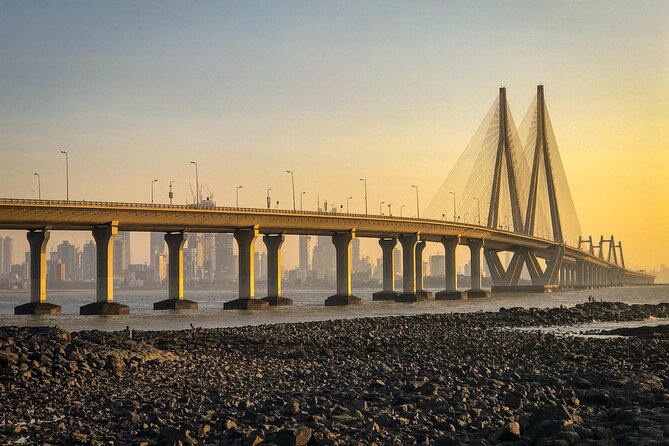
The route then climbs toward Malabar Hill, where the Hanging Gardens and Kamala Nehru Park provide elevated views over Marine Drive. Each stop lasts about 20 minutes.
The Hanging Gardens, also called Pherozeshah Mehta Gardens, sit on terraced ground opposite Kamala Nehru Park. Kamala Nehru Park was built in 1952 and covers about 4,000 square yards. Its main appeal is the view from above, particularly the curve of Marine Drive.
These parks are simple but useful stops. They let you understand Mumbai’s geography, with dense development pressed between the sea and higher ground. You also get a pause from traffic and buildings, though the short schedule leaves little time for a proper garden walk.
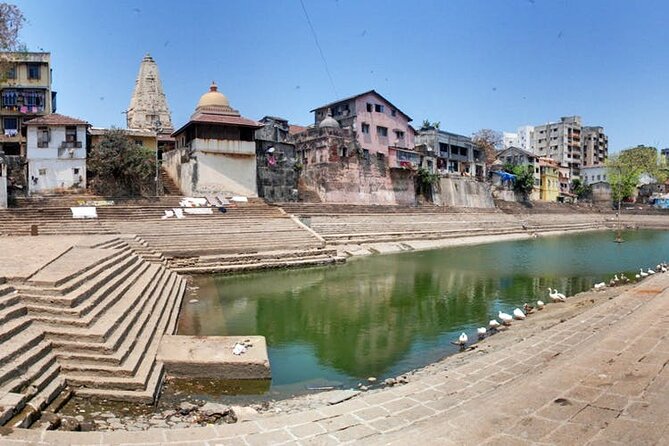
Banganga Tank offers a different kind of setting. It forms part of the Hindu Walkeshwar Temple complex on Malabar Hill. The tank gives your guide a chance to discuss a long-standing religious site within a district better known to many visitors for high-end residences and sea views.
Banganga is best approached respectfully. It is a living religious place, not just a photo stop. Your guide can help you understand what you are seeing and how to behave around worshippers.
Antilia and Mumbai’s sharp economic contrasts
The stop at Antilia lasts about 20 minutes and offers a glimpse of Mumbai’s extreme wealth. Antilia is the private residence of billionaire Mukesh Ambani and his family, who moved there in 2012.
Because it is a private home, this is an exterior viewing stop, not a house visit. Its inclusion may seem unusual, but it helps show the sharp economic range contained within the same city. In one day, you see modest working areas, public institutions, historic monuments, and one of the world’s most discussed private residences.
Your guide’s explanation matters here. Without context, the stop can become little more than a photograph. With a good guide, it becomes part of a larger conversation about land, money, population, and Mumbai’s uneven access to space.
Seeing the work at Mahalaxmi Dhobi Ghat
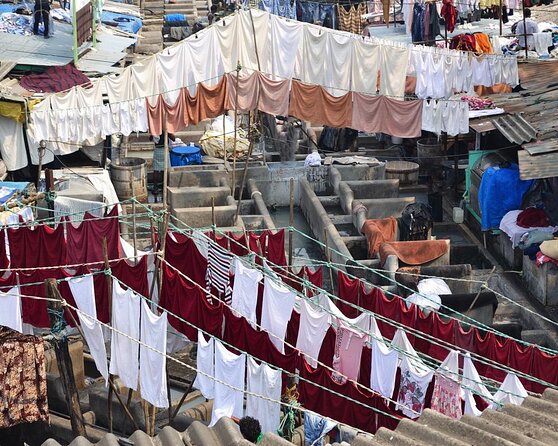
Mahalaxmi Dhobi Ghat receives about 30 minutes, giving it more time than most of the city landmarks. This open-air laundry sits near Mahalaxmi railway station and can also be reached from Jacob Circle monorail station.
Dhobi Ghat is a working place, not a staged attraction. The washers, traditionally known as dhobis, carry out laundry work in a highly organized setting. Your guide can explain how the operation fits into city life and why the site has become one of Mumbai’s best-known working landmarks.
This is a place where your behavior matters. Stay with the guide, avoid treating workers as scenery, and ask before taking close photographs. The best part of the visit is understanding the labor and organization behind the rows of washing areas, not simply collecting dramatic images.
The extra time here is welcome. Thirty minutes allows a better explanation than the 10 or 20-minute architectural stops. If Dhobi Ghat is a priority, confirm whether the visit is from a viewing point or includes a closer walk, since the details provided do not specify the exact arrangement.
Two hours inside Dharavi
Dharavi is the centerpiece of the experience, with about two hours allocated to the neighborhood. It covers just over 2.1 square kilometers and is home to about one million people, according to the supplied tour details.
Those figures explain why a short drive-by would tell you almost nothing. Two hours gives you time to hear about the area’s homes, workshops, local businesses, and daily routines. The tour ends at Kumbhar Wada in Dharavi, so you should be prepared for the day to finish here rather than return automatically to Colaba.
Dharavi demands a careful approach. It is a residential area and a workplace, not a human zoo. The strongest part of this experience is the chance to learn how people live and work in a dense neighborhood, while keeping your attention on the guide’s explanation rather than turning residents into subjects.
The guide makes a major difference. Sid is praised for being clear, passionate, flexible, and willing to explain the city in human terms. Siddhi is also praised for a warm, sensitive manner and for making the visit feel personal without losing its educational purpose. One especially useful detail is that Sid reportedly told a group they did not need to buy anything, which suggests a less pressuring approach.
That does not remove the need for courtesy. Dress and behave respectfully, follow directions about photography, and listen when your guide explains local boundaries. If you are unsure about a photo or conversation, ask first.
How the private format changes the day
This is a private activity, so only your group participates. That is a real advantage in Mumbai, where traffic, heat, and a long chain of stops can make a fixed group tour tiring.
You can ask for more explanation at the Gateway, spend longer at a favorite building, or discuss whether you have already seen one of the listed sites. One guest specifically valued the guide’s flexibility and described adding places after having already visited some scheduled stops.
Pickup is offered, and one account describes hotel pickup and airport drop-off. The stated meeting point, however, is Regal Cinema in Colaba, and the published end point is Kumbhar Wada in Dharavi. Confirm your exact pickup and drop-off arrangements before the morning of the tour, especially if you have a flight or hotel reservation afterward.
The mobile ticket and confirmation at booking make the practical side simple. The tour is near public transportation, and most people can participate. The data does not give detailed information about vehicle type, walking distance, meals, or entrance fees, so ask about those points if they affect your plans.
Is $75.69 per person fair value?
At $75.69 per person, the price is easier to justify for a private group than for a standard shared sightseeing route. You receive six to seven hours with a guide, a broad selection of South Mumbai sights, Dhobi Ghat, and two hours in Dharavi.
The value depends on what you want. If you would otherwise hire separate transport and a private guide, this combines a lot into one day. It also saves you from planning a route between Colaba, central Mumbai, Malabar Hill, Mahalaxmi, and Dharavi.
The schedule does not list admission charges for the stops, and each is marked as having no admission ticket cost. Still, the supplied information does not spell out every tour inclusion. Before booking, ask whether transport, meals, or any optional entry fees are covered.
The tour is less valuable if you want only one or two major sights. You may spend too much time in a vehicle between short stops. It works best when you want a broad first look at Mumbai and are happy to trade depth at individual monuments for variety.
Who will enjoy this Mumbai tour?
I would recommend it to a first-time visitor with one full day for Mumbai. You see the city’s best-known postcard locations, but you also visit places that explain how the city works, including the railway station, market, laundry, religious tank, and Dharavi.
It suits couples, families, and small private groups who prefer to ask questions freely. It also suits people who want a guide to handle the route and explain social contrasts without reducing the city to a list of monuments.
You may want another type of outing if you dislike early starts, long road transfers, or short visits. The day is packed. It also requires sensitivity in Dharavi and Dhobi Ghat, where the people around you are going about their real work and home life.
Free cancellation is available up to 24 hours before the start time. The experience depends on suitable weather and a minimum number of participants, so a poor-weather cancellation can lead to a new date or a full refund.
Should you book it?
Book this tour if you want one private day that shows many sides of Mumbai, especially if Dharavi and Dhobi Ghat are high on your list. The strongest reasons are the two-hour Dharavi visit, the private format, and guides such as Sid and Siddhi, whose clear and considerate style receives the most praise.
Skip it if you prefer slow museum time, independent wandering, or a carefully focused architectural tour. Before committing, confirm pickup, the final drop-off, transport, and the amount of walking. For a first look at Mumbai’s monuments, work, faith, wealth, and daily routines, this is a strong use of a long day.
FAQ
How long does the private Mumbai tour last?
The tour lasts approximately six to seven hours.
What time does the tour start?
The stated start time is 9:30 a.m.
Where does the tour begin?
The listed starting point is Regal Cinema, Apollo Bandar, Colaba, Mumbai.
Where does the tour end?
The listed end point is Kumbhar Wada in Dharavi, Mumbai.
Is this a private tour?
Yes. Only your group participates in the activity.
How much time is spent in Dharavi?
The Dharavi portion is scheduled for about two hours.
Can I cancel for a full refund?
Yes. You can cancel at least 24 hours before the experience start time for a full refund.
More Community Tours in Mumbai
- Mumbai: Dharavi Slum, DhobiGhat, and Dabbawallas Tour
★ 4.9 · 689 reviews - Dharavi Slum Tour
★ 5.0 · 625 reviews - Dharavi Slum tour in Mumbai by local resident
★ 5.0 · 572 reviews - Mumbai: Dharavi Slum Slumdog Millionaire Tour with a Local
★ 4.9 · 529 reviews
Just added in Mumbai
- Mumbai Sightseeing Tour★ 5.0 · 11 reviews
- Mumbai Airport to Mumbai Hotels : Private Transfers★ 5.0 · 13 reviews
- Mumbai Spice Markets and Bazaars Tour with Guide and Transport★ 5.0 · 42 reviews
- Mumbai 800 Year Worli Village: Talking Goddess, Old Fort & more★ 5.0 · 94 reviews
- Customize private tour with pickup★ 5.0 · 95 reviews
- Gufran’s Slum Home Tour in the Mumbai Slums★ 5.0 · 19 reviews
- Private Guided Bandra Half Day City Tour in AC Vehicle★ 5.0 · 72 reviews
- The Famous Bollywood Tour of Mumbai★ 5.0 · 97 reviews
Slum and Community Tours, compared.

Dharavi slum tour in Mumbai by Female tour guides of the slum
Read our review →

Dharavi Slum Slumdog Millionaire Tour with a Local
Read our review →
Mumbai Slum Tour – Visit Dharavi Slum with Local Guide
Read our review →
Dhobi Ghat Laundry and Dharavi Slum Tour with Local
Read our review →Browse the lists this tour appears in