
Reviewed · WALKING TOURS
3 Hour Walking Tour of Buddhism in Sarnath
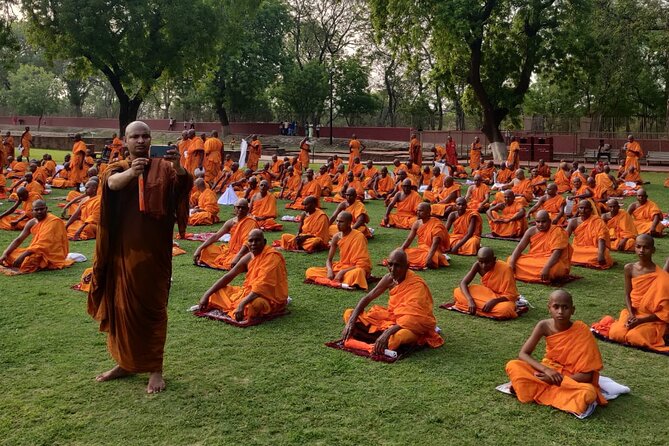
Buddha’s first sermon began here. This three-hour private tour takes you from Varanasi to Sarnath, a quiet Buddhist pilgrimage town about 10 kilometers away, with a local guide and roundtrip tuk tuk transport. I like the personal format and the chance to focus on Sarnath without sorting out transport yourself. I also like that the tour brings together the Dhamekh Stupa, ancient ruins, temples, and the museum in one compact outing.
The main consideration is time. Three hours is enough for a useful introduction, but Sarnath has several important sites, and a guide who explains the religious and archaeological details may make the walk feel full. The meeting point is JHV Mall in Varanasi Cantonment, rather than your hotel unless pickup is arranged.
In This Review
- Key points to know before booking
- Why Sarnath matters beyond another temple visit
- Starting at JHV Mall in Varanasi Cantonment
- Walking toward the Dhamekh Stupa
- Reading the ruins of an ancient learning center
- Mulagandhakuti Vihara and Sarnath’s living faith
- The museum and India’s four lions
- How good is the $33.55 price?
- The guide can make or break the three hours
- Who should book this Sarnath tour?
- My booking verdict
- FAQ
- How long does the Sarnath tour last?
- Where does the tour start?
- Where does the tour end?
- Is transportation from Varanasi included?
- Is this a private tour?
- What is included in the Sarnath visit?
- Can most people take part?
- What is the cancellation policy?
Key points to know before booking
- Buddha’s first sermon: Visit the place where Gautama Buddha is believed to have delivered his first sermon after enlightenment.
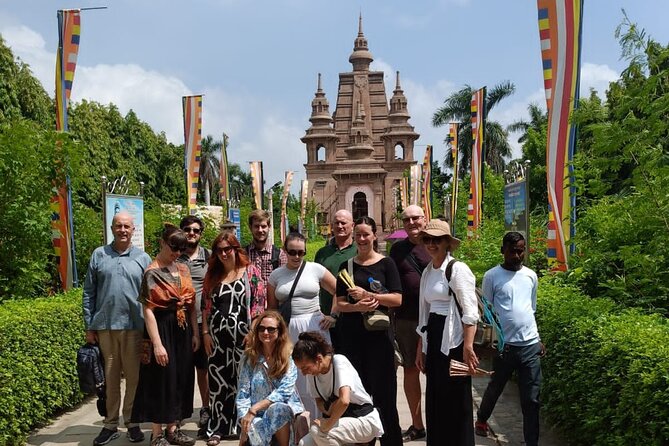
- Private walking tour: Only your group takes part, giving you more room for questions and a more direct conversation with the guide.
- Roundtrip tuk tuk ride: Transport from Varanasi is included, which removes one of the day’s small but real planning chores.
- Dhamekh Stupa and ancient ruins: The main archaeological area connects the spiritual purpose of Sarnath with its earlier role as a major place of learning.
- Ashoka’s lion capital: The museum contains the Ashok Pillar capital with its four lions, now used as India’s national emblem.
- Highly rated guidance: The experience has a 4.9 rating from 160 reviews, with 99 percent recommending it. Guide Shyam is praised for clear English, humor, and wide-ranging explanations.
Why Sarnath matters beyond another temple visit
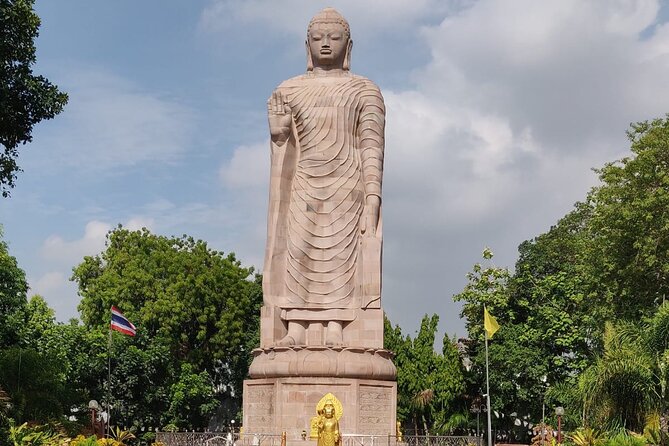
Varanasi can feel intense. Sarnath gives you a different side of the region. It is quieter, more spacious, and tied to one of the most important moments in Buddhist history: Buddha’s first teaching after reaching enlightenment.
According to Buddhist tradition, Buddha came to Sarnath to teach five former companions. His first sermon introduced the central ideas of Buddhism, including the Middle Way and the path toward ending suffering. You do not need to be Buddhist to appreciate the setting. The place works as a history stop, a religious site, and a chance to slow down after time in Varanasi.
Sarnath was also a major school of learning from the 6th century BC to the 12th century AD. That long span gives the ruins more weight than a single monument would have. You are not simply looking at one stupa. You are seeing the remains of a center that drew religious students and teachers for centuries.
I find a local guide especially useful here because the remains can be difficult to read on your own. Stone foundations, walls, and scattered archaeological traces do not always explain themselves. A guide can connect the physical remains with the stories, beliefs, and changing role of the site.
More Walking Tours in Varanasi
- Cultural & Spiritual Trails of Old Town Varanasi Guided Walking Tour
★ 4.5 · 73 reviews - Walking tours – for an authentic Varanasi experience
★ 5.0 · 40 reviews - Single Walking Tour. Local culture, religion, traditions and more. Daily Tour
★ 5.0 · 28 reviews
Starting at JHV Mall in Varanasi Cantonment
The advertised meeting point is JHV Mall on The Mall Road in Varanasi Cantonment. The tour ends back at this same point. Pickup is offered, but you should confirm the exact arrangement when booking instead of assuming the tuk tuk will come to your hotel.
The roundtrip tuk tuk ride is a practical part of the experience. Sarnath is only about 10 kilometers from Varanasi, but having transport organized means you do not need to negotiate a separate ride or work out the return journey. It also keeps the outing within its roughly three-hour schedule.
A tuk tuk is basic transport, not a luxury vehicle. That is part of the local feel, though it may not suit you if you need a fully enclosed or especially comfortable ride. The experience is near public transportation, and the meeting point is in an established area of Varanasi.
Since the tour depends on good weather, check the forecast before you go. If poor weather causes cancellation, you are offered another date or a full refund.
Walking toward the Dhamekh Stupa
The Dhamekh Stupa is the central sight of the tour and the place most closely tied to Sarnath’s Buddhist importance. It marks the area where Buddha gave his first sermon, making it one of the holiest Buddhist sites in the world.
The stupa itself is a large cylindrical brick and stone monument. Its scale helps you understand why this site has remained important across generations. You can walk around it, take in its solid form, and consider how different this setting feels from Varanasi’s crowded religious areas.
Your guide’s role matters most here. The monument is impressive, but its meaning is not always obvious from its size and shape alone. A good explanation can help you see the Dhamekh Stupa not only as an old building, but as a marker of a turning point in Buddhist teaching.
This is also where the private format earns its price. You can ask why the stupa was built, how it relates to Buddha’s sermon, or how the site developed over time without worrying about slowing down a larger group. If your guide is Shyam, you may get the clear English and light humor praised in the feedback for this experience.
Keep in mind that a walking tour involves time on your feet. The available information does not promise a particular pace or special accessibility arrangements, although most people can participate. If you have mobility concerns, ask the operator before booking.
Reading the ruins of an ancient learning center
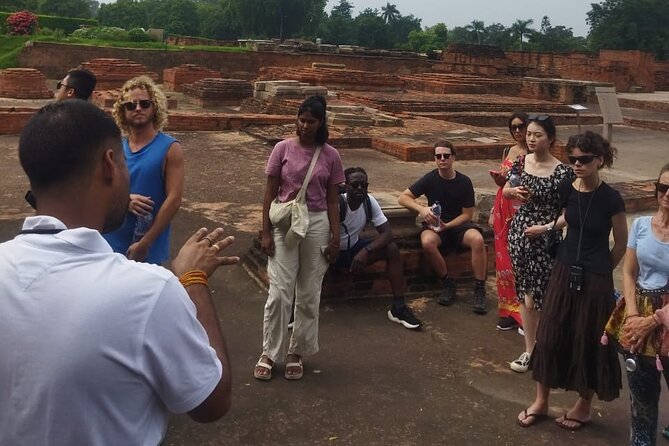
After the stupa, the tour takes you through Sarnath’s archaeological remains. These ruins point to the town’s long role as a place of study and religious activity. The site was a school of learning for many centuries, from the 6th century BC through the 12th century AD.
I like this part because it adds useful context. The Dhamekh Stupa tells you why Sarnath is sacred. The ruins show how that sacred importance supported a larger community of students, teachers, monks, and builders over time.
Do not expect a fully reconstructed ancient town. You will see remains rather than a complete streetscape. That can be a drawback if you prefer sites that are easy to visualize without help. It can also be the best reason to choose a guided visit, since the guide can point out what the foundations and surviving structures represent.
The private setting should make it easier to pause at details that interest you. You may want to spend more time on the religious meaning, or you may prefer the archaeological story. A group tour often requires a fixed pace. Here, your questions can help shape the visit, within the limits of the three-hour schedule.
A completely different kind of day out:
- Varanasi : Full Day City Highlights Day Tour & Ganges Cruise
★ 4.8 · 520 reviews - Hidden Secrets of Varanasi: Vibrant Tradition (Guided Tour)
★ 5.0 · 429 reviews - Varanasi: Sunrise Boat Tour with Arti Ceremony
★ 5.0 · 375 reviews - Banaras Wala Tours
★ 5.0 · 329 reviews
Mulagandhakuti Vihara and Sarnath’s living faith
The itinerary includes a Buddhist temple, with particular attention to Mulagandhakuti Vihara. The temple was built in 1931 by the Sri Lankan Mahabodhi Society, linking modern Buddhist practice with Sarnath’s ancient past.
This is an important contrast. The ruins show what has disappeared. Mulagandhakuti Vihara shows that Sarnath is not only an archaeological site. It remains a place of worship and pilgrimage.
The temple’s connection with Sri Lanka also reflects Sarnath’s international importance within Buddhism. The site is part of a wider religious world that reaches beyond India, even though the tour itself remains focused on this one town.
The supplied details indicate that Buddha spent time at the place associated with the temple, though the available itinerary text is cut off before giving the full explanation. Your guide can provide the fuller story on site. This is a good example of why I would treat the temple as more than a quick photo stop. Listen for the link between the modern building, the ancient teaching, and the continuing religious use of Sarnath.
As with any active religious place, behave respectfully. Keep your voice low and follow the guide’s instructions about where to walk and what may be photographed.
The museum and India’s four lions
The museum is included in the visit, and it contains the Ashok Pillar with its four guardian lions. This capital is especially significant because it became the national emblem of independent India.
For many people, this will be the museum’s most memorable object. The four lions face different directions and represent authority and protection. Seeing the original piece, rather than only its familiar reproduction on official documents and government buildings, gives the national symbol a stronger connection to place.
The museum also helps fill in the gaps left by the open-air ruins. At the archaeological site, you see foundations and monuments in their original setting. Inside, carved objects and artifacts can give you a closer look at the artistic work produced in Sarnath.
Admission is included, which makes the three-hour price easier to assess. You are not paying only for transport and a walk. The fee also covers a guide-led visit that brings together the outdoor remains, temple, and museum.
One practical point: the tour summary specifically includes the museum, but it does not give a separate museum schedule or explain how much time you will spend inside. If the Ashoka capital is a priority, tell your guide early. A private tour gives you a better chance of directing some attention toward it.
How good is the $33.55 price?
At $33.55 per person, this is reasonably priced for a private half-day outing that includes transport from Varanasi and admission. The value depends less on the raw length and more on how much you want help making sense of Sarnath.
A solo visitor or couple may find the cost worthwhile because the private format avoids joining an unknown group. You receive direct attention, and the tuk tuk ride is arranged both ways. For a larger private group, the per-person cost may feel even more attractive, though the listed price is per person.
The tour is not the cheapest possible way to reach Sarnath. You could arrange separate transport and walk around independently. That approach saves money, but it leaves you to interpret the ruins, connect the stupa with Buddha’s teaching, and locate the museum and temple on your own.
I would choose this tour if you value explanation and efficiency. I would skip it if you already know Sarnath well, prefer a slow independent visit, or want a full day with long stops at every site.
The fact that the experience is commonly booked about 24 days ahead suggests that advance planning is sensible, especially if your Varanasi dates are fixed. Confirmation is received at booking, and free cancellation is available up to 24 hours before the start time.
The guide can make or break the three hours
The strongest praise is directed at the guide experience. Shyam is described as informed, humorous, and easy to understand in English. That last point matters if English is not your first language. Clear speech can make the difference between following a complex religious explanation and simply nodding politely.
The feedback also highlights a wide range of subjects, from stories and anecdotes to philosophy. That is a good match for Sarnath, where a short walk can raise questions about archaeology, Buddhist beliefs, Indian history, and modern national identity.
Because the tour is private, ask questions whenever a point catches your attention. You might ask about the first sermon, the purpose of the stupa, the school that operated here, or the history behind the lion capital. You do not need to be an expert to get value from the conversation.
The 4.9 rating from 160 reviews and 99 percent recommendation rate are strong signs, but no guide can remove every limitation. The experience lasts about three hours, and the available details do not promise a specialist archaeologist or a particular language besides the clear English praised in the feedback.
Who should book this Sarnath tour?
I would recommend it most to:
- First-time visitors to Varanasi who want historical and spiritual context.
- People interested in Buddhism, pilgrimage, or the origins of Buddhist teaching.
- Solo visitors who want a private guide rather than a large group.
- Couples or small groups that value arranged transport.
- Visitors with only half a day available.
- Anyone who wants to see the ruins, museum, temple, and stupa in one organized outing.
It may be less suitable for you if you want a long, unhurried archaeological visit. Three hours gives you a useful overview, not unlimited time. It may also be a poor fit if you dislike tuk tuk transport or prefer to arrange every part of your day independently.
My booking verdict
I would book this tour if I had limited time in Varanasi and wanted Sarnath explained rather than simply photographed. The combination of a private guide, roundtrip tuk tuk, included admission, and access to the Dhamekh Stupa, temple, ruins, and museum gives you solid value at $33.55.
Book it especially if you can secure a guide such as Shyam, whose clear English and humor suit the site’s mix of philosophy and ancient remains. Confirm pickup details, allow for a weather-sensitive schedule, and remember that the meeting point is JHV Mall unless another arrangement is made.
If your ideal day means lingering quietly at one monument, this may feel rushed. For a focused introduction to one of Buddhism’s key places, it is an efficient and well-supported choice.
FAQ
How long does the Sarnath tour last?
The tour lasts approximately three hours.
Where does the tour start?
The listed meeting point is JHV Mall on The Mall Road in Varanasi Cantonment, Varanasi, Uttar Pradesh 221002.
Where does the tour end?
The activity ends back at the meeting point.
Is transportation from Varanasi included?
Yes. Roundtrip tuk tuk transport from Varanasi is included, and pickup is offered.
Is this a private tour?
Yes. Only your group participates in the private activity.
What is included in the Sarnath visit?
The tour includes a guided visit to the Dhamekh Stupa, ancient ruins, a Buddhist temple, and the museum. Admission is included.
Can most people take part?
The activity states that most people can participate. It is also near public transportation.
What is the cancellation policy?
You can cancel at least 24 hours before the experience start time for a full refund. Cancellations or changes made less than 24 hours ahead are not accepted for a refund. If poor weather causes cancellation, you are offered a different date or a full refund.
Just added in Varanasi
- The Ultimate 1 Day in Varanasi – How to Spend 13 Hours★ 4.9 · 32 reviews
- Spiritual Tour in Varanasi with a local- 2 Hours Tour★ 4.8 · 13 reviews
- Sarnath Tour- Where Buddhism Originated★ 4.9 · 15 reviews
- Private Sunset Boat Ride and Ganga Aarti with Reserved Seat★ 4.7 · 18 reviews
- Varanasi: Mysticism Tour with Boat Ride & Ganga Aarti★ 3.5 · 33 reviews
- GROUP YOGA CLASS – BEGINNER / ADVANCED – Sunrise Yoga with Ayush in Varanasi★ 5.0 · 79 reviews
- Cultural & Spiritual Trails of Old Town Varanasi Guided Walking Tour★ 4.5 · 73 reviews
- Walking tours – for an authentic Varanasi experience★ 5.0 · 40 reviews
Walking Tours, compared.

The Great Indian Food Tour: Old Delhi Food and Heritage Walk
Read our review →

Blue City Heritage Private Walking Tour With Pickup and Drop-Off
Read our review →
Private Guided Walking Tour in Bandra Queen of Suburbs
Read our review →
Private Jodhpur Blue City Walking Tour with Guide
Read our review →Browse the lists this tour appears in