
Reviewed · WALKING TOURS
Spiritual City Walking Tour-THE Pushkar Route
Pushkar makes religion part of daily life. The Pushkar Route offers a compact way to see that world on foot, with Sikh and Hindu temples, sacred ghats, Brahma legends, and a local guide who explains what you are seeing. I especially like the visit to the Gurudwara Sahib and the chance to try malpua with chai, two details that give the walk more local character than a simple temple checklist. The main drawback is that the food and timing can vary between tour versions, so you should confirm exactly what your booking includes.
At $6.76 per person, this is unusually good value if you want context rather than just photographs. Guides Manish and Vishwanath receive especially warm praise for their explanations and personal connection to Pushkar. Still, the walk can run anywhere from one to three hours, and optional rituals, meals beyond the included tasting, and some differences between morning and evening departures may cost extra.
In This Review
- Key points before you book
- Why Pushkar is best understood on foot
- Starting at Gurudwara Sahib
- Varaha Temple and the story behind its form
- Old Rangji Temple and Rajasthani workmanship
- Atmateshwar Mahadev, Pushkar’s Shiva temple
- Brahma Temple and Pushkar’s unusual claim
- Pushkar Lake and the ghats
- Chai, malpua, and the rooftop pause
- Gau Ghat and what the final stop means
- What you get for $6.76
- Choosing the right timing and tour version
- Who will get the most from this walk
- Should you book The Pushkar Route?
- FAQ
- How much does the Spiritual City Walking Tour cost?
- How long does the tour take?
- What places are included?
- Is hotel pickup available?
- Is breakfast included?
- What drinks are included?
- Are temple entrance fees included?
- Can I join a holy ritual?
- How many people can join the tour?
- What is the cancellation policy?
Key points before you book
- Three religious traditions in one walk: See a Sikh gurudwara, Hindu temples, and sacred lake ghats.
- Manish and Vishwanath are central to the experience: Both are praised for clear explanations of religion, local customs, and Pushkar’s past.
- Malpua and chai are included: The traditional sweet pancake and tea add a useful taste of local food.
- Small groups keep the walk personal: The maximum group size is six people.
- The Brahma Temple and Pushkar Lake anchor the route: These are the most important stops for understanding why Pushkar is holy.
- Clarify the tour version: Morning and sunset options may share the same main temples but differ in food, ceremony, and timing.
Why Pushkar is best understood on foot
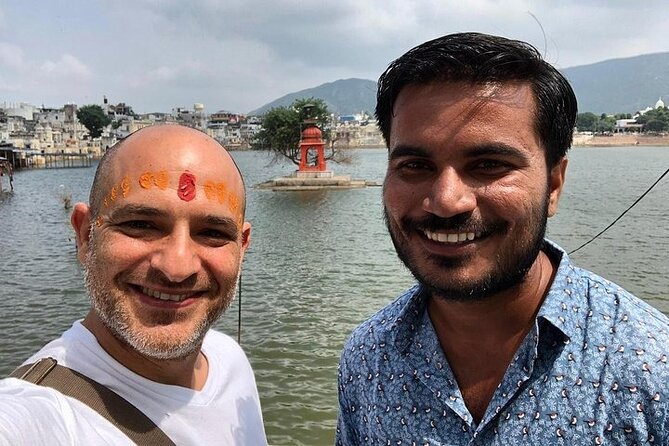
Pushkar is not a city you need to rush through by vehicle. Its important religious places sit among narrow streets, shops, rooftops, shrines, and ghats around the lake. Walking lets you move at the right pace for a town where a small shrine, a temple doorway, or a family prayer may matter as much as a major monument.
The route is designed for that kind of close look. You learn why pilgrims come to Pushkar, how Hindu worship is carried out, and why the town also matters to the Sikh community. The guide’s explanations are the real reason to book. Without them, the temples can blur into a series of ornate buildings.
I like the fact that the route does not focus only on the famous Brahma Temple. It includes smaller and older religious sites, plus the ghats where worship and remembrance continue through the day. That gives you a better sense of Pushkar as a living pilgrimage town rather than a sightseeing stop.
The group limit of six is another plus. A small group makes it easier to ask about Hindu beliefs, Sikh traditions, caste, ceremonies, and local customs. Several published comments praise the guides’ English and their ability to explain complex religious subjects in a clear way.
More Walking Tours in India:
- The Great Indian Food Tour: Old Delhi Food and Heritage Walk
★ 5.0 · 1,698 reviews - Group Guided Walking Tour in Fort and Colaba
★ 5.0 · 1,073 reviews - Private Guided Walking Tour in Fort & Colaba
★ 5.0 · 895 reviews
Starting at Gurudwara Sahib
The walk begins at Gurudwara Sahib, where the guide introduces the Sikh faith and explains Pushkar’s importance to Sikh visitors. This is a smart opening because it widens your understanding of the town from the beginning.
Pushkar is often presented mainly through Hindu mythology, especially the story of Brahma. The gurudwara reminds you that more than one religious tradition has a place here. Manish is specifically praised for including this stop and for explaining its meaning to the Sikh community.
Allow about 30 minutes. The entry is free, and the stop is less about a grand monument than about learning how different faiths connect with the same town. If you have little background in Sikhism, this part may be especially helpful.
One practical point matters here. The route description says not to go to Gau Ghat on location, while the gurudwara is an actual opening stop. If your booking includes a special morning route or a sunset route, ask the guide to confirm the exact order of stops before you begin.
Varaha Temple and the story behind its form
The Varaha Temple brings you into one of Pushkar’s major Hindu traditions. Varaha is an incarnation of Vishnu, and the temple is tied to the town’s long religious importance.
The present statue was installed in 1784. The earlier temple was much taller, described as having reached 150 feet, while the current structure uses heavy stone and plaster in a Rajasthani haveli style.
That architectural detail is worth noticing. A haveli-style temple does not look like a plain modern place of worship. Its design links religious space with the building traditions of Rajasthan, including enclosed courtyards and decorative stonework.
You spend about 25 minutes here, with admission included. Do not expect a long museum visit. The value comes from the guide explaining what the image represents and how the building fits into Pushkar’s religious story.
Old Rangji Temple and Rajasthani workmanship
Old Rangji Temple is also called the Rama Vaikuntha Temple. It is a Vishnu temple known for its workmanship and heavy stone construction.
The stop lasts around 15 minutes, making it one of the shorter visits. I would treat it as an architectural pause rather than a full temple tour. The guide can help you notice details that might otherwise pass quickly, especially the Rajasthani style of the building.
This is one reason a walking guide earns its small fee. You are not simply pointed toward a doorway and sent on. You get a basic explanation of the deity, the temple’s name, and its place within Pushkar’s wider religious setting.
Still, the exact amount of time inside a temple can depend on worship activity and local rules. Respect the atmosphere. Dress modestly, follow instructions about shoes and photography, and avoid treating active prayer as a performance.
A few more options to weigh up in India
- Afternoon Walk Tour with Sunset & Fire Ritual -The Pushkar Route
★ 5.0 · 119 reviews - Evening Walking Tour with Fire Rituals-The Pushkar Route
★ 4.9 · 108 reviews - Spiritual Walking tour with Puja Ceremony -The Pushkar Route
★ 5.0 · 101 reviews - From Jaipur : Private Ajmer Pushkar Tour by Cab
★ 4.5 · 29 reviews
Atmateshwar Mahadev, Pushkar’s Shiva temple
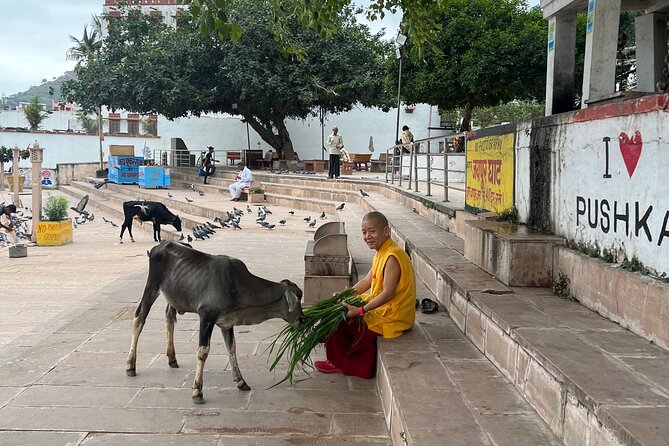
The Atmateshwar Mahadev Mandir is devoted to Shiva and is described as the oldest Shiva temple in Pushkar. You can see Shiva with his complete family, which gives the guide a natural way to explain family relationships within Hindu religious stories.
The visit lasts about 25 minutes and has no admission charge. Compared with the Brahma Temple, this can feel like a quieter and more focused stop. It is useful for understanding that Pushkar is not devoted to just one god or one legend.
I like this part of the route because it adds balance. If you only visit Brahma-related sites, you get a narrow picture of Hindu worship in the town. Atmateshwar introduces Shiva and offers another doorway into the beliefs that shape daily religious life.
The tour is not a formal religious course, so explanations will be suited to general visitors. If you want to ask about rituals, gods, or temple customs, use the small group to raise questions as you go.
Brahma Temple and Pushkar’s unusual claim
The Brahma Temple is the route’s major religious stop. Pushkar is famous for having one of the world’s few major temples dedicated to Brahma, the Hindu creator god. The guide explains why Brahma has only one prominent temple in the world, along with the mythology connected to Pushkar.
The visit is scheduled for around 30 minutes, and entry is included. The building’s architecture and religious story work together here. Even if you know little about Hindu mythology, the guide can give you a framework for understanding why this particular town is so important.
Some visitors also take part in a blessing or prayer ceremony. This is optional, and the cost of holy rituals is not included. That distinction matters. You can visit the temple without paying for a ceremony, but you should ask the guide about any charge before agreeing to participate.
A strong guide also explains what is happening rather than simply asking you to follow along. Past comments particularly praise explanations of ceremonies at the Brahma Temple and ghats. If a ritual is offered, you should feel free to watch instead of joining.
Pushkar Lake and the ghats
After the Brahma Temple, the route heads toward Pushkar Lake and Brahma Ghat. This is where the town’s religious life becomes easiest to see.
Families come to the ghats to pray for happiness and to pay tribute to deceased relatives. The water, steps, priests, flowers, and quiet acts of remembrance create a setting that is both public and personal. Photography may be tempting, but it should be handled with care around people engaged in prayer or mourning.
Brahma Ghat is also described as a good place for photographs. The best views may depend on the time of day, and the sunset option adds a more atmospheric element. One published account specifically praises the sunset and fire ceremony, so an evening departure may suit you if you want a slower, more reflective ending.
The lake is not simply a scenic attraction. It is the spiritual center of Pushkar. The guide’s explanation helps you understand why pilgrims bathe here and why the ghats have such importance in family ceremonies.
Chai, malpua, and the rooftop pause
At Brahma Ghat, the route includes a stop at Alka Rooftop Restaurant, where you can refresh with a drink and a view over the market. The listed beverage is lemon, ginger, and honey, while the included tea is also described elsewhere as masala tea served in a clay cup with cardamom and ginger.
The food item is malpua, a traditional Pushkar sweet. It is a syrup-coated pancake made with curd, spices, khoya, or dried milk solids, and nuts. This is a small tasting rather than a full meal, but it gives you a direct connection with local food.
The food details need careful reading. Foods and drinks beyond the specified inclusion are not covered, and one complaint arose from confusion over breakfast, snacks, and restaurant food. The practical lesson is simple: expect the included malpua and tea or specified refreshment, not lunch or dinner.
If you want a substantial meal, plan to pay separately. The tour is a city walk with a traditional tasting, not a food tour.
Gau Ghat and what the final stop means
Gau Ghat is known as one of the oldest of Pushkar’s 52 ghats. It is also called Gandhi Ghat. The nearby Halwai Gali is known for sweet bakers and confectioners, which adds a useful food note to the area.
The route says not to go to the location for this stop, so you should treat Gau Ghat as part of the guide’s explanation rather than assume you will spend a long period there. This is a minor limitation if you want to photograph every ghat in person.
Even so, knowing the names and roles of the ghats makes a later independent walk more rewarding. You can return to the lake with a better sense of where you are and why each section matters.
What you get for $6.76
At $6.76, the price is excellent for a guided introduction to Pushkar. The fee includes guiding, taxes and handling charges, entrance fees, hotel pickup and drop-off, and lockers for cameras and large bags. The maximum of six people also adds value, since a private guide would normally cost far more.
The strongest value is not the admission fees. Most of the listed temples are free or inexpensive to enter. You are paying for interpretation, route planning, local knowledge, and the chance to ask questions while standing in the places being discussed.
The breakfast or tasting also helps. Malpua and chai are modest inclusions, but they make the experience feel less mechanical. I would not book this solely for the food, yet it is a pleasant bonus at this price.
Hotel pickup and drop-off are included, but one account describes a disagreement about the return arrangement. Confirm where the walk ends and how you will return before setting out, especially if you are staying close to the final temple or ghat.
Choosing the right timing and tour version
The experience can last from one to three hours, depending on the selected option and pace. A morning walk may suit you if you want clearer daylight and a quieter start. The evening version may be better if your priority is sunset, a fire ceremony, and views around the lake.
The tour provider offers 10 tour types, so your interests should be stated when booking. Ask whether your selected option includes the gurudwara, the malpua and chai, the lemon-ginger-honey drink, and the fire ceremony.
Some morning and sunset versions appear to share the same principal temples. That does not mean every detail is identical. The timing, refreshments, ceremony, and final stop may differ, so do not rely on the title alone.
The walk is open to most people, is near public transportation, and accepts a maximum of six participants. Pickup is offered, and confirmation arrives when you book. The activity requires good weather, with a different date or full refund offered if poor weather causes cancellation.
You can cancel for a full refund up to 24 hours before the start time. Changes or cancellations inside that window are not accepted for a refund, so make your decision early.
Who will get the most from this walk
I would recommend The Pushkar Route to you if you want to understand what you are seeing. It suits first-time visitors, people curious about Hinduism and Sikhism, and anyone who prefers a local explanation to a self-guided circuit.
It is also a good fit for visitors who enjoy small groups and questions. The strongest comments praise Manish’s English, his personal connection with Pushkar, and the clear pace of his explanations. Vishwanath is described as coming from a Brahmin family that has lived in Pushkar for seven generations, with a particularly strong grasp of local religious customs.
You should think twice if you want a full meal, a long architectural tour, or a fixed schedule with no variation. Optional ceremonies cost extra, food beyond the included tasting is not covered, and the route may feel brief at some stops.
Also, approach religious ceremonies with respect. You can ask questions, observe, and decline participation. A good visit should leave you better informed without turning worship into entertainment.
Should you book The Pushkar Route?
Yes, if your aim is a low-cost, personal introduction to Pushkar’s temples, lake, and religious customs. The price is hard to argue with, especially when pickup, entry fees, a traditional sweet, and a small group are included.
Book it for the guide’s explanations, not for a full breakfast or a long sightseeing excursion. Confirm your tour time, included drink, food, ceremony, and drop-off plan before you go. If you do that, this walk can give you the cultural footing you need to explore Pushkar on your own afterward.
FAQ
How much does the Spiritual City Walking Tour cost?
The listed price is $6.76 per person.
How long does the tour take?
The experience lasts approximately one to three hours.
What places are included?
The route includes Gurudwara Sahib, Varaha Temple, Old Rangji Temple, Atmateshwar Mahadev Mandir, Brahma Temple, Pushkar Lake, Brahma Ghat, and information about Gau Ghat.
Is hotel pickup available?
Yes. Hotel pickup and drop-off are listed as included.
Is breakfast included?
A traditional malpua tasting is included. Malpua is a sweet pancake coated with sugar syrup and served with ingredients such as curd, spices, khoya, and nuts.
What drinks are included?
The experience includes tea or coffee, with masala tea described as being served in a clay cup with cardamom and ginger. A lemon, ginger, and honey drink is also listed at the rooftop restaurant stop.
Are temple entrance fees included?
Yes. Entrance fees are included, and several stops are listed as free admission.
Can I join a holy ritual?
You may choose to participate in holy rituals and ceremonies, but those charges are not included in the tour price.
How many people can join the tour?
The maximum group size is six people.
What is the cancellation policy?
You can cancel at least 24 hours before the start time for a full refund. Cancellations or changes made less than 24 hours before the experience are not accepted for a refund.
Just added in India
- Five Days Golden Triangle Tour with Ranthambore Delhi Agra Jaipur★ 5.0 · 11 reviews
- 5 Days Golden Triangle Tour with Ranthambore India★ 5.0 · 10 reviews
- 5 Days Golden Triangle Tour with Ranthambore Delhi Agra Jaipur★ 5.0 · 11 reviews
- Delhi, Agra, Jaipur & Ranthambhore Tiger Safari 5-Day Tour★ 5.0 · 47 reviews
- 5-Day Private Luxury Golden Triangle Tour From Delhi★ 5.0 · 45 reviews
- Private 5 Days Golden Triangle Tour – Visit Delhi Agra and Jaipur★ 5.0 · 26 reviews
- 5-Day Private Delhi, Agra and Jaipur with Ranthambhore Tiger Tour From Delhi★ 5.0 · 44 reviews
- 5-Day Private Golden Triangle Tour: Delhi, Agra, and Jaipur★ 5.0 · 62 reviews
Walking Tours, compared.

The Great Indian Food Tour: Old Delhi Food and Heritage Walk
Read our review →

Blue City Heritage Private Walking Tour With Pickup and Drop-Off
Read our review →
Private Guided Walking Tour in Bandra Queen of Suburbs
Read our review →

Private Jodhpur Blue City Walking Tour with Guide
Read our review →
Private Heritage Walking Tour in Jaisalmer Fort and Old Bazaar
Read our review →Browse the lists this tour appears in