

Reviewed · WALKING TOURS
Pondicherry Heritage Walking Tour of French Quarters
Colonial streets tell Pondicherry’s story. This two-hour walk through White Town brings together French-era buildings, public monuments, churches, the seafront, and a useful introduction to the city’s mixed Indian and European character. At $26 per person, the tour is priced as a short guided orientation rather than a full-day cultural program.
I like the compact route and the number of important sights packed into two hours. I also like the small maximum group of 15, which should make it easier to hear the guide and ask questions. The main consideration is guide communication. One guest found the English below expectations, while other feedback praised Vanaraj and Prasanth for being helpful, informed, and attentive to individual needs.
In This Review
- Key Points Before You Book
- Why White Town Works So Well on Foot
- Foyer Du Soldat and Pondicherry’s French Connection
- Raj Niwas: A Short Look at Government Power
- Aayi Mandapam and the Meaning Behind the Monument
- The French War Memorial and the Old Lighthouse
- Eglise de Notre Dame des Anges by the Bay
- Gandhi’s Statue and the Walk Toward Modern India
- What Two Hours Really Gets You
- Guide Quality Matters More Than the Price
- Is $26 a Fair Price?
- Who Should Book This Walk?
- Should You Book the Pondicherry French Quarter Walk?
- FAQ
- How long is the Pondicherry Heritage Walking Tour?
- Where does the walking tour start?
- Where does the tour end?
- How many people can join the tour?
- Is a guide included?
- Are snacks included?
- Are admission tickets included?
- Can children participate?
- Can I cancel for a full refund?
Key Points Before You Book
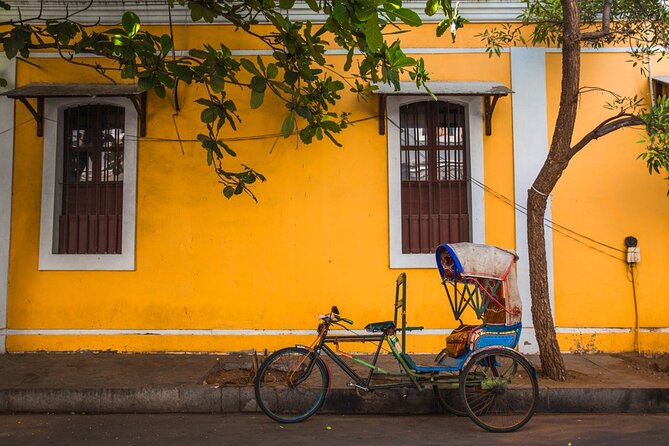
- Eight central stops in two hours: The route covers White Town, Raj Niwas, Aayi Mandapam, the French War Memorial, a historic church, the Old Lighthouse, and the Gandhi Statue.
- A walk through named French Quarter streets: Rue Dumas, Rue Romain Rolland, Rue Suffren, and Rue La Bourdonnais give the tour a strong sense of place.
- A helpful first look at Pondicherry: You get colonial architecture, public monuments, religious history, and the Bay of Bengal in one short outing.
- A small group capped at 15 people: This is a more manageable size than a large coach-style group.
- A guide is included, snacks are not: Bring your own refreshment if you want something during or after the walk.
- A simple point-to-point finish: The walk begins at the Chief Secretariat on Goubert Avenue and ends at the Mahatma Gandhi Statue.
Why White Town Works So Well on Foot
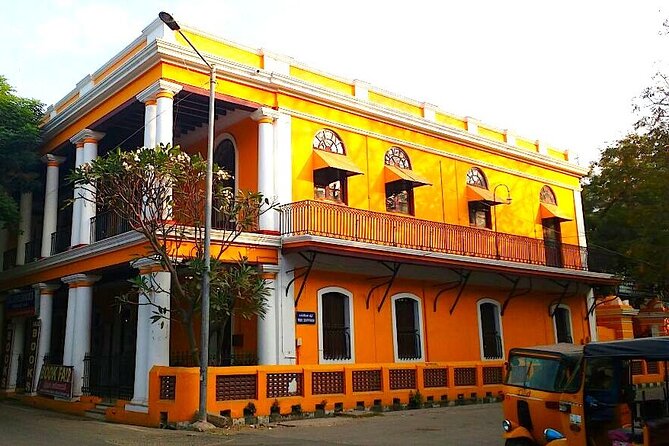
Pondicherry’s French Quarter is best understood at walking speed. The route moves along Rue Dumas, Rue Romain Rolland, Rue Suffren, and Rue La Bourdonnais, where the streets reveal the city’s former French identity through their names, buildings, and layout.
The architecture is one of the main reasons to choose this experience. You may see French, Baroque, Rococo, Neoclassical, and Indian influences appearing close together. That mixture gives the area its particular character. This is not simply a French neighborhood transplanted to India. It is a place where European design and local traditions have occupied the same streets for generations.
I would treat the first 20-minute stop at White Town as the foundation for everything that follows. A guide can point out how the buildings and streets fit together, rather than leaving you to view them as a series of attractive façades. The stop has no admission charge, so the value comes from explanation and context.
Street cafés and the nearby beach add a pleasant change of pace. The tour does not include snacks, but the café setting helps you decide where to pause after the walk. Since the route ends near the seafront, you can also continue exploring on your own once the guide departs.
More Walking Tours in India:
- The Great Indian Food Tour: Old Delhi Food and Heritage Walk
★ 5.0 · 1,698 reviews - Group Guided Walking Tour in Fort and Colaba
★ 5.0 · 1,073 reviews - Spiritual City Walking Tour-THE Pushkar Route
★ 5.0 · 907 reviews
Foyer Du Soldat and Pondicherry’s French Connection
The second stop lasts about 20 minutes and focuses on Foyer Du Soldat, a French legion hall. It serves as a meeting place for former French army soldiers who served in different wars and also hosts cultural events.
This is a more unusual stop than a standard monument. It connects Pondicherry’s colonial past with the people and institutions that carried that connection into later years. The building is not just an architectural object. It reflects the continuing link between local life and France.
You should pay attention here if you are interested in military history or the personal side of colonial rule. The stop may be less rewarding if you want only grand buildings and scenic views, but it adds human context to the walk. A good guide can help explain why a French military hall remains part of Pondicherry’s public identity.
Raj Niwas: A Short Look at Government Power
Raj Niwas is the residence of the Lieutenant Governor of Puducherry. The stop lasts about 10 minutes, and admission is not included, so you should expect an outside view or a limited look rather than a full interior visit.
The building’s story is especially striking. It was first built in the French Baroque style, destroyed by the British in 1761, and later rebuilt in the Rococo style. Those changes reflect the political shifts that shaped Pondicherry over time.
This is a brief stop, but it helps you read the city’s architecture as part of a larger story. Style here is not decoration alone. It reflects French influence, British conflict, rebuilding, and the later role of Puducherry’s administration.
Do not expect a long palace visit. The tour allows only 10 minutes, and the lack of included admission matters. Think of Raj Niwas as a quick architectural and political reference point within a broader street walk.
Aayi Mandapam and the Meaning Behind the Monument
Aayi Mandapam, also called the Park Monument, takes about 15 minutes. Built during the reign of Napoleon III in the 19th century, it uses a Greco-Roman design and commemorates the selfless act of a courtesan named Aayi.
The story gives this monument more weight than its formal appearance might suggest. Aayi’s act became important enough to be remembered in a public structure created during the French imperial period. The contrast between the monument’s European style and its local story is one of the clearest examples of Pondicherry’s cultural blend.
The monument is free to view, making it an easy stop on the route. I would listen closely to the explanation here, since the name and architectural style alone do not tell you why it matters. This is one of the places where a guide adds real value.
A completely different kind of day out:
- Old & New Delhi City Tour – Half or Full Day Options Available
★ 5.0 · 4,811 reviews - Old & New Delhi City Tour – Choose Half or Full Day Experience
★ 5.0 · 4,513 reviews - Same Day Taj Mahal, Agra Fort & Baby Taj Tour from Delhi by Car
★ 5.0 · 4,304 reviews - Taj Mahal Day Tour from Delhi by Superfast Train – TOP RATED TOUR
★ 5.0 · 4,166 reviews
The French War Memorial and the Old Lighthouse
The French War Memorial and Old Lighthouse are separate stops, each lasting about 15 and 10 minutes respectively. Both are linked to French engineering and the city’s changing public infrastructure.
The French War Memorial was built in 1835 and designed by French engineer Louis Guerre. Its original lighting system used six oil lamps and two reflectors. The lamps changed to electricity in 1913, then received another upgrade in 1931.
The Old Lighthouse is also dated to 1835 and is associated with Louis Guerre. The supplied tour details give the same lighting history for this stop, with oil lamps later replaced and upgraded with electric lighting.
These details make the sites more interesting than simple photo stops. You can see how Pondicherry supported navigation, public safety, and memorial traditions during the French period. The tour also shows how technology changed without erasing the earlier structures.
The time allocation is short, so you should not expect an extended lighthouse visit or a detailed engineering demonstration. Still, the pairing works well. One site remembers military service, while the other reflects the practical needs of a coastal city.
Eglise de Notre Dame des Anges by the Bay
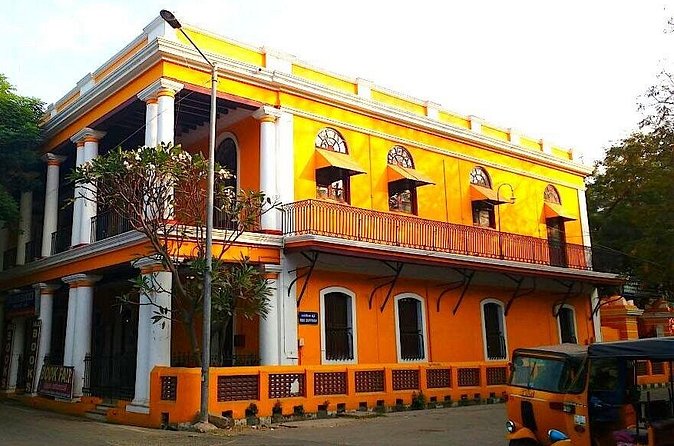
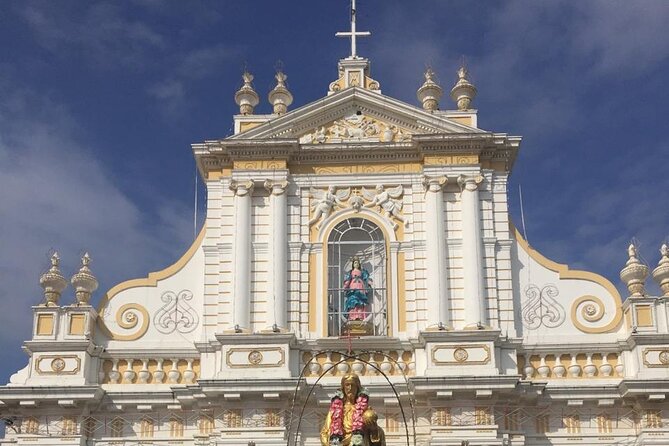
The 20-minute stop at Eglise de Notre Dame des Anges is one of the longer and more substantial parts of the walk. This Catholic church faces the Bay of Bengal and was built in the Greco-Roman style by Louis Guerre in 1855 under Napoleon III.
Its twin towers and stained glass windows give it a distinctive appearance. The church also helps show how religious buildings became part of the French urban plan. Here, architecture, worship, coastal setting, and colonial history come together in one place.
I would allow this stop more attention than a quick photograph. The church provides a change from government buildings and memorials, and its design offers another way to compare European styles with the wider Indian setting.
The tour data does not promise a special interior visit or a religious service. You should therefore treat it as a guided exterior and heritage stop unless the guide tells you otherwise. The 20-minute allocation suggests that the church receives a fuller explanation than several of the shorter monuments.
Gandhi’s Statue and the Walk Toward Modern India
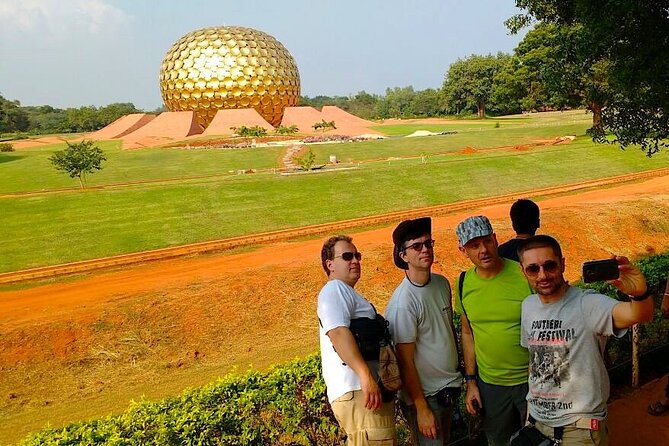
The tour ends at the Mahatma Gandhi Statue on Beach Road. At 13 feet, it is described as one of the tallest Gandhi statues in India. It was created by sculptor Roy Choudhary of the Madras School of Art and Crafts and is surrounded by eight carved pillars.
This ending changes the focus from French colonial Pondicherry to modern Indian public memory. After walking through streets and buildings shaped by French rule, you finish beside one of India’s most recognized national figures.
The location is practical as well as symbolic. The start point is at the Chief Secretariat on Goubert Avenue, and the walk ends at the Gandhi Statue, marked near the seafront. You are not returned to the starting point, so plan your next move from Beach Road.
For me, this is a smart finish. The route does not present Pondicherry as only a French outpost. It closes with an Indian landmark and places the colonial material within the country’s broader history.
What Two Hours Really Gets You
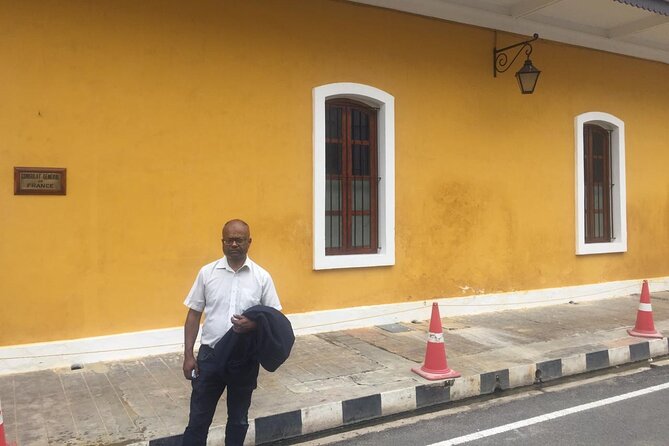
Two hours is enough to get your bearings, but not enough for a slow architectural study of every building. The schedule moves quickly: White Town and Foyer Du Soldat receive about 20 minutes each, Raj Niwas 10, Aayi Mandapam 15, the French War Memorial 15, Notre Dame des Anges 20, the Old Lighthouse 10, and Gandhi’s Statue 10.
That adds up to the advertised approximate duration, with walking between the stops included in the overall experience. You should wear comfortable shoes and expect a steady pace, since the tour covers several streets and landmarks on foot.
The route suits a first visit especially well. It introduces the main visual language of White Town without asking you to commit half a day. It also works for a short stay, since the start and end points are both in central White Town.
Families may find the length manageable. Prasanth received praise for checking whether the experience was meeting expectations and adapting as well as possible for a group traveling with a child. That does not guarantee a custom family itinerary, but it suggests a considerate guiding approach.
Guide Quality Matters More Than the Price
The experience includes a guide, and that guide is the main reason to pay $26 rather than walk the same streets independently. The buildings and monuments are accessible without admission fees at most stops. You are paying for the route, explanations, historical links, and the convenience of seeing the main sights in a sensible order.
Vanaraj was praised for being helpful and well informed. Prasanth was also praised for his city knowledge, enthusiasm, and attention to a family’s needs. Those are strong signs, but the feedback is not completely uniform. One person rated the experience poorly because the guide’s English was below the level needed for clear communication.
That mixed point is important. A walking tour depends on the guide’s voice and explanations. If you cannot follow the history, the monuments may feel like a string of stops rather than a connected story.
The group limit of 15 helps. It should reduce the chance of being lost in a large crowd and gives you a better opportunity to ask questions. Still, guide quality can vary, so I would book this for its strong potential and practical route, not as a guaranteed private-level experience.
Is $26 a Fair Price?
At $26 per person, this is not the cheapest way to walk around Pondicherry, since most listed stops are free. The price makes sense if you want structure, company, and an explanation of what you are seeing.
You receive a two-hour guided route through the core of White Town, with eight planned stops and a maximum group of 15. That is reasonable value for a first orientation, especially if you are unfamiliar with the city’s French street plan or architectural terms.
The value is weaker if you already know Pondicherry well or prefer to move at your own pace. You will not receive snacks, and admission at Raj Niwas is not included. The experience is also short, so it is not designed to replace a full cultural tour or museum visit.
Group discounts may improve the price for larger parties. Mobile tickets make the booking process simple, and confirmation is provided at booking. Free cancellation is available up to 24 hours before the start time, which gives you some flexibility if your plans change.
Who Should Book This Walk?
I would recommend it to first-time visitors who want a clear introduction to White Town without spending a whole day indoors or in a vehicle. It is also a good fit if you enjoy architecture, public monuments, colonial-era institutions, churches, and city stories that connect local and European influences.
Families may appreciate the two-hour length and the possibility of a guide who checks in about the group’s needs. A small group is also useful if you want to ask questions without holding up a large crowd.
You may want to skip it if your priority is a relaxed café crawl, shopping, or a long beach walk. The route has a fixed schedule and several short stops. You should also think twice if clear spoken English is essential and you are not comfortable with some variation in guide communication.
The tour is near public transportation, and most people can participate. Its start and end points are both in White Town, but they are not the same place, so keep that point in mind when arranging transport afterward.
Should You Book the Pondicherry French Quarter Walk?
Book it if you want a short, organized introduction to Pondicherry’s colonial streets and major public landmarks. The strongest parts are the White Town route, the unusual Foyer Du Soldat stop, the architectural variety, the church, and the final transition to Gandhi’s statue.
The experience offers good value when you need orientation and context, not simply a list of photo locations. I would choose it early in a Pondicherry stay, then return later to the streets, cafés, and seafront that caught your attention.
The only real caution is guide communication. The praise for Vanaraj and Prasanth is encouraging, but one negative experience shows that the quality of the explanation may vary. If that risk is acceptable, $26 buys a useful first chapter in understanding Pondicherry.
FAQ
How long is the Pondicherry Heritage Walking Tour?
The tour lasts approximately two hours.
Where does the walking tour start?
It starts at the Chief Secretariat Government of Puducherry on Goubert Avenue, Beach Road, in White Town, Pondicherry.
Where does the tour end?
The walk ends at the Mahatma Gandhi Statue on Beach Road in White Town.
How many people can join the tour?
The activity has a maximum group size of 15 people.
Is a guide included?
Yes. A guide is included in the tour price.
Are snacks included?
No. Snacks are not included.
Are admission tickets included?
Most listed stops have free admission. Admission to Raj Niwas is not included.
Can children participate?
Most people can participate, and the experience was adapted as well as possible for a group traveling with a child. The tour data does not specify a minimum age.
Can I cancel for a full refund?
Yes, if you cancel at least 24 hours before the experience start time. Cancellations made less than 24 hours in advance are not refunded, and changes within that period are not accepted.
Just added in India
- Walking Tour in the old part of the city of Varanasi★ 5.0 · 25 reviews
- Explore Chennai City: Guided Walking Tour on Foot★ 4.3 · 22 reviews
- Vibrant Markets of Trivandrum (2 Hours Guided Walking Tour)★ 4.5 · 15 reviews
- Walk of Divinity Bangalore (2 hours guided walking tour)★ 3.8 · 19 reviews
- Victorian Gothic Heritage Quarter and Art Deco Walking Tour★ 4.9 · 14 reviews
- Vibrant Markets of Mumbai (2 Hours Guided Walking Tour)★ 4.4 · 44 reviews
- Varanasi Walking and Heritage Tour★ 4.6 · 15 reviews
- Varanasi: Manikarnika Ghat (Oldest Cremation Site) Tour★ 4.7 · 22 reviews
Walking Tours, compared.

The Great Indian Food Tour: Old Delhi Food and Heritage Walk
Read our review →



Blue City Heritage Private Walking Tour With Pickup and Drop-Off
Read our review →
Private Guided Walking Tour in Bandra Queen of Suburbs
Read our review →

Private Jodhpur Blue City Walking Tour with Guide
Read our review →Browse the lists this tour appears in