
Reviewed · VARANASI TOURS
Sarnath Tour- Where Buddhism Originated
Buddha’s first sermon happened here. Sarnath gives you a calm half-day away from Varanasi, with the Dhamekh Stupa and ancient monastic ruins at its center. I like the included air-conditioned car and monument entry tickets, and I also like that the tour leaves room for questions rather than rushing from one site to the next.
The main consideration is that four hours can feel short if you want to study every monument and spend time in the museum. Food and drinks are not included, so plan a little refreshment before or after the visit.
In This Review
- Key points to know before you go
- Why Sarnath makes a good break from Varanasi
- The drive from Varanasi and meeting your guide
- Dhamekh Stupa and Buddha’s first teaching
- Dharmarajika Stupa and the story of relics
- Mulgandh Kuti Vihar and a place for reflection
- The 1910 museum and its collection of statues
- What the guide adds to the experience
- What is included, and what is not
- Who will enjoy this four-hour visit
- Booking details worth knowing
- Should you book the Sarnath tour?
- FAQ
- Where is Sarnath located?
- How long does the Sarnath tour last?
- What language is the tour conducted in?
- What is included in the tour price?
- Are food and drinks included?
- Where is the meeting point?
- Which sites are visited in Sarnath?
- Can I cancel or pay later?
Key points to know before you go
- Dhamekh Stupa marks Buddha’s first sermon: This is the central stop and the place where the Buddha first taught his Dhamma.
- An air-conditioned car is included: The drive from Varanasi is more comfortable than arranging separate transport, especially after time in the city.
- The tour covers several major sites: You visit the Dhamekh Stupa, Dharmarajika Stupa, Mulgandh Kuti Vihar, and the museum.
- Guide Monu brings local context: His explanations cover both Sarnath and wider questions about Varanasi, Buddhism, and the area.
- The British-built museum dates to 1910: It contains several types of statues and gives useful context for the ruins outside.
- You get flexible booking terms: Cancellation is free up to 24 hours before the tour, and you can reserve now and pay later.
Why Sarnath makes a good break from Varanasi
Sarnath is about 15 kilometers from Varanasi city center. That distance matters. Varanasi can be noisy, crowded, and demanding, while Sarnath offers a quieter setting for thinking about Buddhist teachings and ancient religious sites.
I would not treat this as just another sightseeing stop. Sarnath is important because it marks the beginning of Buddha’s public teaching. After reaching enlightenment, Buddha came here and delivered his first sermon to five former companions. The tour helps connect that major religious event with the buildings and ruins you can still see today.
The contrast with Varanasi is part of the appeal. You spend the morning or afternoon moving through a historic Buddhist site, then return to the city with time to continue exploring. Several people who booked the tour appreciated the calm pace and the chance to learn more without handling the transport and entry arrangements themselves.
The tour lasts four hours. That is enough for the principal monuments and museum, but it is not an unlimited archaeological visit. If you enjoy reading every display, studying every carved stone, or taking many photographs, you will need to keep an eye on the clock.
A few more options to weigh up in Varanasi
- Varanasi : Full Day City Highlights Day Tour & Ganges Cruise
★ 4.8 · 520 reviews - Hidden Secrets of Varanasi: Vibrant Tradition (Guided Tour)
★ 5.0 · 429 reviews - Varanasi: Sunrise Boat Tour with Arti Ceremony
★ 5.0 · 375 reviews
The drive from Varanasi and meeting your guide
The meeting point is outside Hotel Ganges Grand in the Godowlia area. Your guide contacts you on WhatsApp using the number provided when you book, so keep your phone available and watch for messages before departure.
An air-conditioned car is included. That is a real benefit in Varanasi, where arranging a car at short notice can add uncertainty to a half-day plan. You do not need to organize a separate taxi to Sarnath, and the cool car gives you a brief pause from the heat and noise of the city.
The exact starting time depends on availability, so you should check the schedule before booking. The tour is conducted in English. The information provided does not specify the car size or group size, so you should ask the provider if those details matter to you.
The guide associated with the experience is Monu, sometimes written as Mono in feedback. He is also connected with the local provider, Shwetank Rao Tripathi. I like the fact that Monu is described as a local to Varanasi, since that can make the visit more useful than a simple recitation of dates and names. He has also helped people with questions beyond the main Sarnath itinerary.
Dhamekh Stupa and Buddha’s first teaching
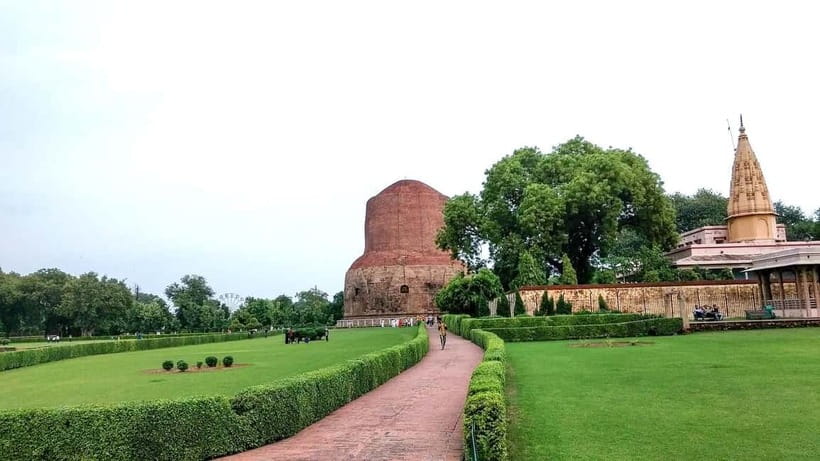
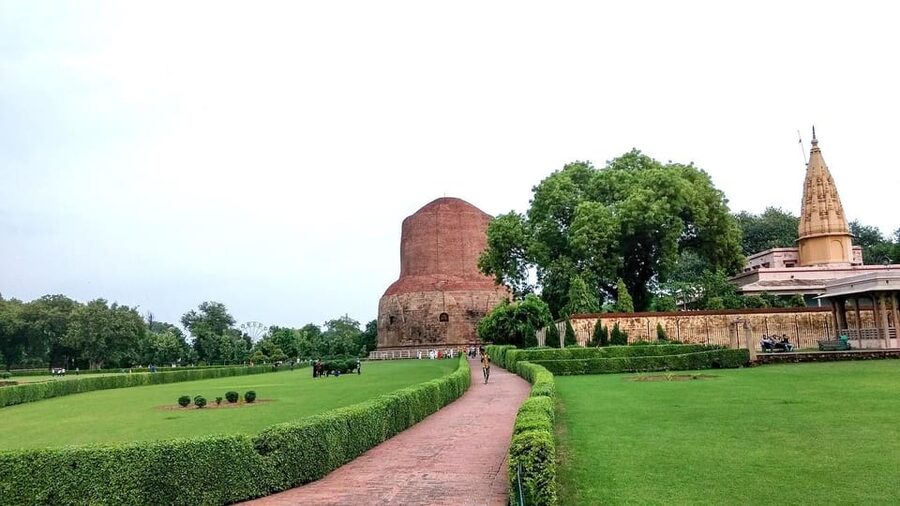
The Dhamekh Stupa is the emotional center of the visit. This is where Buddha is said to have given his first sermon, teaching the principles of the Dhamma after attaining enlightenment.
The structure you see is a large cylindrical stupa, and its size gives you a sense of the importance attached to this place over many centuries. The supplied history connects it with King Ashoka, whose name is closely tied to the spread of Buddhism and the construction of Buddhist monuments.
Do not expect a complete ancient building. Sarnath is an archaeological site, and much of what surrounds the stupa consists of foundations, broken walls, and traces of earlier structures. That may sound less dramatic than a perfectly preserved temple, but it also makes the visit more honest. You are looking at the remains of a major religious center rather than a modern recreation.
Your guide is especially useful here. Without context, the stupa can look like a large brick monument surrounded by open ground. With an explanation of the first sermon and the growth of Buddhism, the place gains meaning. Several high ratings praise the guide’s detailed explanations and his respectful approach to the sacred setting.
Take a moment to look beyond the monument itself. The value of this stop is not only in its architecture. It is the link between a particular place and a teaching that later spread across much of Asia.
Dharmarajika Stupa and the story of relics
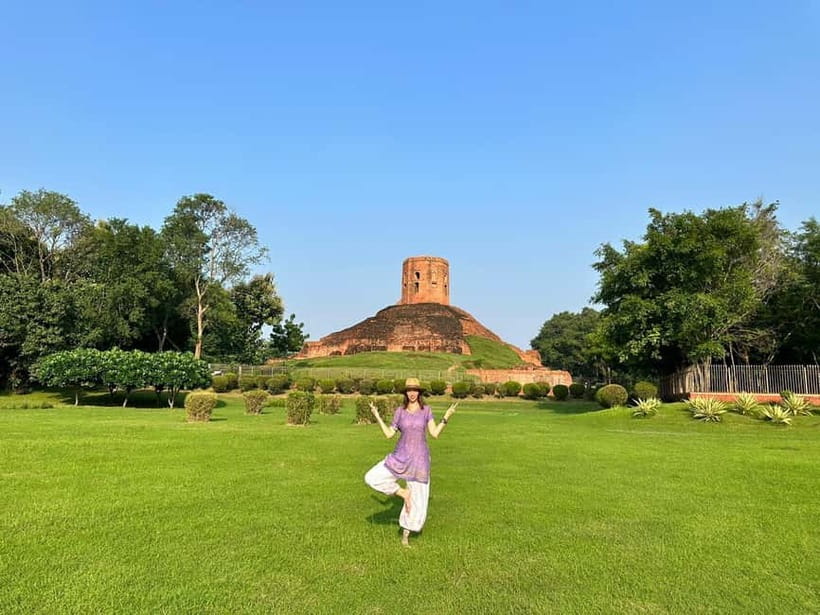
The Dharmarajika Stupa offers a different kind of connection. It is associated with relics of Buddha that were brought here after his death.
The remains today are ruined, so this stop requires more imagination than the Dhamekh Stupa. You will not find a fully intact monument, but the ruins show how extensive and important the site once was. This is where a guide can help you read the ground plan and understand what you are seeing.
I like the contrast between the two stupas. Dhamekh gives you a powerful landmark connected with Buddha’s first sermon. Dharmarajika gives you a quieter reminder of Buddhist devotion and the practice of preserving sacred relics.
If you prefer polished interiors and complete monuments, this part may feel less immediately rewarding. If you enjoy connecting scattered remains with the religious life of an ancient center, it becomes more interesting. Keep your expectations realistic: this is a historical site with ruins, not a restored palace complex.
A completely different kind of day out:
- Banaras Wala Tours
★ 5.0 · 329 reviews - The Ultimate 1 Day in Varanasi – How to Spend 13 Hours – Private Guided Tour
★ 5.0 · 295 reviews - A Journey of A lifetime
★ 5.0 · 272 reviews - Varanasi: Hidden Secrets of Vibrant Tradition (Guided Tour)
★ 4.9 · 176 reviews
Mulgandh Kuti Vihar and a place for reflection
Mulgandh Kuti Vihar is another important stop. It represents the Gupta period and is described as the place where Buddha used to meditate.
The site adds a more personal note to the visit. The Dhamekh Stupa is linked with public teaching, while Mulgandh Kuti Vihar points toward meditation and private spiritual practice. Together, the two places help you picture different sides of Buddhist life.
The Gupta-period connection also gives the guide an opening to explain how Sarnath developed across different eras. You are not simply seeing one building from one moment in time. The monuments reflect layers of construction, devotion, destruction, and renewal.
As with the other ruins, the remains may not be visually dramatic from every angle. The reward comes from knowing what the place represents. Give yourself time to pause rather than treating it as a quick photograph stop.
The 1910 museum and its collection of statues
Sarnath’s museum was built by the British in 1910. It contains several types of statues and is an important indoor part of the visit.
The museum helps solve a common problem at archaeological sites: stone fragments and damaged carvings can be hard to understand outdoors. Inside, the statues offer a closer look at the artistic traditions connected with Sarnath and Buddhism.
This is also where you can slow down after walking among the monuments. If the weather is hot, the museum provides a useful change of pace. You should still confirm the exact operating details on the day, since the supplied tour information does not give a museum schedule.
The museum may be the most rewarding stop for anyone who likes sculpture. Those who are mainly interested in Buddha’s life and the location of the first sermon may prefer to spend more time at the stupas. A good guide can help balance both interests within the four-hour visit.
What the guide adds to the experience
The strongest part of this tour is the guided explanation. Sarnath has enough ruins to confuse a first-time visitor, especially if you do not already know the difference between a stupa, monastery, temple, and museum collection.
Monu is praised for giving detailed explanations, answering questions, and treating the site with respect. That last point matters. Sarnath is not only an archaeological park. It remains a sacred place, and visitors should behave accordingly. A reminder to be respectful is useful, particularly when moving through religious monuments.
His local connection to Varanasi is another advantage. You can ask about the city as well as Sarnath, and one booking included help with wider questions about the area. The guide has also been willing to leave people at a preferred location afterward, which can help if you want to continue sightseeing rather than return directly to your hotel.
The tour is in English only. If you need another language, this experience may not be the right choice unless the provider can make a separate arrangement.
What is included, and what is not
The $40 per-person price includes an air-conditioned car and entry tickets to the monuments. That makes the cost easier to judge. You are paying not only for a guide, but also for transport from Varanasi and the convenience of having monument admissions handled for you.
For a short visit, that package has solid value. A separate taxi, admission payments, and a guide arranged on your own could take more time and effort. The value is strongest for first-time visitors who want the main story without spending half a day working out the practical details.
Food and drinks are not included. Since the tour is only four hours, this is not a major problem, but you should avoid assuming that refreshments are part of the package. Plan to eat before departure or after returning to Varanasi.
The price can feel less attractive if you already have private transport, know the site well, and prefer to explore without a guide. In that case, you are paying mainly for interpretation and convenience. For most first-time visitors, those are precisely the useful parts.
Who will enjoy this four-hour visit
I would recommend the tour to anyone staying in Varanasi who wants to understand Buddhism at its starting point. It suits people with a general interest in religion, ancient monuments, Indian history, or the connection between Varanasi and Sarnath.
It is also a good choice if you want a quieter half-day. The trip gives you a break from Varanasi’s noise without requiring an overnight stay or a complicated plan.
Families and older visitors may appreciate the air-conditioned car and the organized entry arrangements. The information does not specify accessibility features, walking distances, or vehicle modifications, so anyone with mobility needs should contact the provider before booking.
This is less suited to people seeking a long archaeological study. Four hours covers the key sites, but the schedule may not allow leisurely time at every ruin, statue, or display. Photography fans should also ask how much time is available at each stop if that is a major priority.
The experience has a 4.9 rating from 15 verified bookings. The most consistent praise centers on three things: clear explanations, smooth arrangements, and respectful guiding. Those are useful signs, though the small number of ratings means you should still judge the tour against your own expectations.
Booking details worth knowing
You can cancel up to 24 hours before the tour for a full refund. You can also reserve now and pay later, which is helpful if your Varanasi schedule is still changing.
When booking, provide a WhatsApp number you will actually check. Your guide uses it to contact you, and the meeting point is outside Hotel Ganges Grand in Godowlia, not necessarily inside your own hotel.
Check the available start times, confirm the English-language guiding, and ask about the expected group size if that affects your decision. Since meals are not included, arrange your own food and water around the four-hour schedule.
Should you book the Sarnath tour?
Book it if you want a well-organized introduction to Sarnath, especially if this is your first visit and you do not want to arrange transport or monument tickets yourself. The combination of a local English-speaking guide, air-conditioned car, and clear focus on the main Buddhist sites makes the $40 price reasonable.
I would be more cautious if you want a slow, independent archaeological visit or already have transport and strong background knowledge. In that case, the fixed four-hour format may feel limiting.
For most people staying in Varanasi, I would choose this as a half-day outing. Sarnath gives you space to think, the monuments give the visit real weight, and a good guide can turn a field of ruins into a clear story about Buddha’s first public teaching.
FAQ
Where is Sarnath located?
Sarnath is in Uttar Pradesh, India, about 15 kilometers from Varanasi city center.
How long does the Sarnath tour last?
The tour lasts four hours.
What language is the tour conducted in?
The live tour guide speaks English.
What is included in the tour price?
The $40 per-person price includes an air-conditioned car and entry tickets to the monuments.
Are food and drinks included?
No. Food and drinks are not included in the tour price.
Where is the meeting point?
You should wait outside Hotel Ganges Grand in the Godowlia area. The guide contacts you through WhatsApp using the number supplied at booking.
Which sites are visited in Sarnath?
The tour covers the Dhamekh Stupa, Dharmarajika Stupa, Mulgandh Kuti Vihar, and the Sarnath museum, along with other monuments, monasteries, temples, and ruins in the area.
Can I cancel or pay later?
Yes. You can cancel up to 24 hours in advance for a full refund, and you can reserve now and pay later.
Just added in Varanasi
- The Ultimate 1 Day in Varanasi – How to Spend 13 Hours★ 4.9 · 32 reviews
- Spiritual Tour in Varanasi with a local- 2 Hours Tour★ 4.8 · 13 reviews
- Private Sunset Boat Ride and Ganga Aarti with Reserved Seat★ 4.7 · 18 reviews
- Varanasi: Mysticism Tour with Boat Ride & Ganga Aarti★ 3.5 · 33 reviews
- GROUP YOGA CLASS – BEGINNER / ADVANCED – Sunrise Yoga with Ayush in Varanasi★ 5.0 · 79 reviews
- Cultural & Spiritual Trails of Old Town Varanasi Guided Walking Tour★ 4.5 · 73 reviews
- Walking tours – for an authentic Varanasi experience★ 5.0 · 40 reviews
- Single Walking Tour. Local culture, religion, traditions and more. Daily Tour★ 5.0 · 28 reviews
Varanasi Tours, compared.
Full Day City Highlights Day Tour & Ganges Cruise
Read our review →
Hidden Secrets of Varanasi: Vibrant Tradition (Guided Tour)
Read our review →

The Ultimate 1 Day in Varanasi – How to Spend 13 Hours – Private Guided Tour
Read our review →
Hidden Secrets of Vibrant Tradition (Guided Tour)
Read our review →
Private Heritage and Spiritual Walk Tour – Varanasi Kashi
Read our review →Browse the lists this tour appears in