
Reviewed · WALKING TOURS
British Architecture Walk, an immersive walking tour in Chennai
Chennai’s old buildings tell surprising stories. This 2.5-hour British Architecture Walk links railway stations, civic halls, bridges, and university buildings with a local guide who explains how British rule shaped the city’s public architecture. I like the small maximum group of 15, which should make it easier to ask questions, and I like that coffee, tea, and snacks are included rather than treated as extras.
The route is also easy to understand: start at Egmore Railway Station and finish near the University of Madras. The main consideration is that several buildings are viewed from outside, and admission is not included at every stop. At $55 per person, the tour makes the most sense if you care about architecture and want context you would likely miss on your own.
In This Review
- Why this Chennai walking tour is worth your time
- Start at Egmore, where the architecture sets the tone
- Chennai Central shows the Gothic Revival approach
- Victoria Public Hall connects architecture with public life
- Ripon Building is Chennai’s white civic landmark
- Southern Railway Headquarters brings in the Indo-Saracenic blend
- Napier Bridge adds a piece of working infrastructure
- The University of Madras brings the walk toward Marina Beach
- Victory War Memorial closes the historical story
- What the guide adds to the experience
- Coffee, snacks, and the small-group advantage
- Is $55 a fair price?
- Who will enjoy this walk most?
- Practical advice before you book
- Should you book the British Architecture Walk?
- FAQ
- How long does the British Architecture Walk last?
- How much does the tour cost?
- Where does the tour begin?
- Where does the tour end?
- How many people can join the tour?
- Is hotel pickup included?
- Are food and drinks included?
- Are admission tickets included at every stop?
- Can I cancel for a full refund?
Why this Chennai walking tour is worth your time
- Egmore and Central railway stations reveal two different architectural moods, from Indo-Saracenic design to Gothic Revival.
- Ripon Building and Victoria Public Hall show how civic buildings served public life, not only colonial administration.
- The group is capped at 15 people, a useful size for a walking tour built around explanations and questions.
- Coffee, tea, and snacks are included, adding a welcome local pause during the walk.
- The route reaches Napier Bridge, the University of Madras, and Victory War Memorial, so you see more than a row of government facades.
- Optional hotel transfers are available, though they cost extra because pickup and drop-off are not part of the standard price.
Start at Egmore, where the architecture sets the tone
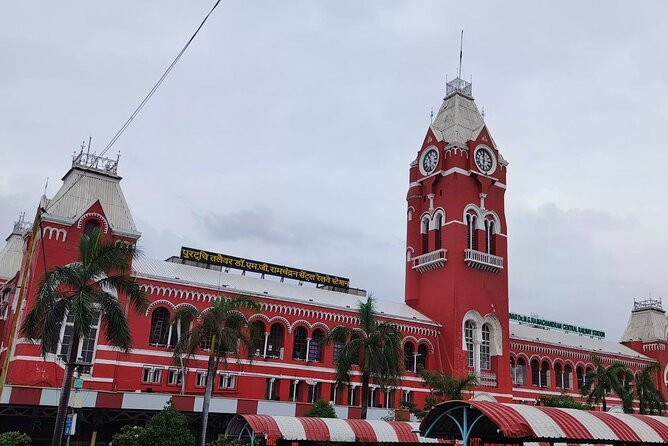
The walk begins at Chennai Egmore Railway Station on Gandhi Irwin Road. This station is more than a century old and is one of the early Chennai examples of Indo-Saracenic architecture, a style that blends European planning with Indian decorative forms.
The guide points out that architect Henry Irwin designed Egmore to be larger than Charing Cross station in London. That comparison gives the building a useful sense of ambition. This was not a minor suburban stop. It was designed to announce modern transport and imperial confidence in a major Indian city.
You spend about 20 minutes here, with admission included. That is enough time for an introduction to the style and for close views of the exterior without letting the tour become stuck at the first stop.
I would pay attention to the shape of the domes, arches, and decorative details rather than trying to memorize every date. The value here is learning how British architects used Indian visual references in public buildings. Once your guide explains that idea, later stops become easier to read.
More Walking Tours in Chennai
- Gods of Mylapore walking tour- tourism ministry approved company
★ 5.0 · 267 reviews - Georgetown heritage walking tour in Chennai about the founding of Chennai
★ 5.0 · 144 reviews - Mahabalipuram walking tour by tourism ministry approved company
★ 5.0 · 102 reviews
Chennai Central shows the Gothic Revival approach
The next stop is Chennai Central Railway Station, built in 1873 in the Gothic Revival style by British architect George Harding. You spend about 30 minutes here, making it one of the longer stops on the walk.
Central is a useful contrast to Egmore. Instead of the Indo-Saracenic blend, Gothic Revival design relies on a more European vocabulary, including strong vertical lines and pointed architectural forms. Robert Chisholm later modified the station, adding the central clock tower and Travancore caps on the main structure.
That change matters because it shows that Chennai’s colonial architecture did not arrive as one fixed style. Buildings were altered, expanded, and adapted over time. A good guide can turn those changes into a practical lesson in how cities grow.
The station remains a working transport hub, so you should expect a public setting rather than a quiet museum. That can make close inspection less relaxed, but it also keeps the building connected to its original purpose. Admission is included at this stop.
Victoria Public Hall connects architecture with public life
Victoria Public Hall opened in 1887 to mark Queen Victoria’s Golden Jubilee. It was named for the queen and hosted public meetings, events, and other gatherings.
You have about 20 minutes here. Admission is not included, so the walk should be understood mainly as an architectural and historical visit rather than a guaranteed interior tour. The building’s importance comes from its civic role. It was designed as a place where public life could happen, not simply as an office for colonial officials.
I find this kind of stop especially useful because it adds human purpose to a discussion of facades. Ask your guide how the building was used and who had access to its events. The available information does not promise a full inside visit, so you should not book this tour expecting extended interior access.
Ripon Building is Chennai’s white civic landmark
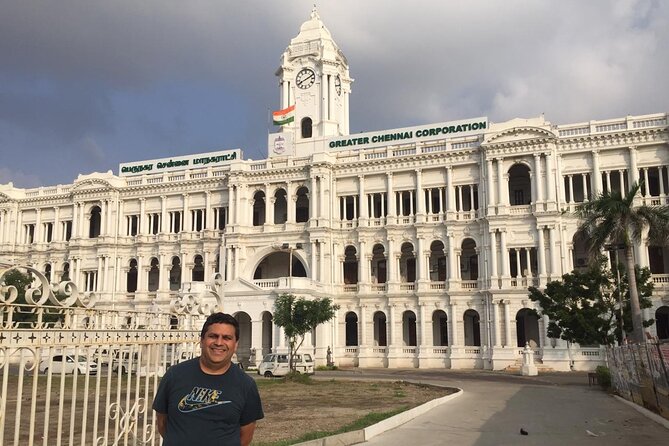
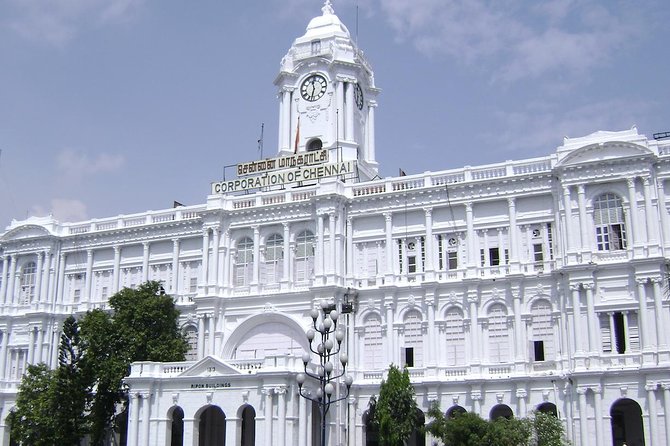
The walk continues to the Greater Chennai Corporation Office, better known as Ripon Building. Commissioned in 1913, it was designed by G.S.T. Harris and built by Loganatha Mudaliar. It is named after Lord Ripon, a Governor-General of India.
The building’s civic function makes it a natural part of this route. Here, British-era architecture is tied to municipal government and the daily running of the city. You can look at it not only as an attractive historic structure, but also as a statement about who controlled urban planning and administration at the time.
The scheduled stop is about 15 minutes, and admission is not included. That short visit is probably enough for an exterior explanation and photographs. If you want a long interior tour, this experience may feel limited. If you want a clear introduction to the building and its place in Chennai’s public architecture, the timing is more reasonable.
A completely different kind of day out:
- Mahabalipuram tour by Tourism Ministry approved company
★ 5.0 · 405 reviews - Mahabalipuram & Kanchipuram by tourism ministry approved company
★ 5.0 · 264 reviews - Chennai tour in car with guide-winner of traveller’s choice award
★ 5.0 · 258 reviews - Mahabalipuram Private tour from Chennai by car with guide and lunch by Wonder
★ 5.0 · 137 reviews
Southern Railway Headquarters brings in the Indo-Saracenic blend
Next comes the Southern Railway Headquarters, completed in 1921. It was designed by N. Grayson and built by Samynada Pillai in the Indo-Saracenic style.
This building pairs well with Egmore because you can compare two structures using related design ideas from different periods. The walk helps you see how the style developed rather than treating Indo-Saracenic architecture as a single look frozen in time.
The stop lasts about 15 minutes, and admission is not included. Expect an exterior-focused explanation. The building’s railway connection also gives the route a clear thread: railways were a major force in the growth of colonial cities, and these stations and offices were part of that wider system.
You do not need a technical background to enjoy this section. The best questions are simple ones: Which details are European? Which details draw on Indian forms? Why were these styles chosen for railway and civic buildings? A small group makes those questions easier to ask.
Napier Bridge adds a piece of working infrastructure
Napier Bridge was built in 1869 across the Cooum River and named after Francis Napier, the British governor of Fort St George. It connects Marina Beach with Fort St George.
The bridge was later widened, which is another reminder that colonial structures were not preserved as untouched museum pieces. They had to handle changing traffic and a growing city.
You spend about 15 minutes here, and admission is included. This is a different kind of architectural stop because the focus is not a grand hall or railway terminal. It is infrastructure. The bridge shows how movement between the waterfront and the fort shaped Chennai’s urban form.
The stop may appeal to you if you enjoy seeing how old buildings fit into present-day city life. If your main interest is ornate decoration, this will feel less dramatic than Egmore or the Senate House. Its value is in the connection between geography, transport, and colonial administration.
The University of Madras brings the walk toward Marina Beach
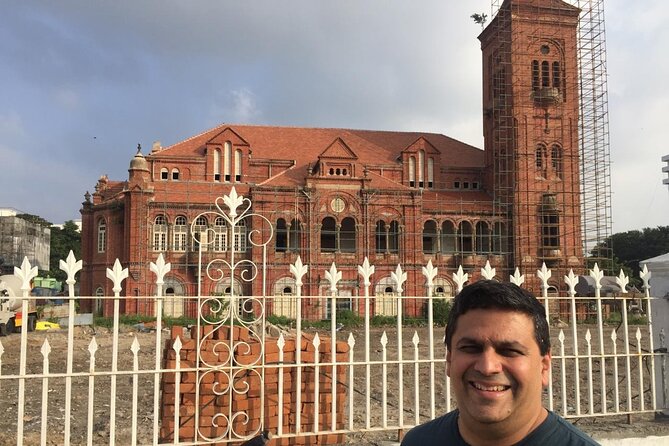
The route reaches the University of Madras, including the Senate House along Marina Beach. Designed by Robert Chisholm, the Senate building is regarded as a major example of Indo-Saracenic architecture.
This is likely one of the strongest architectural stops because the building brings together the design themes introduced earlier. Chisholm’s work helps you see how the style could be used for a major educational institution, not only for railway facilities or government offices.
The scheduled time is about 15 minutes, and admission is not included. That distinction matters. You can appreciate the building from the outside, but you should not assume that the tour fee guarantees entry into the Senate House.
The location near Marina gives the final part of the route a broader setting. You are no longer looking at a building in isolation. You are seeing how education, government, transport, the fort, and the waterfront sit within the same historic part of Chennai.
Victory War Memorial closes the historical story
The final listed stop is Victory War Memorial, formerly known as Cupid’s Bow. It commemorates the victory of the Allied Armies in World War I from 1914 to 1918. It later became known as the Victory War Memorial.
You spend about 15 minutes here, with admission included. The memorial changes the subject from architecture connected with administration and transport to memory and military history.
This is a short stop, but it gives the walk a useful closing note. British influence in Chennai was not limited to buildings where people worked, studied, or traveled. It also shaped the monuments used to record imperial conflict and victory.
The stated end point is the University of Madras in Navalar Nagar, Chepauk, although the route information also includes Victory War Memorial. Because the exact walking order can matter to your plans, confirm the final meeting details when booking or before the start. The tour finishes in central Chennai rather than returning you to your hotel unless you select the optional transfer.
What the guide adds to the experience
The buildings are worth seeing on their own, but the guide is the main reason to choose an organized walk. The tour is built around dates, designers, architectural styles, and the changing uses of public buildings. Without that explanation, it would be easy to see a station or government office, take a photograph, and move on without understanding the design choices.
Two guides named in the tour’s feedback are Hareesh and Satish. Hareesh was praised for explaining the buildings clearly and adding fascinating historical facts. He also bought an Indian coffee during the walk, a small gesture that shows how the food break can become part of the local experience. Satish was described as informative and enthusiastic, especially when discussing Chennai’s history and buildings.
You should not assume which guide you will receive, but these names give you a sense of the personal style associated with the experience. The group limit of 15 is important here. A guide can give more attention to questions in a small group than in a large coach tour.
Coffee, snacks, and the small-group advantage
Coffee or tea is included, along with snacks at no extra cost. That is a practical benefit during a 2.5-hour walk, particularly if you have scheduled the tour at a time when you might otherwise need to stop on your own.
One guide bought Indian coffee for the group, but you should treat that as a possible personal touch rather than a guaranteed part of the package. The confirmed inclusion is coffee or tea and snacks.
A group of up to 15 is small enough for a more direct exchange, though it is not a private tour. If you want one-on-one attention throughout, you may still find the group format limiting. If you prefer some company but dislike large crowds, this is a sensible middle ground.
Most people can participate, and the meeting point is near public transportation. Hotel pickup and drop-off are optional, not standard. If you select that service, it can reduce the hassle of reaching Egmore, but it changes the overall cost.
Is $55 a fair price?
At $55 per person, this is not the cheapest way to walk past Chennai’s colonial buildings. You can see some exteriors independently and use a map or guidebook for basic dates.
The fee becomes easier to justify if you value interpretation. You are paying for a local guide, a planned sequence connecting eight architectural and memorial sites, coffee or tea, snacks, taxes, and handling charges. You also avoid the work of researching the architects, dates, styles, and links between the buildings.
The value is strongest for first-time visitors, architecture fans, and anyone with limited time in Chennai. It is less convincing if you already know the city well or prefer to move at your own pace. Since admission is not included at Victoria Public Hall, Ripon Building, Southern Railway Headquarters, and the University of Madras, check what access is possible before you book. The route is mainly about seeing and understanding the buildings, not a full series of interior tours.
The tour is often booked about 29 days ahead, which suggests you should not leave it until the last minute if your schedule is fixed. Free cancellation is available when you cancel at least 24 hours before the start time. Cancellations or changes made inside that window are not accepted for a refund.
Who will enjoy this walk most?
I would choose this experience if you fit one or more of these descriptions:
- You enjoy architecture but want a guide to explain unfamiliar styles.
- You want to understand Chennai beyond temples, markets, and beaches.
- You have about half a day and prefer a focused route.
- You like walking tours with a small group rather than a large bus.
- You want practical historical context from a local guide.
- You appreciate a coffee and snack break included in the price.
You may want another option if you need guaranteed indoor access, dislike walking in a city setting, or want hotel pickup included in the base fare. The tour is also not designed as a broad survey of all Chennai history. Its focus is British-era architecture and the public institutions connected with it.
Practical advice before you book
Wear comfortable footwear. The experience lasts about two hours and 30 minutes, and the route includes several stops in central Chennai. The information provided does not specify the exact walking distance, so you should be prepared for a sustained urban walk rather than a series of vehicle transfers.
Start at Chennai Egmore Railway Station, Gandhi Irwin Road, Egmore, Chennai, Tamil Nadu 600008. The listed end point is the University of Madras, Navalar Nagar, Chepauk, Triplicane, Chennai, Tamil Nadu 600005.
A mobile ticket is available, and confirmation is sent at the time of booking. The tour is near public transportation, which helps if you are making your own way to Egmore. Optional hotel transfers are available, but hotel pickup and drop-off are not included unless you choose that option.
Do not assume every stop includes entry. Admission is included at Egmore Railway Station, Chennai Central Railway Station, Napier Bridge, and Victory War Memorial. It is not included at Victoria Public Hall, Ripon Building, Southern Railway Headquarters, or the University of Madras.
Should you book the British Architecture Walk?
Book it if you want Chennai’s British-era buildings explained rather than simply photographed. The route covers an impressive range of purposes and styles, from the Gothic Revival form of Central station to the Indo-Saracenic design of Egmore, Southern Railway Headquarters, and the University of Madras.
I especially like the small group, the local guides, and the included coffee, tea, and snacks. Hareesh and Satish have both been praised for clear, enthusiastic guiding, and that personal connection is central to the tour’s appeal.
At $55, the price is fair when you value history, design, and a well-planned route. It is less attractive if you expect extensive interior access or included hotel transport. For the right visitor, this is a smart way to read Chennai’s streets, one railway station, civic hall, bridge, and memorial at a time.
FAQ
How long does the British Architecture Walk last?
The walk lasts approximately 2 hours and 30 minutes.
How much does the tour cost?
The listed price is $55 per person.
Where does the tour begin?
The tour begins at Chennai Egmore Railway Station on Gandhi Irwin Road, Egmore, Chennai, Tamil Nadu 600008, India.
Where does the tour end?
The listed end point is the University of Madras at Navalar Nagar, Chepauk, Triplicane, Chennai, Tamil Nadu 600005, India.
How many people can join the tour?
The group has a maximum of 15 travelers.
Is hotel pickup included?
Hotel pickup and drop-off are not included unless you select the optional hotel transfer service.
Are food and drinks included?
Coffee or tea and snacks are included at no extra cost.
Are admission tickets included at every stop?
No. Admission is included at Egmore Railway Station, Chennai Central Railway Station, Napier Bridge, and Victory War Memorial. Admission is not included at Victoria Public Hall, Ripon Building, Southern Railway Headquarters, or the University of Madras.
Can I cancel for a full refund?
Yes, if you cancel at least 24 hours before the experience start time. Cancellations and changes made less than 24 hours before the start time are not accepted for a refund.
Just added in Chennai
- Exploring Georgetown: A Heritage Walking Tour of Chennai★ 4.5 · 16 reviews
- Traditional Cooking Class in Chennai in a Local Home with Sundari★ 5.0 · 38 reviews
- Food Trail Through Sowcarpet Market: A Taste of Chennai★ 5.0 · 38 reviews
- St Thomas Trail in Chennai by Wonder tours★ 4.5 · 11 reviews
- Shopping and Bazaar trail in Chennai★ 5.0 · 23 reviews
- Colonial Charm & Cultural Treasures Chennai Sightseeing Tour★ 4.0 · 10 reviews
- Full-Day Private Tour to the Kanchipuram Temples from Chennai★ 5.0 · 73 reviews
- Experience Mylapore: Enriching Walking Trail Tour★ 5.0 · 18 reviews
Walking Tours, compared.

The Great Indian Food Tour: Old Delhi Food and Heritage Walk
Read our review →



Blue City Heritage Private Walking Tour With Pickup and Drop-Off
Read our review →
Private Guided Walking Tour in Bandra Queen of Suburbs
Read our review →

Private Jodhpur Blue City Walking Tour with Guide
Read our review →Browse the lists this tour appears in