
Reviewed · WALKING TOURS
Mahabalipuram walking tour by tourism ministry approved company
Ancient stone tells the story here. This Mahabalipuram tour makes the sprawling Pallava monuments easier to understand, with a small group capped at 15 people and a guide who explains the carvings instead of simply pointing at them. I especially like the choice between walking and autorickshaw rides, plus the focused route through ten major sights. The main consideration is time: three hours is enough for an excellent introduction, but not enough for a slow look at every carving.
The guide Ramesh earns especially warm praise for his storytelling, flexibility, and clear explanations of Pallava sculpture techniques. I also like that admission is included at every listed stop. Still, Mahabalipuram can be hot, and the experience requires good weather, so this is best treated as an active outdoor visit rather than an easy indoor tour.
In This Review
- Key Things to Know Before You Go
- Why Mahabalipuram Works Best With a Guide
- Pancha Rathas: Five Stone Chariots
- Pancha Pandava Cave and Its Yali Pillars
- Arjuna’s Penance, a Huge Stone Story
- Krishna’s Butter Ball and the Site’s Sense of Humor
- Varaha Cave and Trimurti Cave
- Ganesh Ratha and the Story of Changing Dedications
- The Old Lighthouse Above a Former Port
- Mahishasura Mardini Cave’s Two Powerful Reliefs
- Shore Temple Beside the Bay of Bengal
- Walking, Autorickshaws, and the Pace of the Visit
- Is $50 a Fair Price?
- Who Should Book This Mahabalipuram Tour?
- Should You Book It?
- FAQ
- How long does the Mahabalipuram walking tour last?
- How many people can join the tour?
- What is the price?
- Are admission tickets included?
- Can I use an autorickshaw instead of walking?
- Where does the tour start?
- Where does the tour end?
- Is the tour available in poor weather?
- What is the cancellation policy?
Key Things to Know Before You Go
- Ten major monuments in about three hours: You see the Pancha Rathas, caves, bas-reliefs, lighthouse, and Shore Temple in one compact outing.
- Small group limit of 15: The size gives you a better chance to hear the guide and ask questions.
- Walking or autorickshaw choice: You can cover the site on foot or use local rides, with buggy rides also praised as a thoughtful option for older participants.
- Ramesh is a strong guide choice: His style combines Pallava history with stories and practical explanations of how the sculptures were made.
- Admission is included: Each listed stop includes its entry ticket, which makes the $50 price easier to judge.
- Check the route carefully: The published meeting point is Shore Temple, while the listed stop order begins at Pancha Rathas and ends at Shore Temple.
Why Mahabalipuram Works Best With a Guide
Mahabalipuram is not one single monument. It is a spread-out group of temples, caves, freestanding carvings, and boulders, all linked to the Pallava rulers and the port city they developed from the seventh century onward.
You can walk among the stones on your own and still have a good day. The trouble is that many of the most important details are easy to miss. A cave may look like a dark opening until someone points out the lions on its pillars, the three gods inside, or the story carved across its wall.
That is where this tour earns its keep. The guide gives you a thread to follow through the site. You learn how the Pallavas worked directly into granite, how religious stories appear in sculpture, and why Mahabalipuram matters beyond its photogenic Shore Temple.
I particularly value the small-group format. With no more than 15 participants, the guide can explain a carving without shouting across a crowd. If Ramesh leads your visit, expect a guide who has been praised for being pleasant, flexible, and more of a storyteller than a lecture reader.
The experience is also useful for visitors who want to see a lot without sorting out the site plan themselves. The ten stops cover a broad range of Pallava work. You get caves, monoliths, a huge relief, a famous boulder, a lighthouse, and a coastal temple in one route.
More Walking Tours in Chennai
- Gods of Mylapore walking tour- tourism ministry approved company
★ 5.0 · 267 reviews - Georgetown heritage walking tour in Chennai about the founding of Chennai
★ 5.0 · 144 reviews - Chennai Walking Tour ( 2 hours guided tour)
★ 3.8 · 85 reviews
Pancha Rathas: Five Stone Chariots
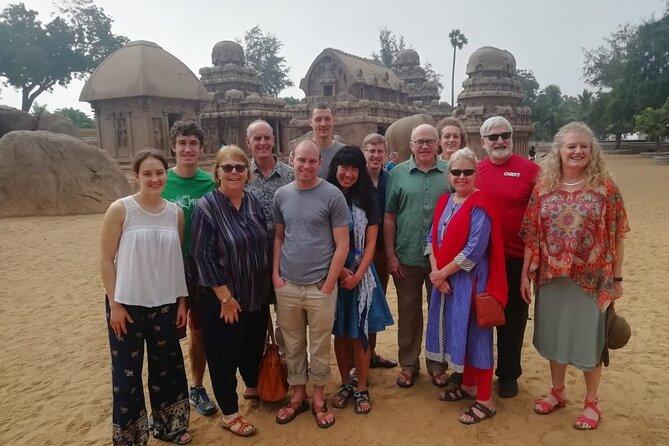
The Pancha Rathas, or Five Rathas, make a strong introduction to Mahabalipuram’s style. These are monolithic structures, each carved from a single mass of rock rather than assembled stone by stone.
The name refers to chariots, and the group is connected with the five Pandava brothers from the Mahabharata. The buildings look like a miniature collection of temples, but they are not simply small working shrines. Their value is in the way the Pallava sculptors tested forms, roofs, columns, and decorative details in solid granite.
Your guide can help you compare the different shapes and explain the religious figures and animals around them. Without that context, you may see five attractive stone buildings and move on in a few minutes.
The scheduled stop lasts about 20 minutes, with admission included. That is enough for an overview and photographs, though anyone fascinated by stonework may want more time here. The meeting details list Five Rathas as the end point, so confirm the exact direction of your walk before setting out because the published stop order places it first.
Pancha Pandava Cave and Its Yali Pillars
The Pancha Pandava Cave is described as the largest cave temple at Mahabalipuram. It is supported by six pillars and two pilasters, with three striking yali figures carved into the supports.
A yali is a mythical creature, often shown with an animal-like body and a powerful, almost theatrical presence. These figures give the cave a different mood from the open monoliths at Pancha Rathas. Here, the stone has been cut away to create an interior, and the columns become part of the sculpture.
You will spend about 15 minutes at this stop. That sounds brief, but a guide’s explanation helps you use the time well. Ask about the carvings on the pillars and how the Pallava artists balanced structure with decoration.
The cave is one of the places where a walking tour is more useful than a hurried photo stop. The important features are not always obvious from the entrance.
Arjuna’s Penance, a Huge Stone Story
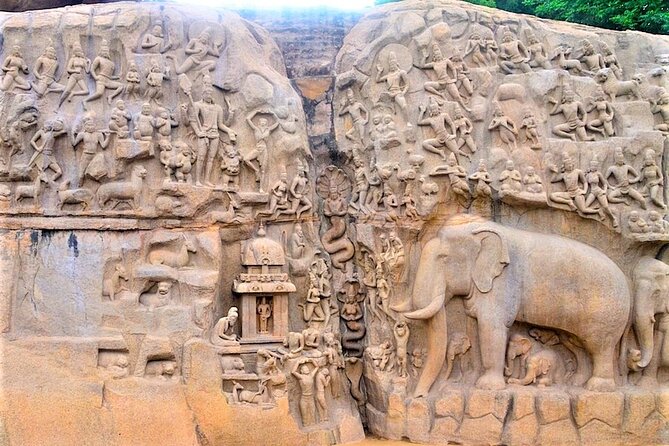
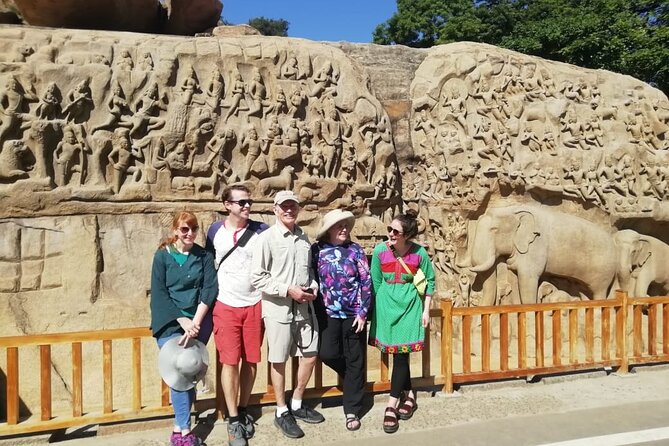
Arjuna’s Penance is one of Mahabalipuram’s great set pieces. This open-air bas-relief measures about 100 feet long and 45 feet high, giving it an enormous surface for figures, animals, and scenes from the Mahabharata.
The relief rewards patient looking. Rather than presenting one isolated statue, it creates a crowded stone narrative. Your guide can explain the main story and point out details that disappear when you view the wall as a whole.
The name links the carving to Arjuna’s penance, but the imagery has been interpreted through more than one reading. A good guide should help you understand the story without pretending the monument is as simple as a single label.
The planned stop is 20 minutes. I would pay close attention here, since this is the sort of monument you could photograph in seconds but study for much longer. The scale also makes it a useful point for understanding the ambition of Pallava artists.
A completely different kind of day out:
- Mahabalipuram tour by Tourism Ministry approved company
★ 5.0 · 405 reviews - Mahabalipuram & Kanchipuram by tourism ministry approved company
★ 5.0 · 264 reviews - Chennai tour in car with guide-winner of traveller’s choice award
★ 5.0 · 258 reviews - Mahabalipuram Private tour from Chennai by car with guide and lunch by Wonder
★ 5.0 · 137 reviews
Krishna’s Butter Ball and the Site’s Sense of Humor
Krishna’s Butter Ball is a massive granite boulder perched on a sloping rock surface. It looks as if it should roll away, yet it has stayed in place, earning its playful name and a permanent place in Mahabalipuram’s sightseeing circuit.
This is the lightest stop on the route. After the dense religious scenes at the caves and bas-reliefs, the boulder gives you a moment to enjoy the site’s odd physical surprises. It is also a natural place for photographs.
The visit lasts about 15 minutes. Do not expect a long historical explanation here. The value is the contrast between a naturally positioned rock and the carefully carved monuments nearby.
Varaha Cave and Trimurti Cave
The Varaha Cave Temple dates to the seventh century and was cut into a large piece of granite. Its pillars feature squatting lions, a detail worth seeking out rather than merely passing on the way inside.
Varaha refers to the boar incarnation of Vishnu. The cave gives you a close look at how Pallava builders turned a rock face into a religious space. The work took decades, which helps explain why these monuments feel both architectural and sculptural.
The scheduled visit is 20 minutes. That is enough to inspect the entrance, pillars, and major carvings if the guide keeps the group moving.
The Trimurti Cave offers a different focus. It is dedicated to Brahma, Vishnu, and Shiva, the Hindu trinity. Elephants appear among the carvings, adding another layer to the cave’s decoration.
This stop also lasts about 20 minutes. I like the pairing of these two caves because you can compare their layouts and subjects while the details are still fresh in your mind. The Pallava style becomes easier to recognize after several examples.
Ganesh Ratha and the Story of Changing Dedications
Ganesh Ratha is another chariot-shaped temple carved from one stone. It was built in the seventh century by King Mahendravarman I and was originally dedicated to Shiva. Today, it contains an image of his son, Ganesha.
That change gives the monument a useful human detail. Sacred spaces can develop over time, and their present identity does not always tell the whole story.
The stop is about 15 minutes. Look at the overall shape first, then examine the entrance and the stone details. A guide can explain how this monument relates to the other rathas without treating them as identical copies.
The Old Lighthouse Above a Former Port
The Old Lighthouse is dated to the year 640 and is described as India’s oldest lighthouse, as well as one of the oldest in the world. Its presence points to Mahabalipuram’s role as a busy port from the seventh century.
This stop broadens the tour beyond temples. The city was not only a religious and artistic center. Its position on the Bay of Bengal also made safe navigation important.
You will have about 20 minutes here. The lighthouse is especially worthwhile if you want some historical context for the Shore Temple and the coast. The two sites make more sense together: one helped mariners, while the other marked the importance of the port and its rulers.
Mahishasura Mardini Cave’s Two Powerful Reliefs
The Mahishasura Mardini Cave contains two major bas-reliefs. One shows Vishnu sleeping on the coils of a serpent. The other depicts the goddess Durga fighting the demon Mahishasura while riding a lion.
The opposing scenes create a strong visual balance. One wall presents calm and rest, while the other shows movement and conflict. Your guide can help you read the figures, poses, and relationships instead of seeing them as a mass of carved stone.
The scheduled visit is 15 minutes. That is short for two major reliefs, so stay focused. This is another stop where the guide’s explanation adds real value, especially if Hindu stories are unfamiliar to you.
Shore Temple Beside the Bay of Bengal
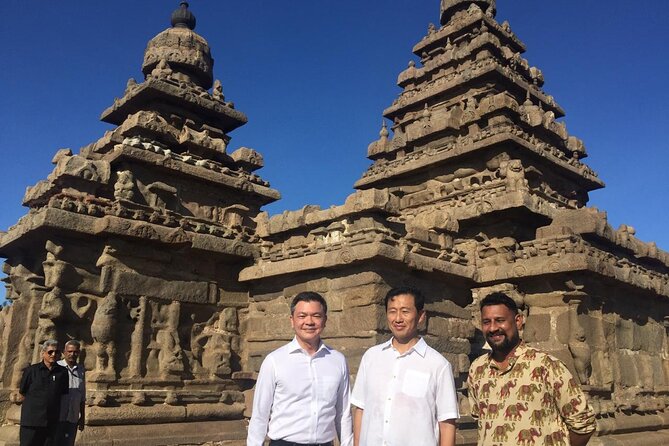
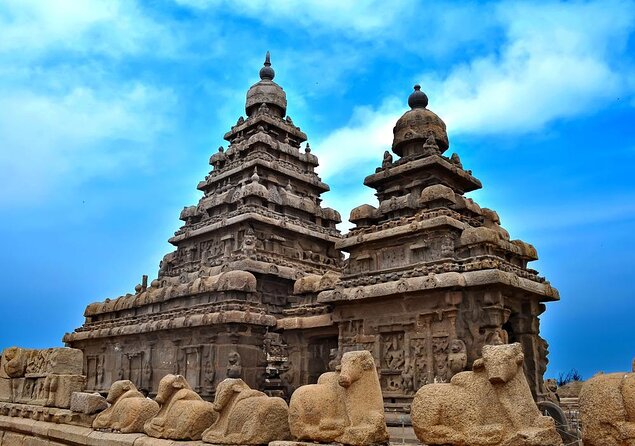
The Shore Temple is the natural closing image for a Mahabalipuram visit. It faces the Bay of Bengal and recalls the city’s importance during the Pallava period, when Mahabalipuram served as a major port.
After the caves and inland rock carvings, the coastal setting changes the experience. You see how the temple relates to the sea, trade, and royal power. It is not just a pretty structure beside the water.
The listed stop lasts about 20 minutes. Take time to look at the temple’s silhouette, stone surfaces, and position by the shore. The tour information gives Shore Temple as the starting meeting point, yet the listed itinerary places it last, so this is the one logistical point I would clarify before booking or meeting the guide.
Walking, Autorickshaws, and the Pace of the Visit
The tour lasts roughly three hours, and the route covers ten stops. That is an efficient pace, but it is not leisurely. You will move between monuments, listen to explanations, and take photographs without lingering at every site.
You can choose to explore on foot or use autorickshaws. That flexibility matters in Mahabalipuram, especially in hot weather or for anyone who finds a long outdoor walk tiring. A buggy ride was also praised as a thoughtful option for seniors, though you should confirm the exact transport arrangement with the provider.
I would choose walking if you want the clearest sense of how the monuments relate to one another. I would choose the autorickshaw option if comfort, shade, or mobility matters more. The key benefit is not speed alone. It is avoiding the fatigue that can make the final temples blur together.
The group limit of 15 is another practical advantage. It is small enough for personal attention but large enough that the experience is not a private-tour price. If you have a detailed question about sculpture, religion, or Pallava construction, there is a better chance of getting an answer than in a large coach group.
Is $50 a Fair Price?
At $50 per person, this is not the cheapest way to see Mahabalipuram. You can visit the monuments independently, and the town is near public transportation.
The value comes from what is bundled into the experience. You receive a guide, a structured route, a small group, and admission tickets at all ten listed stops. You also avoid spending time deciding which cave or relief to visit next.
For a history or architecture enthusiast, the price is easier to justify. The guide’s explanations about Pallava sculpture techniques are a major part of what you are paying for. The strongest praise centers on Ramesh’s storytelling and his ability to keep the history clear rather than overly technical.
For a visitor on a tight budget, the tour may feel expensive if you mainly want photographs of the Shore Temple and Krishna’s Butter Ball. In that case, independent sightseeing could be enough. But if you want the monuments to connect into one story, $50 is a reasonable price for a compact, guided introduction.
Who Should Book This Mahabalipuram Tour?
I would recommend it most strongly to first-time visitors, history fans, architecture students, and anyone who wants help reading ancient Indian art. It also suits people who prefer a small group to a private tour and those who want transport flexibility between monuments.
Families may appreciate the mix of dramatic stories, animals, caves, and the gravity-defying boulder. Older participants should ask about the autorickshaw or buggy option before the tour begins.
I would be more cautious if you dislike heat, outdoor walking, or a fixed schedule. Three hours moves quickly, and the route does not leave much room for an unplanned pause. Good weather is required, and poor conditions can lead to a new date or a full refund.
Free cancellation is available up to 24 hours before the start time. Changes or cancellations inside that window are not refunded, so keep the local cut-off time in mind.
Should You Book It?
Book this tour if you want Mahabalipuram explained, not merely photographed. The combination of ten major monuments, included admission, a group limit of 15, and the option of an autorickshaw gives you a practical way to cover a large historic site.
The guide matters most. Ramesh receives especially strong praise for his clear explanations, friendly manner, flexibility, and storytelling. If he is available, that is a useful reason to choose this experience.
Before paying, confirm the meeting direction because the published details name Shore Temple as the start and Five Rathas as the end, while the stop sequence runs the other way. Once that is clear, this is a strong choice for an informative half-day visit to Mahabalipuram.
FAQ
How long does the Mahabalipuram walking tour last?
The tour lasts approximately three hours.
How many people can join the tour?
The group has a maximum of 15 participants.
What is the price?
The listed price is $50 per person.
Are admission tickets included?
Yes. Admission is included for each of the ten listed stops.
Can I use an autorickshaw instead of walking?
Yes. The experience offers a choice between visiting on foot and using an autorickshaw.
Where does the tour start?
The published meeting point is Mahabalipuram Shore Temple on Beach Road, Mahabalipuram.
Where does the tour end?
The published end point is Five Rathas, also called Pancha Rathas, on W Raja Street.
Is the tour available in poor weather?
The experience requires good weather. If it is canceled because of poor weather, you will be offered another date or a full refund.
What is the cancellation policy?
You can cancel at least 24 hours before the start time for a full refund. Cancellations or changes made less than 24 hours before the start time are not refunded or accepted.
Just added in Chennai
- Exploring Georgetown: A Heritage Walking Tour of Chennai★ 4.5 · 16 reviews
- Traditional Cooking Class in Chennai in a Local Home with Sundari★ 5.0 · 38 reviews
- Food Trail Through Sowcarpet Market: A Taste of Chennai★ 5.0 · 38 reviews
- St Thomas Trail in Chennai by Wonder tours★ 4.5 · 11 reviews
- Shopping and Bazaar trail in Chennai★ 5.0 · 23 reviews
- Colonial Charm & Cultural Treasures Chennai Sightseeing Tour★ 4.0 · 10 reviews
- Full-Day Private Tour to the Kanchipuram Temples from Chennai★ 5.0 · 73 reviews
- Experience Mylapore: Enriching Walking Trail Tour★ 5.0 · 18 reviews
Walking Tours, compared.

The Great Indian Food Tour: Old Delhi Food and Heritage Walk
Read our review →


Blue City Heritage Private Walking Tour With Pickup and Drop-Off
Read our review →
Private Guided Walking Tour in Bandra Queen of Suburbs
Read our review →

Private Jodhpur Blue City Walking Tour with Guide
Read our review →Browse the lists this tour appears in