
Reviewed · 5-DAY EXPERIENCES
5 Day Golden Tingle Luxury Private Tour with Guide
India’s grandest sights fit into five busy days. This private Golden Tingle tour links Delhi, Agra, and Jaipur with a dedicated vehicle, city guides, four nights of accommodation, and hotel pickup. I like the private format, which lets you adjust the pace, and I like that the route covers the major monuments without making you arrange separate transport between cities. The $422 per-person price can be strong value if the included hotels match your expectations.
The main caution is the schedule. You will cover a great deal in a short time, with long road transfers and several major monuments packed into single days. Admission fees, lunch, dinner, and tips are extra, and the breakfast information needs checking because the package details list three breakfasts while several booking comments describe breakfast throughout the stay.
In This Review
- Key points to know before booking
- Why this five-day route works
- Day one: Delhi from Humayun’s Tomb to Jama Masjid
- Day two: Agra Fort and the Yamuna view
- Day three: the Taj Mahal and Fatehpur Sikri
- Day four: Jaipur’s forts, palaces, and observatory
- The driving plan and hotel value
- What the strongest service points mean for you
- Should you book this Golden Triangle tour?
- FAQ
- Where does the tour usually start?
- How long is the tour?
- Is the tour private?
- What is included in the price?
- Are entrance tickets and meals included?
- Can I cancel for a full refund?
Key points to know before booking
- Delhi starts with four major sights: Humayun’s Tomb, Qutub Minar, Lotus Temple, India Gate, and Jama Masjid create a broad first look at the capital.
- Agra is more than the Taj Mahal: Agra Fort and Mehtab Bagh add Mughal power, architecture, and a useful view across the Yamuna.
- Fatehpur Sikri breaks up the road to Jaipur: This former imperial capital offers one of the tour’s most distinctive historical stops.
- Jaipur packs in five landmarks: Amber Palace, City Palace, Jantar Mantar, Hawa Mahal, and Jal Mahal give you both grand monuments and quick city views.
- A private driver changes the rhythm: You travel by private vehicle, with pickup and drop-off included, rather than managing India’s intercity connections yourself.
- The final transfer takes about five hours: Plan your Delhi flight carefully, or use Jaipur airport if that suits your onward plans.
Why this five-day route works
The classic Golden Triangle connects Delhi, Agra, and Jaipur, three places with very different personalities. Delhi gives you imperial avenues, old mosques, and layered religious architecture. Agra focuses on Mughal monuments and the Taj Mahal. Jaipur shifts to Rajput palaces, observatories, forts, and the Pink City.
I like the route because it provides a clear first visit to northern India. You do not spend five days in one type of sight. Instead, you move from garden tombs to minarets, from Mughal forts to marble mausoleums, then on to Rajput court buildings and hilltop defenses.
The private arrangement is especially useful here. Delhi traffic, the distance between Agra and Jaipur, and the final airport transfer can make independent planning tiring. A driver who meets you at the airport, takes you to your hotel, and manages the road portions removes much of that friction. Previous bookings praised Manoj Sharma for responding quickly to changes, while drivers such as Ravinder and Vivek received special mention for safe, caring service.
Still, this is not a relaxed five-day holiday. The itinerary is built around seeing the main sights, not lingering in each city. If you want long meals, open afternoons, or several hours of shopping, you will need to ask for changes before departure.
More Private Tours in India:
- From Delhi: Taj Mahal & Agra Private Day Trip with Transfers
★ 4.9 · 3,181 reviews - Old & New Delhi Private Tour – Half or Full Day (Rated Excellent)
★ 5.0 · 2,226 reviews - Taj Mahal and Agra Private Car Tour from Delhi with 5* Lunch
★ 5.0 · 1,633 reviews
Day one: Delhi from Humayun’s Tomb to Jama Masjid
The Delhi day begins with Humayun’s Tomb, a handsome Mughal garden mausoleum built in 1565, nine years after the emperor’s death. His senior widow, Bega Begam, commissioned it. The setting matters as much as the building: the tomb sits within a walled enclosure organized around chaharbagh garden squares, paths, and water channels.
I would pay attention to the symmetry here. The central mausoleum, double dome, and formal gardens point toward the later Mughal design perfected at the Taj Mahal. It is a good first stop because it gives you architectural context before you reach Agra.
Qutub Minar follows, with about an hour set aside. This tapering tower rises from the Qutab complex and was built in stages. The first level dates to the 12th century, while later levels were added in the 13th and 14th centuries. Its design recalls the Minaret of Jam in western Afghanistan, and the tower marks the beginning of Muslim rule in India.
Admission is not included, so keep entrance fees separate from the tour price. The complex offers more than the tower itself, but the schedule specifies about an hour, so you may need to keep moving.
Lotus Temple is a shorter stop of about 30 minutes. The Bahá’í House of Worship welcomes people from all religious backgrounds and expresses the faith’s focus on human and religious unity. The visit is less about royal power or military history and more about a modern place of worship with a broad message.
India Gate is a quick, free stop. Designed by Edwin Lutyens, it was commissioned as a war memorial through the Imperial War Graves Commission. The cornerstone was laid in 1921, and New Delhi was formally dedicated as the capital in 1931. I see this as a useful pause between larger monument visits, though 30 minutes is enough mainly for photographs and a short look.
The day ends at Jama Masjid, Shah Jahan’s final major architectural project. Completed in 1656 after six years of construction, the mosque has a vast courtyard that can hold up to 25,000 worshippers. The site also contains notable relics, including an old Quran written on deer skin.
Jama Masjid is in Old Delhi, so the change from formal New Delhi to the older city is important. The itinerary gives you an hour, which should allow time to appreciate the scale of the courtyard. Dress and behavior should be respectful at this active religious site. The admission is listed as free, though any local access rules should be confirmed with your guide.
Day two: Agra Fort and the Yamuna view
Agra Fort takes the first major part of day two. Its red sandstone walls enclose an imperial city stretching about 2.5 kilometers around the historic core. Inside are palaces such as Jahangir Palace and Khas Mahal, audience halls including Diwan-i-Khas, and two mosques.
The fort helps you understand the Mughal court in a way the Taj Mahal cannot. The Taj is a monument of love and mourning, while Agra Fort shows where emperors governed, received visitors, and lived. Because the itinerary gives you about an hour, concentrate on the grand courtyards, palace spaces, and views toward the Taj rather than trying to inspect every corner.
Entrance is not included. That matters when you compare the headline price with the final cost, especially if you are traveling with a family or several adults.
Mehtab Bagh fills the second half of the day. This crescent-shaped Mughal garden lies beside the Yamuna and is prized for its view toward the Taj Mahal. It is particularly useful for photography because you see the famous monument from across the river rather than only from the main entrance.
The garden is given an hour. I would treat it as a calmer counterpoint to Agra Fort, but do not expect another Taj Mahal visit from this side. The appeal is the view, the garden setting, and the change in perspective. Admission is not included.
Day three: the Taj Mahal and Fatehpur Sikri
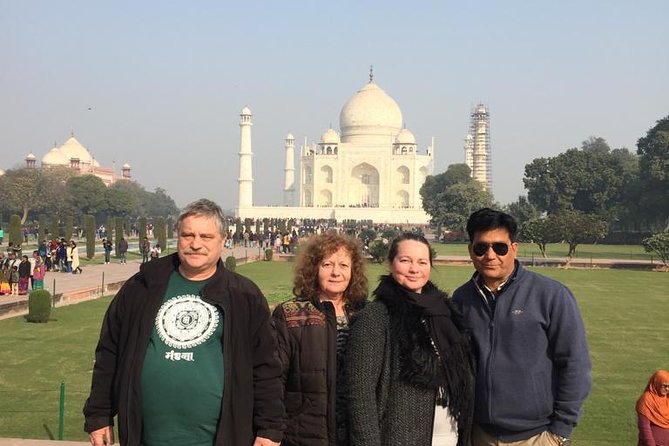
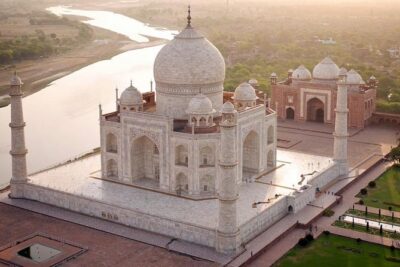
The Taj Mahal receives two hours, which is sensible for a first visit. Built by Mughal emperor Shah Jahan for Mumtaz Mahal, it carries an emotional story of love, loss, remorse, and remembrance. The white marble is the obvious draw, but the larger experience comes from seeing how the building, dome, gardens, and reflecting water work together.
Your guide can help turn a famous photograph into a historical visit. Ask about the building’s connection to Shah Jahan, Mumtaz Mahal, and the Mughal style you first saw at Humayun’s Tomb. Admission is not included, so confirm the current fee and entry procedure before the morning begins.
The schedule places the Taj Mahal before Fatehpur Sikri on the road toward Jaipur. This is practical, but it may make day three one of the most demanding portions of the trip. The Taj visit requires an early start in many itineraries, and then you continue by road toward the next city.
Fatehpur Sikri was Emperor Akbar’s short-lived capital from 1571 to 1585. It was built after the Sufi saint Shaikh Salim Chishti foretold the birth of a son and heir. When the prophecy came true, Akbar gave the new city a special place in his plans. The name Fatehpur means city of victory and also recalls the Mughal conquest of Gujarat.
The fortified city is a fine example of Indo-Islamic architecture, and the hour allotted here gives you a focused introduction. You can expect courtyards, monumental buildings, and a strong sense of an imperial project that did not last long as a capital. Admission is listed as free.
I like this stop because it prevents the route from becoming only a parade of famous photographs. Fatehpur Sikri has a more unusual story, and its location between Agra and Jaipur makes it a useful break in the transfer. You should still ask how much walking is involved and wear practical shoes, since the itinerary does not promise a leisurely visit.
A few more options to weigh up in India
- Jaipur: Private Full Day Sightseeing Tour By Car with Guide
★ 4.9 · 1,839 reviews - Elephanta Caves & Island Guided Private Tour
★ 5.0 · 1,327 reviews - Group Guided Walking Tour in Fort and Colaba
★ 5.0 · 1,073 reviews - Mumbai: Elephanta Caves Half-Day Guided Tour with Expert
★ 4.8 · 1,032 reviews
Day four: Jaipur’s forts, palaces, and observatory
Jaipur is the busiest sightseeing day, with five stops. Amber Palace comes first and receives two hours. Located about 11 kilometers from Jaipur, Amer Fort was built in 1592 by Raja Man Singh and served as the state capital before Jaipur was established.
The fort combines red sandstone and marble with Hindu and Muslim design elements. Inside, look for Diwan-i-Aam, Sheesh Mahal, Sukh Mahal, the Shila Devi Temple, and Ganesh Pol, the gate leading toward the private royal quarters. Maotha Lake adds to the view from the fort.
This is one of the tour’s strongest stops, but it is also a place where two hours can pass quickly. The fort has many halls and pavilions, so ask your guide to focus on the spaces that matter most to you. Admission is not included.
City Palace comes next, with an hour. Jaipur was planned as a city of nine blocks, with the royal palace placed at the center. The visit gives you a direct look at the city’s royal planning and court life.
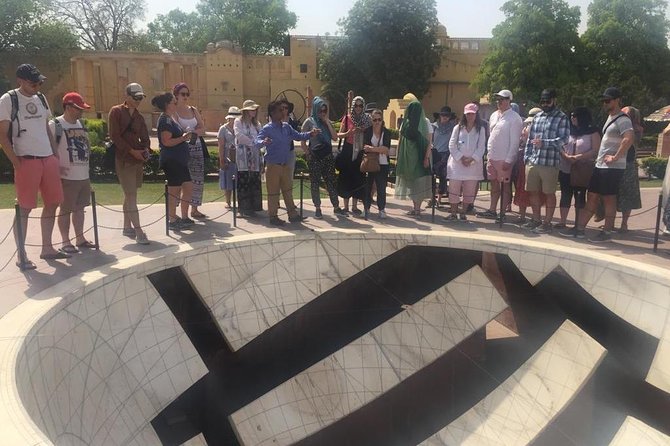
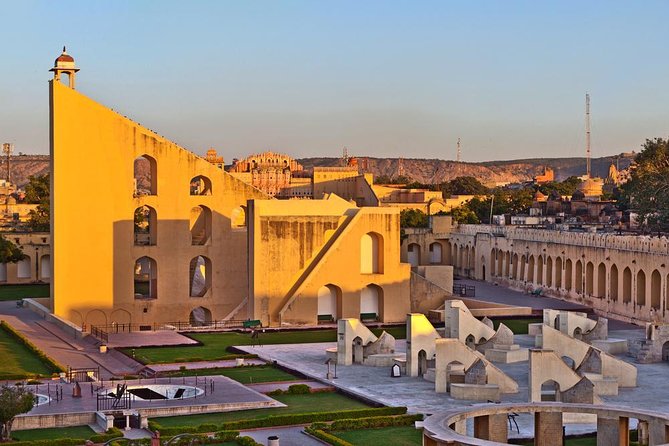
Jantar Mantar follows for another hour. Built in 1724 by Maharaja Jai Singh II of Jaipur, it is an astronomical observatory with large instruments, including a major sundial. The site is easier to appreciate with explanation, so this is a stop where a city guide adds real value. Admission is not included.
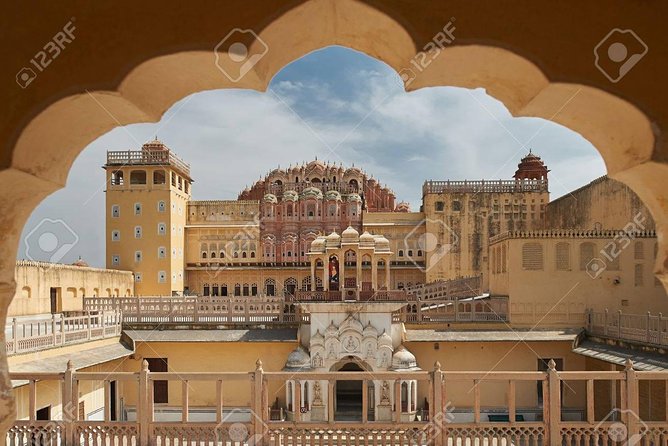
Hawa Mahal, or Palace of the Winds, is a 30-minute stop. Built in 1799 by Maharaja Sawai Pratap Singh, its distinctive facade is one of Jaipur’s best-known sights. Half an hour is enough for an exterior view and photographs, but not a slow architectural study.
The final stop is Jal Mahal, the Water Palace, set in Man Sagar Lake. The visit lasts about 15 minutes and is free. This is a brief viewpoint stop rather than a full palace visit, so keep your expectations realistic. Its value is the unusual setting and the chance to see a Jaipur landmark without adding much time to an already full day.
The driving plan and hotel value
The tour includes private transport, hotel pickup and drop-off, a driver or guide, and four nights of accommodation. Most international flights arrive in Delhi, so the route usually begins there. If you arrive at Jaipur airport instead, the same service is available at the same cost.
The final day involves about five hours on the road from Jaipur to New Delhi. Your driver then takes you to Delhi airport according to your flight schedule. You can also depart from Jaipur airport, which may save a long final transfer.
I would not book a close international connection from Delhi after the Jaipur drive. The tour is designed around your flight schedule, but road conditions and traffic can affect timing. If your flight options allow it, departing from Jaipur may make day five simpler.
The price is $422 per person. That includes four nights, private vehicle transport, a driver or guide, hotel transfers, and breakfast as specified. Lunch, dinner, entry tickets, and guide or driver tips are not included.
That price can be good value for a private five-day route, especially for two or more people sharing the vehicle. It is less easy to judge without the exact hotel names and room category. Some bookings have included five-star hotels, and one booking specifically praised a Haveli hotel in Jaipur, but you should request the hotel list before paying.
The package allows one child below age 10 to travel free with two adults. Group discounts are available, and confirmation is sent at booking. The activity is private, so only your own group participates. Most people can take part, although the itinerary involves multiple monument visits and road transfers.
What the strongest service points mean for you
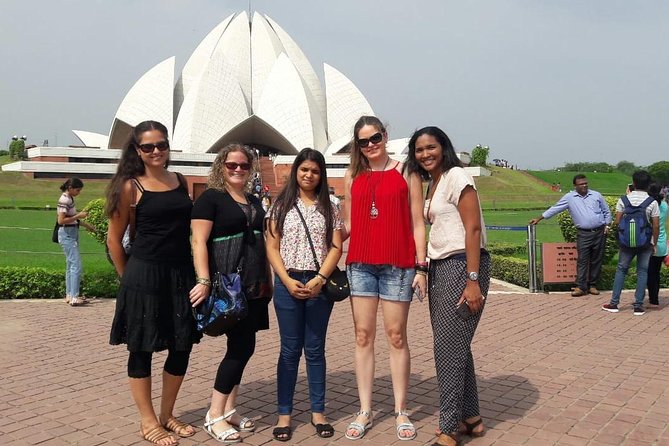
The most consistently praised elements are the planning, communication, drivers, guides, and hotel cleanliness. Manoj Sharma is repeatedly described as responsive and willing to adjust a private itinerary. That flexibility matters because the standard program is full, and you may want to reduce stops or change the final airport plan.
Drivers receive especially warm comments for safe and patient service. Ravinder is singled out for being sweet and careful, while Foran Singh is described as an experienced driver. Names and assignments can change, so treat these as examples rather than guarantees.
City guides are also praised for explaining the monuments in detail and maintaining a professional manner. This is useful at Humayun’s Tomb, Jantar Mantar, and Fatehpur Sikri, where a quick explanation can give the buildings much more meaning.
The accommodation has earned praise for cleanliness and friendly staff. At the same time, hotel quality is the point I would verify most carefully. Ask for the properties, star ratings, room type, and whether breakfast is included on each morning. The written package says three breakfasts, while booking comments describe breakfast on all days, so clarification is sensible.
Should you book this Golden Triangle tour?
I would book it if you want the main Delhi, Agra, and Jaipur sights handled in one private package, with a driver, guides, hotels, and airport transfers arranged together. It suits first-time visitors, families, and people who value a flexible itinerary more than independent rail planning.
I would hesitate if you dislike early starts, long drives, or tightly scheduled sightseeing. You should also compare the final cost after entrance tickets, meals, and tips, then confirm the hotel list and breakfast count in writing.
The best use of this tour is as an efficient introduction to northern India. Ask for your preferred start airport, build realistic flight times around the five-hour Jaipur to Delhi transfer, and use the private format to protect some breathing room in the schedule.
FAQ
Where does the tour usually start?
The tour usually starts in Delhi because most international flights arrive there. Pickup from Jaipur airport is also available at the same cost.
How long is the tour?
The experience lasts approximately five days and includes four nights of accommodation.
Is the tour private?
Yes. Only your own group participates in the activity.
What is included in the price?
The package includes four nights of accommodation, a driver or guide, hotel pickup and drop-off, private vehicle transport, and breakfast as specified in the package details.
Are entrance tickets and meals included?
No. Admission tickets for several major sights are not included. Lunch and dinner are also excluded, as are driver and guide tips.
Can I cancel for a full refund?
You can cancel for a full refund if you do so at least 24 hours before the experience start time. Changes or cancellations made less than 24 hours in advance are not accepted for a refund.
Just added in India
- Five Days Golden Triangle Tour with Ranthambore Delhi Agra Jaipur★ 5.0 · 11 reviews
- 5 Days Golden Triangle Tour with Ranthambore India★ 5.0 · 10 reviews
- 5 Days Golden Triangle Tour with Ranthambore Delhi Agra Jaipur★ 5.0 · 11 reviews
- 5-Day Private Luxury Golden Triangle Tour From Delhi★ 5.0 · 45 reviews
- Delhi, Agra, Jaipur & Ranthambhore Tiger Safari 5-Day Tour★ 5.0 · 47 reviews
- 5-Day Private Delhi, Agra and Jaipur with Ranthambhore Tiger Tour From Delhi★ 5.0 · 44 reviews
- 5-Day Private Golden Triangle Tour: Delhi, Agra, and Jaipur★ 5.0 · 62 reviews
- Private 5 Days Golden Triangle Tour – Visit Delhi Agra and Jaipur★ 5.0 · 26 reviews
5-Day Experiences, compared.

5 Days Luxury Kerala Tour with Houseboat Experience
Read our review →

Private 5-Day Ranthambhore Tiger Tour from Delhi including the Taj Mahal, Agra and Jaipur
Read our review →
5-Day Private Luxury Golden Triangle Tour to Agra and Jaipur From New Delhi
Read our review →
Private 5-Day Charming Kashmir Package Tour from Srinagar
Read our review →
5 Days Private Kerala Tour with Houseboat by Sanguine Holidays
Read our review →
5-Day Private Golden Triangle Tour: Delhi, Agra, and Jaipur
Read our review →Browse the lists this tour appears in