
Reviewed · TEMPLES AND RELIGIOUS SITES
Jaipur Heritage Walking Tour – Local life, Havelis and Temples
Jaipur reveals itself on foot. This three-hour walk takes you beyond postcard views into old havelis, a wholesale flower market, temple rituals, artisan lanes, and carefully chosen street food stops. I like the local focus and the chance to see working Jaipur rather than only grand monuments. I also like that bottled water, tea or coffee, and snacks are included. The main consideration is that the tour moves through crowded lanes and spends only a short time at major sights, with Hawa Mahal viewed from outside.
Guide Viru earns special praise for his clear explanations, easygoing manner, and willingness to match the pace of a family with an eight-year-old child. The tour is private, so only your group joins. That makes the $16 price per person especially appealing, though you should expect a walking tour, not a full palace sightseeing day.
In This Review
- Key points at a glance
- Why this Jaipur walk feels different
- Starting beside Hawa Mahal
- Old havelis in the Pink City
- The flower and vegetable market
- Govind Devji Temple and the Aarti ceremony
- Tripolia Bazar and Jaipur’s working crafts
- Street food, tea, and practical comfort
- Guide Viru and the value of a private group
- Walking conditions and who should book
- Price, timing, and cancellation terms
- Should you book the Jaipur Heritage Walking Tour?
- FAQ
- How long does the Jaipur Heritage Walking Tour last?
- How much does the tour cost?
- Where does the tour begin?
- Where does the tour end?
- Is transportation included?
- What food and drinks are included?
- Is entry to Hawa Mahal included?
- Is the tour private?
- Can I cancel for a full refund?
Key points at a glance

- Hawa Mahal from the street: Spend about 10 minutes seeing Jaipur’s famous Palace of Wind from the outside. Entry is not included.
- A working wholesale market: The flower and vegetable market offers a close look at daily trade in the old city.
- Temple life in real time: The walk may include an Aarti ceremony at Govind Devji Temple, with morning timing personally advised.
- Crafts along Tripolia Bazar: See lac bangle making, marble carving, and brass utensil work.
- Food and water included: Snacks, bottled water, and coffee or tea are part of the experience.
- Private, three-hour format: Only your party participates, with a meeting and return point near Hawa Mahal.
Why this Jaipur walk feels different
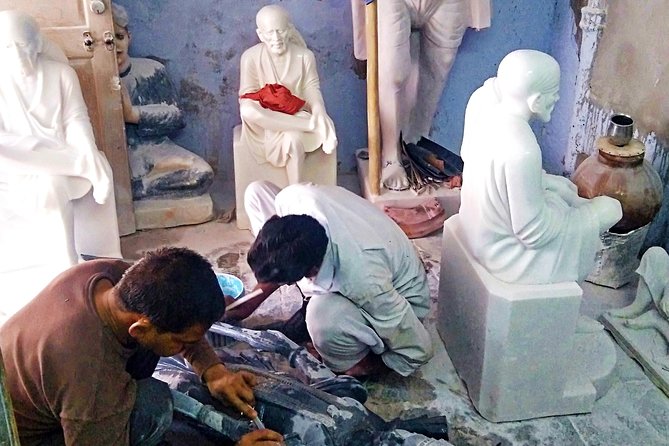
Jaipur is easy to reduce to palaces, forts, and carefully framed photographs. This walk takes another route. You still begin beside one of the city’s best-known buildings, but most of the time is spent watching people work, shop, pray, and move through the old city.
That distinction matters. A monument can tell you who ruled Jaipur. A market can show you what people need today. A craft lane can explain how old skills still earn a living. A temple ceremony can give you a glimpse of religious practice that is not arranged just for a sightseeing schedule.
The price is $16 per person, which is strong value if you want orientation and local context in a short visit. You are paying for a guide, food samples, water, and access to a route that can be difficult to understand on your own. You are not paying for admission to Hawa Mahal or a private vehicle, so keep your expectations in the right place.
The booking pattern also suggests planning ahead. This experience is booked, on average, 42 days in advance. That does not guarantee every date will sell out, but it is a useful reason to reserve early if your Jaipur schedule is fixed.
More Temples and Religious Sites in Jaipur
- Jaipur Tuk Tuk Sightseeing Tour with Monkey Temple Sunset View
★ 5.0 · 108 reviews - Jaipur Guided Tour with Monkey Temple
★ 5.0 · 55 reviews - Jaipur: Private Evening Tour with Monkey Temple Sunset
★ 4.6 · 27 reviews
Starting beside Hawa Mahal
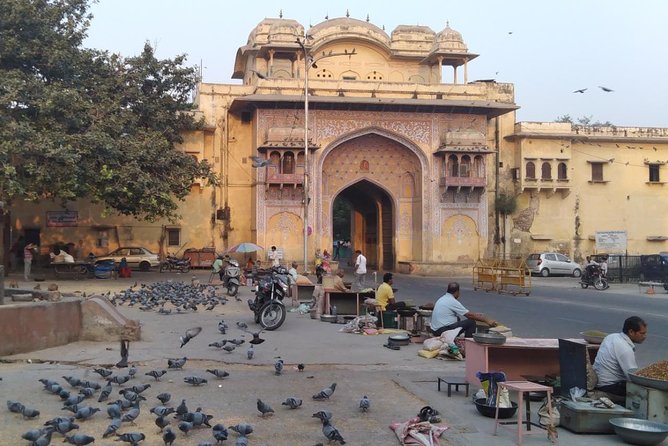
The meeting point is on Hawa Mahal Road, near Badi Choupad and J.D.A. Market in the Pink City. This puts you in the middle of Jaipur’s old center from the first minute, rather than asking you to begin in a quiet hotel district and lose time reaching the sights.
Hawa Mahal is the natural opening scene. Built by Sawai Pratap Singh in 1799, the Palace of Wind allowed women of the royal court to watch processions and the life of the market without appearing in public. Its honeycomb-like front is one of Jaipur’s most recognizable views, but this tour treats it mainly as a point of departure.
You spend about 10 minutes here, and admission is not included. The supplied program describes seeing the exterior, so do not book this walk expecting an extended visit inside the palace. If entering Hawa Mahal is a priority, plan that separately and allow extra time.
Still, a short exterior stop has a benefit. You get the essential architectural context without using half the tour inside one monument. Your guide can then connect the palace facade to the streets and markets it once overlooked.
Old havelis in the Pink City
From the main road, the walk turns toward the old lanes and traditional havelis. These residences are valued for their architecture, painted frescoes, courtyards, and narrow passageways. They offer a different mood from Jaipur’s royal buildings.
A haveli helps you see how urban life was organized at a smaller scale. Instead of a palace built to project power, you look at homes designed around shade, privacy, family life, and shared space. Details are easy to miss when you walk alone, especially when a doorway or courtyard appears beside an ordinary lane.
The stop is listed at about 10 minutes, so it is best treated as a quick architectural introduction. You will not have a long, museum-style examination of every fresco. The value comes from seeing these buildings within the living old city, not behind a rope barrier.
I would pay close attention to the transition between the grand Hawa Mahal frontage and the quieter domestic architecture nearby. That change is one of the walk’s useful lessons: Jaipur’s character is not confined to its headline monuments.
The flower and vegetable market
The wholesale flower and vegetable market receives about 30 minutes, making it one of the stronger parts of the route. It is described as Jaipur’s only wholesale flower and vegetable market, so this is a place where buying and selling are central, not a decorative market created for sightseeing.
You can expect color, movement, and the practical business of supplying the city. Flowers may have a religious use, while vegetables connect the market to everyday kitchens and meals. The guide’s role here is important because a market can look like noise and motion until someone explains what you are seeing.
This is also a good point for questions. Ask about the flowers, the role of the wholesale trade, or how the market connects with nearby temple activity. The program does not promise a shopping stop, so I would not treat it as a place to collect souvenirs. Its value is observation and context.
The market may be the least polished part of the tour, which is exactly why it can be memorable. You are seeing a workplace. Be prepared for narrow spaces and a busy setting, and follow your guide’s lead rather than trying to stop in the middle of trade.
More Walking Tours in Jaipur
- Jaipur Bazaar & Food Walking Tour
★ 5.0 · 281 reviews - Heritage Walk & Street Food Tasting in Jaipur
★ 5.0 · 158 reviews - Jaipur Heritage Walk with Rickshaw Ride
★ 5.0 · 105 reviews - Food Walking Tour in Jaipur
★ 5.0 · 71 reviews
Govind Devji Temple and the Aarti ceremony
The walk then reaches Govind Devji Temple, an 18th-century Hindu temple dedicated to Govind Devji. About 15 minutes are set aside here, with the possibility of seeing one of the seven daily Aarti ceremonies according to the program.
Aarti is a worship ceremony involving ritual offerings and prayer. Timing matters, and the tour provider personally advises attending the morning ceremony. If this moment is important to you, check the scheduled start time carefully before booking, since a walking tour cannot include every ceremony at every departure.
This stop adds a spiritual dimension that a monument-only tour would miss. You are not simply looking at a building. You may see a place of active worship, so respectful behavior is essential. Dress and conduct should suit a temple visit, and your guide can help you understand what is happening.
The 15-minute length means this is an introduction, not an extended temple visit. That is reasonable in a three-hour route, but it also means you should not expect time for a long private prayer or detailed architectural study.
Tripolia Bazar and Jaipur’s working crafts
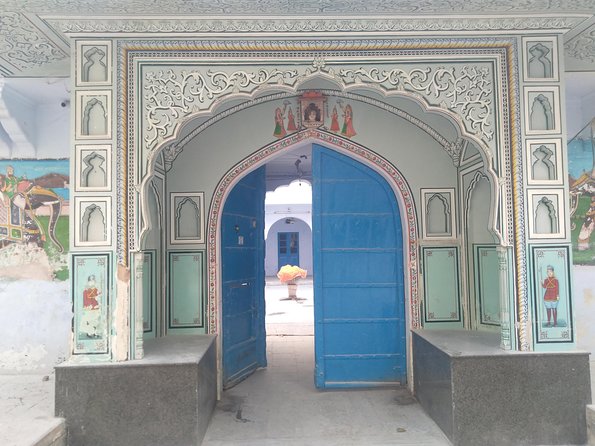
Tripolia Bazar receives the largest block of time, about 1 hour and 30 minutes. That tells you where the walk places its greatest emphasis. Here, you can see traditional craft work including lac bangle making, marble carving, and brass utensil crafting.
These demonstrations are valuable because they put a human hand behind objects you might otherwise see only in a shop window. Lac bangles, carved marble, and brass utensils are not just souvenirs. They reflect techniques, materials, and occupations tied to Jaipur’s artisan culture.
I like this part of the route because it gives you something to watch. You can see how a piece begins, how tools are used, and how a finished object takes shape. The supplied details do not promise that a purchase is required, so you can treat the demonstrations as cultural stops rather than sales appointments.
Tripolia Bazar also helps explain why a private guide can be useful. Craft areas can be confusing, and you may not know which lane or workshop is worth your attention. Viru is praised for showing people the areas where different professions work, including blacksmiths, marble carvers, food sellers, and bangle artists. That wider view makes the bazar feel like part of a neighborhood economy, not a single staged display.
The long stop can be a plus or a drawback. If you enjoy traditional work and want time for questions, it is likely the heart of the tour. If you prefer a rapid checklist of monuments, 90 minutes in the bazar may feel slow.
Street food, tea, and practical comfort
Street food is built into the walk, with snacks from vendors considered reliable by the tour provider. Coffee or tea and bottled water are also included. That is a small but meaningful advantage in Jaipur, where a three-hour walk can feel tiring, particularly in warm weather.
The food component is not presented as a full meal. Think of it as a chance to try local snacks while moving through the old city. The exact dishes are not specified, so you should not book this expecting a fixed tasting menu.
Reliable vendors matter, but food preferences and dietary needs are not detailed. If you have allergies, restrictions, or a sensitive stomach, tell the guide before accepting anything. You can also ask what each snack contains.
Free bottled water keeps the walk simple. You do not need to pause the group to search for a drink, and the inclusion helps add value to a low-cost tour. Coffee or tea gives the route a brief social pause, while snacks connect what you are seeing in the market with what people eat.
Guide Viru and the value of a private group
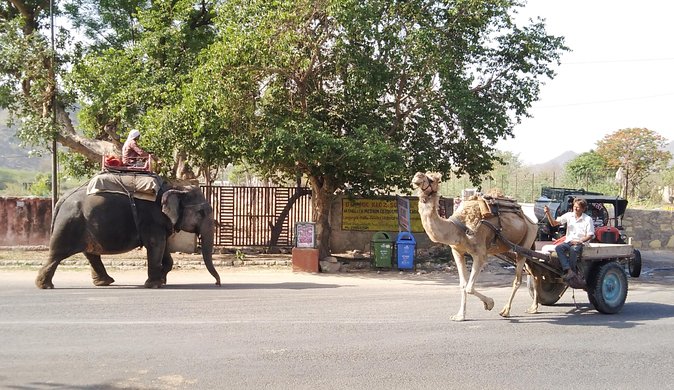
Viru is the guide most closely associated with the experience, and the feedback about him is unusually specific. He is praised for bringing Jaipur’s past to life, explaining praying rituals, showing local markets, and adjusting the pace for an eight-year-old child.
That adaptability is useful for families. Three hours on foot can be too much for a child if every stop becomes a lecture. A guide who can vary the pace and keep explanations clear makes the route more manageable.
The activity is described as private, meaning only your group participates. That is different from joining a large shared departure. You can ask more questions, pause briefly at a craft demonstration, or move on when a child is tired without negotiating with a busload of strangers.
There is one point to clarify before booking: the highlights refer to small group sizes, while the additional information identifies the activity as private. In practical terms, expect a personal experience for your own party, but confirm the group arrangement if the distinction matters to you.
Walking conditions and who should book
This is a genuine walking tour through old-city streets. Private transportation is not included, and the activity begins and ends at the Hawa Mahal Road meeting point. You should arrive ready to walk for roughly three hours, with the route moving between markets, temple areas, havelis, and the bazar.
Most people can participate according to the supplied information. Still, the old city includes narrow lanes and active market areas, so anyone who dislikes crowded streets or extended walking should consider the pace before booking.
I would recommend this for:
- First-time visitors who want a quick orientation to Jaipur’s old city
- Families seeking a private format and a guide who can adjust the pace
- People interested in markets, food, worship, and crafts
- Visitors who have already seen major monuments and want local daily life
- Budget-conscious visitors who value a guide more than included admissions
I would choose another experience if your main goal is a full interior visit to Hawa Mahal, City Palace, or a longer palace tour. This walk gives you brief architectural stops and spends its time on streets, markets, temple activity, and craft work.
The route is also best for people who enjoy observation. You will get more from it if you are willing to pause and notice how the city functions, rather than racing from one photo stop to the next.
Price, timing, and cancellation terms
At $16 per person, the tour offers good value for a private three-hour introduction. Snacks, water, and coffee or tea are included, and you avoid arranging a guide on your own. The strongest value comes from the route itself, particularly the wholesale market and artisan areas.
Admission to Hawa Mahal is not included, and no private transportation is provided. The tour ends back at the meeting point, so plan any onward sightseeing or restaurant reservation with that return location in mind.
You can cancel for a full refund up to 24 hours before the start time. Changes or cancellations inside that 24-hour window are not accepted for a refund. Poor weather or failure to meet the minimum number of participants can lead to a different date or a full refund.
Should you book the Jaipur Heritage Walking Tour?
Book it if you want Jaipur explained through its streets, people, crafts, food, and worship rather than through palaces alone. The private format, low price, included refreshments, and strong reports about Viru make it a sensible first look at the Pink City.
Skip it if you need long interior visits or door-to-door transport. For everyone else, the tour offers a compact and personal way to see how Jaipur works behind its famous facade. Reserve early if your dates are fixed, and aim for a morning departure if attending the Govind Devji Temple ceremony is important to you.
FAQ
How long does the Jaipur Heritage Walking Tour last?
The tour lasts approximately three hours.
How much does the tour cost?
The listed price is $16 per person.
Where does the tour begin?
It begins on Hawa Mahal Road near Badi Choupad, J.D.A. Market, in Jaipur’s Pink City.
Where does the tour end?
The activity ends back at the meeting point.
Is transportation included?
No. Private transportation is not included. This is a walking tour.
What food and drinks are included?
Snacks, bottled water, and coffee or tea are included.
Is entry to Hawa Mahal included?
No. Admission to Hawa Mahal is not included. The route includes an exterior stop of about 10 minutes.
Is the tour private?
Yes. The activity is listed as private, so only your group participates.
Can I cancel for a full refund?
Yes. You can cancel at least 24 hours before the start time for a full refund. Cancellations or changes made within 24 hours are not refunded.
Just added in Jaipur
- Jaipur Private Sightseeing Tour – All-Inclusive with Car & Guide★ 5.0 · 16 reviews
- Jaipur Private Tour 2 Days with Car & Guide★ 5.0 · 13 reviews
- Private Jaipur Tour with Guide & All Entry Tickets★ 5.0 · 20 reviews
- Yoga in Jaipur with Amit (Yogi on Travel)★ 5.0 · 17 reviews
- Vintage Walk Amer★ 5.0 · 11 reviews
- Private 4-Day Wildlife & Taj Mahal Tour from Jaipur to Delhi★ 5.0 · 23 reviews
- Wheel Pottery Workshop★ 4.5 · 19 reviews
- Ranthambore Tiger Safari Private Same Day Trip from Jaipur★ 5.0 · 18 reviews
Temples and Religious Sites, compared.
Dhobi Ghat Laundry and Dharavi Slum Tour with Local
Read our review →
Best of Mysore, UNESCO Somnathpur Temple & Srirangapatna Day Tour
Read our review →

Old Delhi Food-Spice Market-Temples Tour Soon Featured on NETFLIX
Read our review →
Private Guided Spiritual Walk in Banganga Hindu Temples
Read our review →
Private Combo Tours Sightseeing + Dharavi Slum + Dhobi Ghat & Dabbawalas
Read our review →
Private Delhi Temples and Spiritual Sites 6 Hours Tour
Read our review →
Tipu Palace + Koté Vishnu + Fort + KR Market + Jain Temple = Bengaluru Pété Walk
Read our review →Browse the lists this tour appears in