Reviewed · TOURS
The Hipster Chandigarh Architecture History Tour
Modernism feels personal here. The Hipster Chandigarh Architecture History Tour turns a planned city into a readable story, led by Rusty, a third-generation Chandigarh resident and journalist who spent 24 years in Le Corbusier-era public housing. I especially like the rare access to working public housing and the warm, funny way Rusty connects concrete buildings with daily life. The main drawback is the packed two-day schedule, which may feel intense if architecture is not your main reason for visiting Chandigarh.
I also like that the tour does not stop at famous monuments. You see university buildings, a market, a lake, a war memorial, museums, a yacht club, and social housing. At $71.02 per person, the price is strong if you value private transport, included entry fees, and local interpretation, though snack stops cost extra and a group of up to 41 people could feel less personal than a small private outing.
In This Review
- Key points at a glance
- Why Chandigarh makes such a good architecture tour
- Day one: from the Capitol Complex to Jeanneret’s home
- The Capitol Complex and the Open Hand Monument
- The Le Corbusier Centre
- Gandhi Bhawan at Panjab University
- Chandigarh Architecture Museum
- Geometric Hill and the Tower of Shadows
- Museum Maison Jeanneret
- Day two: water, shopping, memory, and ordinary housing
- Sukhna Lake
- Sector 17 Market
- Chandigarh War Memorial
- Pierre Jeanneret’s public housing
- Government Museum and Art Gallery
- Lake Club
- What the $71.02 price really covers
- The guide’s role makes the difference
- Timing, comfort, and who should book
- Should you book the Hipster Chandigarh Architecture History Tour?
- FAQ
- How long does the Hipster Chandigarh Architecture History Tour last?
- What is the price per person?
- Is pickup included?
- Is transportation provided during the tour?
- Are entrance fees included?
- Are food and snacks included?
- How large can the group be?
- Is the Capitol Complex included?
- Does the tour visit Pierre Jeanneret’s public housing?
- What happens if bad weather cancels the tour?
Key points at a glance
- Rusty’s local connection: Your guide lived in Corbusier-designed public housing, studied in Pierre Jeanneret schools, and worked in Maxwell Fry buildings.
- Two full days of sites: The program covers the Capitol Complex, Panjab University, Sukhna Lake, Sector 17, museums, public housing, and more.
- Rare access matters: Some buildings and spaces are not simple walk-up sights, including the Capitol Complex, Jeanneret’s former home, and the Lake Club.
- Architecture with social context: The tour links modernist design with Chandigarh’s town planning, public institutions, and socialist housing.
- Good value for a packed program: Transport, parking, photography charges, and admission fees are included.
- Flexible, human hosting: Rusty is praised for humor, pacing, food suggestions, and adjusting the day when closures or personal preferences get in the way.
Why Chandigarh makes such a good architecture tour
Chandigarh is not just a city with a few striking buildings. It was planned as a new capital, and its design makes more sense when you see the full system: government offices, university spaces, markets, parks, water, roads, housing, and public gathering places.
Le Corbusier receives much of the attention, but the city also reflects the work of Pierre Jeanneret, Maxwell Fry, and other architects involved in its creation. That wider view is one of the tour’s best features. You are not simply shown a famous concrete facade and handed a date. You are encouraged to think about how a city functions and how architecture affects ordinary life.
Rusty’s background gives the experience a useful personal angle. He describes himself as someone who grew up inside the city’s architecture, rather than someone who arrived later to study it. That helps explain why the tour moves beyond design vocabulary and asks practical questions about schools, homes, offices, markets, cooling, shade, and public use.
The tone also sounds intentionally broad. Rusty aims to keep the material entertaining for families, accessible for students, and serious enough for architects and urban planners. His humor is described as politically neutral, a sensible choice in a city tied closely to government and national history.
Other trips worth a look in India:
- Old & New Delhi City Tour – Half or Full Day Options Available
★ 5.0 · 4,811 reviews - Old & New Delhi City Tour – Choose Half or Full Day Experience
★ 5.0 · 4,513 reviews - Same Day Taj Mahal, Agra Fort & Baby Taj Tour from Delhi by Car
★ 5.0 · 4,304 reviews
Day one: from the Capitol Complex to Jeanneret’s home
The first day begins at 9:00 a.m. and carries the heaviest architectural load. It is the day for grand civic design, major institutions, and the story of Chandigarh’s modernist foundations.
The Capitol Complex and the Open Hand Monument
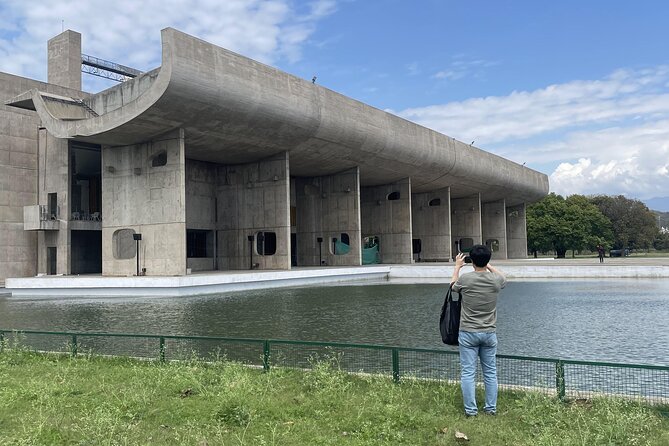
The Capitol Complex is the natural starting point. This UNESCO World Heritage site includes the Secretariat, the Assembly Hall, and the Open Hand Monument, all built around powerful concrete forms and large civic spaces.
The value here is access. Many visitors can admire Chandigarh’s famous buildings from a distance, but an insider-guided visit gives you a better chance to understand how the spaces were intended to work. The scale can be hard to grasp from photographs. In person, the relationship between open ground, heavy concrete, and monumental government buildings becomes much clearer.
You have about an hour here, with admission included. Wear comfortable shoes and bring water, since the experience involves movement through a large complex rather than a short museum visit.
The Open Hand appears again later as its own stop, allowing more time with the symbol itself. Le Corbusier designed it as a sign of peace and unity, and the tour explains its place in Chandigarh’s public identity. If the wind is favorable, you might see the hand rotate, which adds a small bit of movement to an otherwise solid monument.
The Le Corbusier Centre
The former architects’ building is now the Le Corbusier Centre, a museum and memorial space. The visit lasts about 50 minutes and includes visual demonstrations of an early attempt at green, naturally cooled design.
That detail makes this stop especially useful. Chandigarh’s architecture is often reduced to concrete and strong geometric shapes, but climate matters too. The center gives you a way to consider how buildings responded to heat, air movement, and local conditions.
I would pay close attention to the visual explanations rather than rushing through them for photographs. The displays help connect abstract architectural ideas to things you can feel in a building: shade, airflow, exposure, and comfort.
A completely different kind of day out:
- Taj Mahal Day Tour from Delhi by Superfast Train – TOP RATED TOUR
★ 5.0 · 4,166 reviews - Full Day Taj Mahal, Agra Fort & Baby Taj Tour from Delhi by Car
★ 5.0 · 3,647 reviews - From Delhi: Taj Mahal & Agra Private Day Trip with Transfers
★ 4.9 · 3,181 reviews - Taj Mahal Tour from Delhi by Express Train (Viator Award Winner)
★ 5.0 · 2,849 reviews
Gandhi Bhawan at Panjab University
Gandhi Bhawan is one of Chandigarh’s most recognizable structures. Designed by Pierre Jeanneret, it has a distinctive lotus-like roof that gives it a softer and more symbolic character than some of the city’s heavier concrete buildings.
The guided visit lasts around 30 minutes. It takes place within Panjab University, so you get a sense of how Chandigarh’s planning extended into education and public life. The university is not just a collection of academic buildings. It forms part of the city’s larger experiment in institutions, movement, and shared space.
The tour also includes a 40-minute insider visit to Panjab University itself. These two stops work well together, though the repeated campus focus may feel slow if you want only the headline sights.
Chandigarh Architecture Museum
The Chandigarh Architecture Museum is housed in a raw concrete building inspired by Le Corbusier’s 1965 Zurich Pavilion. Its tubular stairway and three levels of exhibits provide a clear setting for the city’s modernist story.
This is where the many buildings begin to form a timeline. You can use the exhibits to place Chandigarh’s planning and architecture in context rather than treating each stop as an isolated object. The museum includes rare material, and the guided format should help you understand why certain designs matter.
Allow an hour here. The stop will appeal most to visitors who enjoy drawings, models, documents, and architectural explanation. If your interest is mainly in street life, this is one of the more indoor and academic portions of the program.
Geometric Hill and the Tower of Shadows
Geometric Hill is a short 20-minute visit through a sculptural setting of earth mounds and concrete forms. It was designed as part of the Capitol Complex and reflects Le Corbusier’s use of geometry on a monumental scale.
The nearby Tower of Shadows takes about 15 minutes. This open-air concrete structure was designed as a demonstration building for studying solar movement. It shows Le Corbusier’s interest in how sunlight changes through the day, rather than treating a building as a fixed object.
These are brief stops, but they add an important practical layer. You see that the architecture was not only about appearance. Light, heat, time, and orientation were part of the design problem.
Museum Maison Jeanneret
The first house constructed in Chandigarh later became Museum Maison Jeanneret. It was Pierre Jeanneret’s residence for 11 years and offers a more intimate look at the architect’s life and ideas.
After the large civic structures, this house gives the first day a welcome change of scale. A home reveals how design works at human height: rooms, furniture, circulation, and daily routines. The 30-minute visit is short, but it helps balance Le Corbusier’s monumental public buildings with Jeanneret’s domestic work.
Day one includes a lot of stops, and the subjects overlap. That is useful for building a connected understanding, but you should not expect long, unhurried time at every site. The schedule suits an active day with frequent transitions.
Day two: water, shopping, memory, and ordinary housing
The second day broadens the picture. Instead of focusing mainly on landmark buildings, it shows how Chandigarh’s planning reaches into recreation, commerce, remembrance, and everyday homes.
Sukhna Lake
Sukhna Lake begins the day with a gentler 30-minute walk. It is a manmade lake associated with Corbusier’s planning, created to refresh groundwater and help cool the northern sectors of the city.
This stop matters because it shows planning at an environmental scale. The city’s modernism was not only about offices and assembly halls. Water, open space, and climate were also part of the plan.
The walk is a good change after day one’s many buildings. It should also help you see Chandigarh as a lived city rather than a museum of concrete. The tour describes the lake’s creation and its later development, giving the place a story beyond its pleasant setting.
Sector 17 Market
Sector 17 is the commercial center of Chandigarh, and the tour spends about an hour walking its shaded, tree-lined paths. This is one of the strongest choices in the program because it addresses an area that can be overlooked beside the more famous civic buildings.
You look at Corbusier’s commercial design while also watching how people use the space. Commerce, culture, and community meet here, and the experience becomes less about architectural theory and more about urban behavior.
The visit is free, but plan for personal spending if you want refreshments or shopping. Frequent snack stops are part of the experience, but you pay for your own food and drinks. The stops are intended to stay inexpensive, which suits students and budget-conscious visitors.
Chandigarh War Memorial
The War Memorial sits within Bougainvillea Garden in Sector 3. The half-hour visit offers a quieter shift in tone, with a solemn memorial setting and a focus on military remembrance.
Its inclusion gives the tour more historical range. You are not looking only at the designers of Chandigarh. You are also considering the people and events remembered within the city. The setting allows for a reflective pause after the more technical architecture stops.
Pierre Jeanneret’s public housing
This may be the most distinctive stop for anyone interested in how design affects daily life. The tour offers rare walking access through Pierre Jeanneret’s public socialist housing, still functioning in its original form, subject to local conditions.
Rusty’s own experience living in this housing gives the visit unusual weight. He spent 24 years in Corbusier’s public social housing, so he can discuss the buildings from the point of view of someone who used them as homes, not just as architectural examples.
The visit lasts about an hour. Access is not guaranteed in every circumstance, so keep your expectations flexible. If the visit goes ahead, it may be more revealing than a polished monument because you can consider how the original ideas have held up in everyday use.
Government Museum and Art Gallery
The Government Museum and Art Gallery occupies a 1960s heritage building designed by Le Corbusier. The one-hour guided visit includes material from the pre-partition era in Pakistan and one of the world’s largest collections of Greco-Buddhist art.
This stop gives the tour a strong cultural and historical dimension. Chandigarh’s story did not begin with concrete buildings. The museum’s collections connect the city to the wider region and to the upheavals surrounding Partition.
The museum also gives you another chance to see Le Corbusier’s work at a practical scale. A public museum has different demands from a government complex or a private home, and the building’s purpose helps broaden your understanding of his approach.
Lake Club
The final stop is the Lake Club, a rarely known private yacht club designed by Corbusier about a year before his death. The guided visit lasts roughly 30 minutes and focuses on recreational boating, social life, and the building’s design.
It is an unusual closing stop because it moves away from formal government and education. You see how the city’s planning included leisure and social interaction. Access is described as insider guided access, but private venues can be sensitive to local conditions, so flexibility is wise.
What the $71.02 price really covers
At $71.02 per person, this is not a bare sightseeing drive. The fee includes an air-conditioned vehicle, pickup and drop charges, parking, driving, waiting time, photography fees, and entry tickets at the paid sites.
That package can represent good value in Chandigarh, especially across two days. Admission fees alone are not the whole calculation. You are also paying for transport between spread-out parts of the city and for a guide who has spent years researching the subject.
The price becomes less attractive if you want only a few famous buildings or prefer to explore independently. It is also worth noting that the group can reach 41 people. A large group may limit personal conversation and make access or movement feel less intimate, even though Rusty’s style is described as attentive and adaptable.
Snacks and drinks are extra, while gratuities are optional. The food stops are meant to be budget friendly, and Rusty can adjust lunch choices to your preferences, according to the information provided about the experience.
The guide’s role makes the difference
Rusty is the central reason this tour sounds more personal than a standard architecture circuit. He combines 11 years as a journalist with lifelong experience of Chandigarh. That mix supports both careful research and storytelling.
His approach appears flexible rather than rigid. When an unexpected public holiday closed key sites, he filled the day with other interesting visits instead of allowing the experience to collapse. That is useful in a city where government buildings, museums, and private spaces may not always operate on the same schedule.
His humor is another strength. Architecture tours can become a procession of names, dates, and technical terms. Rusty’s style aims to make the facts approachable without stripping away the serious planning and social questions beneath them.
The strongest praise focuses on his warmth, enthusiasm, good humor, and ability to explain Chandigarh in context. One important point is that the city cannot be understood through architecture alone. Town planning and social purpose are just as important, and Rusty’s background helps tie those subjects together.
Timing, comfort, and who should book
You start at 9:00 a.m., and both days are active. The first day includes nine stops, with the second adding six more. The individual visits range from 15 minutes to one hour, so expect regular changes of place and subject.
Pickup is offered, and the air-conditioned vehicle includes driving, parking, and waiting charges. That makes the tour easier than arranging separate transport for each part of Chandigarh. Most people can participate, service animals are allowed, and the tour is near public transportation.
I would choose this experience if you are an architect, student, urban planner, photographer, design fan, or simply curious about why Chandigarh looks so different from other Indian cities. Families and couples can enjoy it too, especially if Rusty’s humor helps keep the technical material lively.
I would hesitate if you dislike structured sightseeing, need a slow pace, or have little patience for museums and institutional buildings. The program is broad and full, not a casual highlights tour.
The tour requires good weather. If poor weather causes cancellation, you are offered another date or a full refund. For cancellations by you, a full refund requires at least six full days’ notice. Two to six days allows a 50 percent refund, while cancellation less than two full days before the start receives no refund.
Should you book the Hipster Chandigarh Architecture History Tour?
Book it if you want to understand Chandigarh as a planned society, not just photograph its concrete monuments. The combination of insider access, local experience, included transport, and Rusty’s personal connection gives the two days real purpose.
The best parts are the Capitol Complex, Jeanneret’s public housing, Museum Maison Jeanneret, and the everyday urban view at Sector 17. The main caution is the scale of the program and the possible group size. You will get the most from it if you welcome a full schedule and are willing to let architecture lead you into questions about climate, politics, housing, education, and public life.
For a first visit to Chandigarh, this is a strong choice. For a repeat visit, it may be even better, since Rusty’s local perspective can reveal meaning in places you might otherwise pass without a second thought.
FAQ
How long does the Hipster Chandigarh Architecture History Tour last?
The experience lasts approximately two days, with a 9:00 a.m. start time.
What is the price per person?
The listed price is $71.02 per person.
Is pickup included?
Yes. Pickup and drop charges are included, along with driving, parking, and waiting charges.
Is transportation provided during the tour?
Yes. The tour uses an air-conditioned vehicle.
Are entrance fees included?
Yes. Entry tickets, admission fees, photography tickets, and photography charges are included where applicable.
Are food and snacks included?
No. Snack stops are part of the experience, but you pay for your own snacks and drinks. The stops are described as inexpensive.
How large can the group be?
The maximum group size is 41 people.
Is the Capitol Complex included?
Yes. The tour includes guided access to the Capitol Complex, including the Secretariat, Assembly Hall, and Open Hand Monument.
Does the tour visit Pierre Jeanneret’s public housing?
Yes. It offers rare walking access through the housing, subject to local conditions.
What happens if bad weather cancels the tour?
If poor weather causes cancellation, you are offered a different date or a full refund.
Just added in India
- Five Days Golden Triangle Tour with Ranthambore Delhi Agra Jaipur★ 5.0 · 11 reviews
- 5 Days Golden Triangle Tour with Ranthambore India★ 5.0 · 10 reviews
- 5 Days Golden Triangle Tour with Ranthambore Delhi Agra Jaipur★ 5.0 · 11 reviews
- 5-Day Private Luxury Golden Triangle Tour From Delhi★ 5.0 · 45 reviews
- Delhi, Agra, Jaipur & Ranthambhore Tiger Safari 5-Day Tour★ 5.0 · 47 reviews
- Private 5 Days Golden Triangle Tour – Visit Delhi Agra and Jaipur★ 5.0 · 26 reviews
- 5-Day Private Delhi, Agra and Jaipur with Ranthambhore Tiger Tour From Delhi★ 5.0 · 44 reviews
- 5-Day Private Golden Triangle Tour: Delhi, Agra, and Jaipur★ 5.0 · 62 reviews
Tours, compared.
Old & New Delhi City Tour – Half or Full Day Options Available
Read our review →
Old & New Delhi City Tour – Choose Half or Full Day Experience
Read our review →
Same Day Taj Mahal, Agra Fort & Baby Taj Tour from Delhi by Car
Read our review →
Taj Mahal Day Tour from Delhi by Superfast Train – TOP RATED TOUR
Read our review →
Full Day Taj Mahal, Agra Fort & Baby Taj Tour from Delhi by Car
Read our review →
Taj Mahal Tour from Delhi by Express Train (Viator Award Winner)
Read our review →
All Inclusive Private Taj Mahal Luxury Tour from Delhi by Car
Read our review →