
Reviewed · GOLDEN TRIANGLE TOURS
Private 4-Day Golden Triangle Tour – Delhi Agra and Jaipur
India rewards a well-planned first visit. This private four-day Golden Triangle tour links Delhi, Agra, and Jaipur with a dedicated car, hotel pickup, and local guides at the major sights. It is designed for first-time visitors who want to see the Taj Mahal and the best-known monuments without sorting out trains, buses, or city transfers on their own.
I especially like the private vehicle and driver, which gives you more control over departure times and comfort on long road days. I also like the mix of famous monuments and less hurried stops, from Humayun’s Tomb and the Baby Taj to Jaipur’s stepwell and royal cenotaphs. The main drawback is the pace: Delhi is packed into one long first day, and several entry fees and meal costs may require clarification before booking.
The tour has received a 100 percent recommendation rate from 51 published ratings, with particular praise for drivers including Ajit, Manoj, Vinodh, Amit Kasana, and Deepu. The strongest pattern is personal service: polite driving, help with timing, restaurant suggestions, and flexibility when plans change.
In This Review
- Key points to know before you book
- Why a private car makes the Golden Triangle easier
- Day 1: Old Delhi, Mughal monuments, and a long ride to Agra
- Day 2: Sunrise at the Taj Mahal and the road to Jaipur
- Day 3: Jaipur’s royal center and pink sandstone icons
- Day 4: Cenotaphs, a water palace, and Amer
- What the $270 price really offers
- Who will enjoy this tour most
- Should you book the Golden Triangle tour?
- FAQ
- How long does the Golden Triangle tour last?
- Is hotel pickup included?
- Are hotels included in every package?
- Is breakfast included?
- What type of vehicle is used?
- Is the Taj Mahal open every day?
- Are monument entrance fees included?
Key points to know before you book
- Delhi is covered in one very full day: Jama Masjid, Raj Ghat, India Gate, Humayun’s Tomb, Lotus Temple, and Qutub Minar are all included before the drive to Agra.
- The Taj Mahal is visited at sunrise: This is the right time for softer light and cooler temperatures, but you will need an early start.
- A private driver is the tour’s greatest practical advantage: You avoid public transport and can discuss timing, comfort stops, and small changes with your driver.
- Hotels are optional: Packages are available with or without three nights of accommodation, and breakfast is included only with the hotel option.
- The schedule covers major Jaipur sights well: City Palace, Jantar Mantar, Hawa Mahal, Albert Hall Museum, Amer, Jal Mahal, and Panna Meena Stepwell are all part of the route.
- Check entrance-fee details carefully: The inclusions state that monument fees are covered, but individual stops also show admission as not included.
Why a private car makes the Golden Triangle easier
The Golden Triangle covers a lot of ground. Delhi to Agra takes about three hours by way of the Yamuna Expressway, and Agra to Jaipur adds another substantial road journey after a morning of monuments. A private, air-conditioned vehicle turns those transfers into useful rest time instead of another transport puzzle.
The car type depends on your party. One to three people travel in a four-seat Toyota Etios or Dzire. Groups of three to four use a six-seat Toyota Innova, Innova Crysta, or Ertiga, while five to ten people are assigned a ten-seat minivan. If you are carrying large bags, ask about available luggage space before you settle on the vehicle.
The driver is not the same as the local guide at every monument. You have an English-speaking driver for transport and separate private local guides for sightseeing in each city. That arrangement can work very well because the driver concentrates on the roads while the guide explains the site.
The most useful praise has focused on the drivers. Ajit was described as polite and professional. Vinodh earned repeated praise for careful driving in both city traffic and on highways, along with thoughtful suggestions about avoiding busy periods. Manoj was also praised for helping with food choices, restaurants, and local craft workshops. These details matter because a good driver can make a long Indian road trip feel far less tiring.
More Golden Triangle Tours in New Delhi:
- 3-Days Private Golden Triangle Tour: Delhi, Agra & Jaipur by Car
★ 5.0 · 1,107 reviews - 3-Days Private Golden Triangle Tour: Delhi, Agra & Jaipur by Car
★ 5.0 · 1,098 reviews - 3-Day Delhi, Agra and Jaipur Private Tour – India Golden Triangle
★ 5.0 · 812 reviews
Day 1: Old Delhi, Mughal monuments, and a long ride to Agra
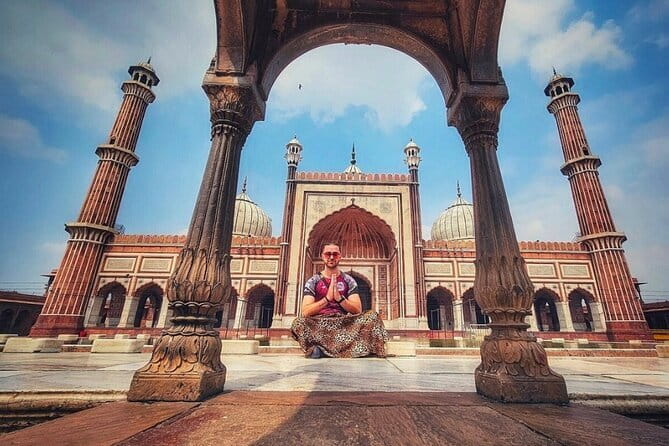
Your first day begins with Jama Masjid, one of Old Delhi’s great Mughal monuments. Built by Shah Jahan between 1644 and 1658, the mosque has broad courtyards, grand gateways, and a strong sense of scale. The scheduled visit is about 30 minutes, so expect a quick introduction rather than a slow architectural study. Admission is listed separately in the stop details.
Next comes Raj Ghat, the memorial marking Mahatma Gandhi’s cremation site. The black marble platform and eternal flame create a quiet contrast with Old Delhi. Thirty minutes is enough for a respectful visit and a short explanation from your guide.
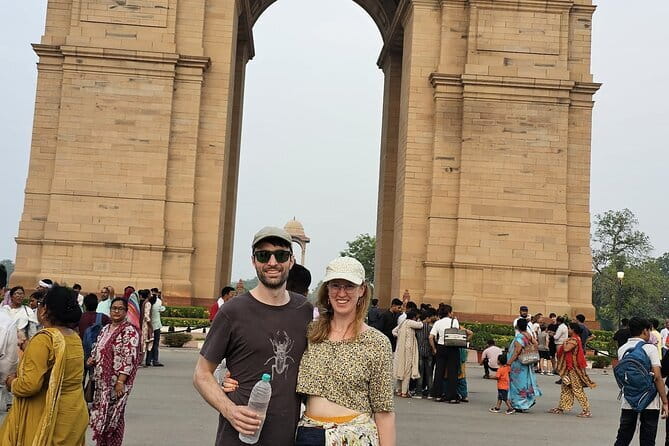
India Gate is a brief photo and history stop. The 42-meter arch honors Indian soldiers who died in World War I and other conflicts, and the names of more than 13,000 soldiers are inscribed there. The visit is scheduled for only 15 minutes, so treat it as a viewpoint rather than a full museum experience.
The route also passes Rashtrapati Bhavan and Parliament House. These are exterior landmarks in the planned sightseeing sequence, with no visit duration supplied. Your guide can provide useful context about New Delhi’s planned government district and the work of architects Edwin Lutyens and Herbert Baker, but you should not expect an interior tour based on the information provided.
Humayun’s Tomb deserves more time. This UNESCO World Heritage site, completed in 1565, uses Persian garden planning, a high central dome, and red sandstone with pale stone details. At 45 minutes, the stop gives you enough time to appreciate the grounds and understand why the building is often linked to the later style of the Taj Mahal.
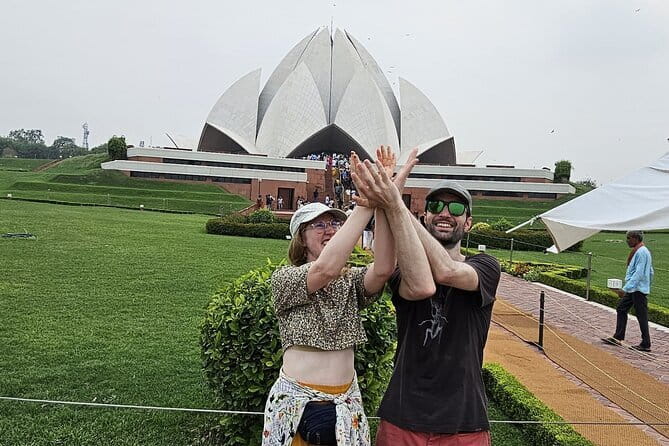
Lotus Temple offers a different mood. Its 27 white marble petals form a lotus-shaped Bahá’í House of Worship open to people of all faiths for meditation and prayer. The scheduled half-hour visit is short, but it gives you time to see the unusual design and pause after a packed day of monuments.
The final Delhi sight is Qutub Minar, a 73-meter brick minaret begun by Qutb-ud-Din Aibak in 1193. The surrounding complex includes early Indo-Islamic architecture, and the 45-minute visit is enough for the main structure and some nearby remains. By this point, you may be ready for the car.
The drive to Agra takes about three hours on the Yamuna Expressway. This is an efficient transfer, but Day 1 is demanding. If you enjoy a broad overview, the pace works. If you prefer long museum visits and unhurried meals, you may want to ask if one Delhi stop can be shortened or removed.
Day 2: Sunrise at the Taj Mahal and the road to Jaipur
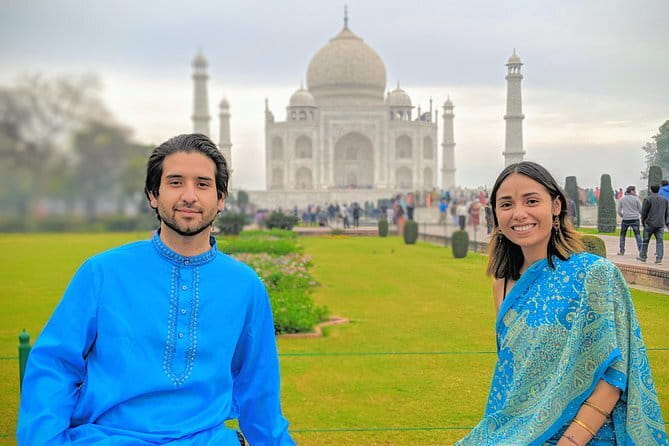
The Taj Mahal at sunrise is the emotional center of the tour. You spend about two hours at the monument with a guide, including the interior visit. The early timing brings cooler air and softer light, though it also means an early departure from your Agra hotel.
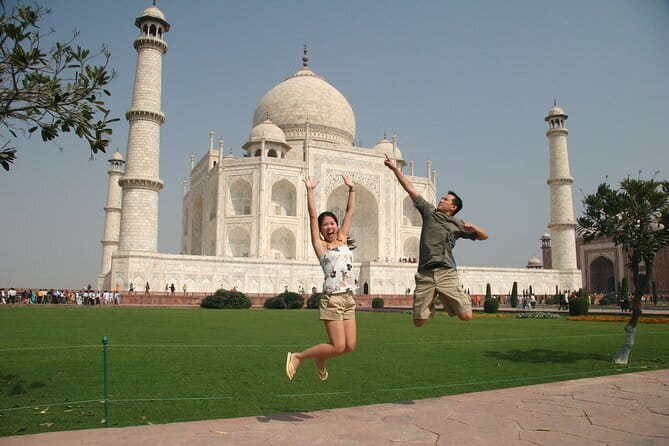
The Taj Mahal was built by Mughal emperor Shah Jahan as a mausoleum for Mumtaz Mahal. Your guide adds meaning to the marble, gardens, symmetry, and inlaid decoration, helping you see more than a famous photograph. Keep in mind that the Taj Mahal is closed to general viewing on Fridays, so the start date and weekly schedule need checking.
Agra Fort follows, with about one hour inside. This red sandstone complex was a Mughal imperial residence, not simply a military outpost. Palaces, balconies, courtyards, and gardens reveal how rulers lived and governed. The fort also gives you a useful counterpoint to the Taj Mahal: one is a place of power and daily court life, the other a monument of mourning.
The Tomb of I’timād-ud-Daulah, often called the Baby Taj, receives another hour. This smaller mausoleum is valued for its delicate decoration and for anticipating features later used at the Taj Mahal. It is a good stop for anyone who wants to compare Mughal design rather than rush from one famous site to the next.
After Agra, the route continues to Fatehpur Sikri, a UNESCO World Heritage site built by Emperor Akbar in the 16th century. It served as the Mughal capital for only a short period, yet its palaces, courtyards, and red sandstone buildings remain a major stop. Two hours allows your guide to explain how the city was organized and gives you time to walk through the complex.
Then comes the road to Jaipur and hotel check-in. The schedule gives about three hours for the transfer and settling in. This is a full day, but the order makes sense: the Taj Mahal first, major Agra sights next, and Fatehpur Sikri on the way toward Rajasthan.
Day 3: Jaipur’s royal center and pink sandstone icons
Jaipur’s City Palace begins the third day. Built in 1721, it served as the Maharaja’s administrative and ceremonial center. A one-hour visit introduces the courtyards, palace buildings, and royal collections. The time is useful for an overview, though anyone interested in textiles, arms, or court life may want to ask how much of the complex is included.
Jantar Mantar is one of Jaipur’s most distinctive sights. The 19 astronomical instruments were built in 1734 by Sawai Jai Singh II, the Rajput ruler who founded Jaipur. These huge stone and masonry structures were designed to measure time and track the heavens. A guide makes a real difference here because the instruments can look abstract until someone explains how they work.
Hawa Mahal, the Palace of Winds, is a 1799 five-story structure of pink and red sandstone. Its many small windows allowed royal women to observe street life without being seen. The scheduled 45-minute stop is enough for exterior photographs and a visit around the building, though the most famous view is from outside.
The Albert Hall Museum closes the day’s main circuit. Built in 1876, it combines Indian and European design and holds art, textiles, sculpture, and historical objects. One hour provides a useful sample, but the museum could easily absorb longer for anyone who enjoys collections rather than only monumental architecture.
Jaipur’s third day is more manageable than Delhi’s first. The stops are relatively close together, and the mix of palace, science, architecture, and museum gives the day variety. Still, admission fees are listed as not included at each stop, so confirm the payment arrangement before you arrive.
A few more options to weigh up in New Delhi
- Old & New Delhi City Tour – Half or Full Day Options Available
★ 5.0 · 4,811 reviews - Same Day Taj Mahal, Agra Fort & Baby Taj Tour from Delhi by Car
★ 5.0 · 4,304 reviews - Taj Mahal Day Tour from Delhi by Superfast Train – TOP RATED TOUR
★ 5.0 · 4,166 reviews - Full Day Taj Mahal, Agra Fort & Baby Taj Tour from Delhi by Car
★ 5.0 · 3,647 reviews
Day 4: Cenotaphs, a water palace, and Amer
The fourth day opens at Royal Gaitor, a complex of royal cenotaphs near the Aravalli Hills. These marble and sandstone memorials honor Jaipur’s former Maharajas and combine Rajput and Mughal design details. The schedule displays an unusual duration of one day and six hours, which cannot be a realistic stop length within a four-day tour. Treat this as a timing error and ask the operator for the intended visit length.
Jal Mahal is a quick 15-minute photo stop. The palace appears to float in Man Sagar Lake, although the planned visit is from the shore rather than an interior tour. It is a pleasant change after several enclosed monuments, but the short duration means you will mainly view and photograph the building.
Panna Meena ka Kund offers another change of pace. This 16th-century stepwell uses repeated flights of stairs to form a striking geometric pattern leading down toward the water. Thirty minutes is enough to see the design and hear its practical purpose.
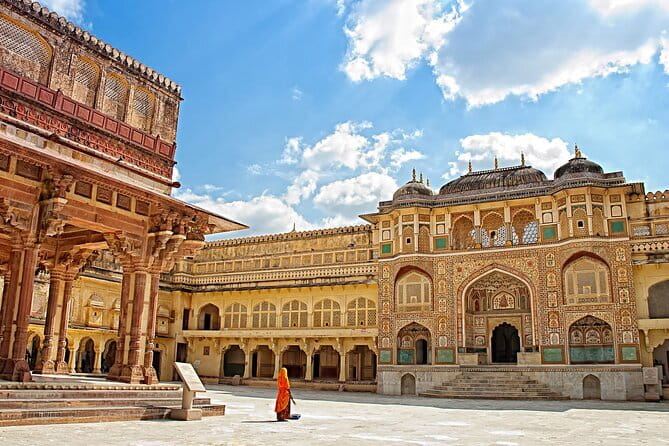
The final major stop is Amer, the historic town and fort area near Jaipur. The two-hour visit allows time for the architectural complex, old streets, temples, and traditional buildings. Amer is an important finish because it brings together the Rajput setting and Mughal influences that shape so much of Rajasthan’s built heritage.
The provided plan does not specify the final drop-off time or location in detail, but hotel or airport pickup and drop-off are included. Confirm where the tour ends if you have a flight, train, or onward hotel reservation.
What the $270 price really offers
At $270 per person, the tour can be strong value if you choose the hotel package and want a private car, driver, guides, and three nights of accommodation in one arrangement. You are paying for convenience across three cities, not just admission to monuments.
The package choices matter. Some options include hotels and three breakfasts, while others do not include accommodation. Daily breakfast is included only when you book the hotel option. Meals beyond breakfast are not included, so allow extra money for lunch, dinner, drinks, and snacks.
There is one important point to settle before payment. The inclusions state that monument entrance fees are covered, yet many individual stops say admission is not included. Ask for a written list of exactly which tickets are paid by the operator and which you must buy yourself. This is the clearest way to protect the value of the $270 price.
Group discounts may also be available, and larger parties can use the ten-seat minivan. Since the tour is private, only your own group participates. That gives you more privacy than a coach trip and makes it easier to request sensible changes, though the main route and four-day schedule still limit how much can be added.
Who will enjoy this tour most
I would recommend this experience to a first-time visitor who wants the classic Delhi, Agra, and Jaipur sights without handling Indian rail connections or local taxi arrangements. It also suits couples, families, and small groups that value a private car and can manage several early mornings and long sightseeing days.
It is less suitable if you want a slow cultural trip with open afternoons. Delhi alone includes seven listed sights before the road to Agra, and Day 2 combines sunrise at the Taj Mahal with Agra Fort, the Baby Taj, Fatehpur Sikri, and a transfer to Jaipur.
The tour is also a good fit if you appreciate practical help on the road. Drivers such as Vinodh, Manoj, Ajit, and Amit Kasana have been praised for punctuality, safe driving, flexibility, food suggestions, and help with changing plans. Your own driver may differ, so request the driver’s name and confirm how the local guides are arranged.
Free cancellation is available when you cancel at least 24 hours before the experience begins. Changes or cancellations made inside that window are not accepted for a refund.
Should you book the Golden Triangle tour?
Book it if you want efficient sightseeing with a private driver, a sunrise Taj Mahal visit, and guided stops in all three cities. The transport setup and strong praise for individual drivers give this tour a practical edge over trying to arrange each transfer alone.
Before booking, confirm the hotel category, exact final drop-off, monument-ticket coverage, and the intended length of the Royal Gaitor stop. If those details match your needs, $270 per person offers a convenient introduction to India’s most famous northern route. If you prefer more free time, consider asking for a custom version with fewer Delhi stops.
FAQ
How long does the Golden Triangle tour last?
The experience lasts approximately four days and includes Delhi, Agra, and Jaipur.
Is hotel pickup included?
Yes. Hotel or airport pickup and drop-off are included.
Are hotels included in every package?
No. Packages with and without hotels are available. The hotel option includes three nights of accommodation.
Is breakfast included?
Breakfast is included with the hotel package, with three breakfasts listed. Other meals are not included.
What type of vehicle is used?
One to three passengers use a four-seat Toyota Etios or Dzire. Three to four passengers use a six-seat Toyota Innova, Innova Crysta, or Ertiga. Groups of five to ten use a ten-seat minivan.
Is the Taj Mahal open every day?
The Taj Mahal is closed on Fridays for general viewing. On other days, it is listed as open.
Are monument entrance fees included?
The tour information states that monument entrance fees are included, but individual stop details also mark several admissions as not included. Confirm the exact ticket coverage before booking.
Just added in New Delhi
- Five Days Golden Triangle Tour with Ranthambore Delhi Agra Jaipur★ 5.0 · 11 reviews
- 5 Days Golden Triangle Tour with Ranthambore India★ 5.0 · 10 reviews
- 5 Days Golden Triangle Tour with Ranthambore Delhi Agra Jaipur★ 5.0 · 11 reviews
- Delhi, Agra, Jaipur & Ranthambhore Tiger Safari 5-Day Tour★ 5.0 · 47 reviews
- 5-Day Private Luxury Golden Triangle Tour From Delhi★ 5.0 · 45 reviews
- Private 5 Days Golden Triangle Tour – Visit Delhi Agra and Jaipur★ 5.0 · 26 reviews
- 5-Day Private Delhi, Agra and Jaipur with Ranthambhore Tiger Tour From Delhi★ 5.0 · 44 reviews
- 5-Day Private Golden Triangle Tour: Delhi, Agra, and Jaipur★ 5.0 · 62 reviews
Golden Triangle Tours, compared.
3-Days Private Golden Triangle Tour: Delhi, Agra & Jaipur by Car
Read our review →3-Days Private Golden Triangle Tour: Delhi, Agra & Jaipur by Car
Read our review →
3-Day Delhi, Agra and Jaipur Private Tour – India Golden Triangle
Read our review →
Four-Day Private Luxury Golden Triangle Tour to Agra and Jaipur From New Delhi
Read our review →
5 Nights 6 Days Private Golden Triangle Tour – Delhi Agra Jaipur
Read our review →

Private Car and Drive for Golden Triangle (4N/5D)
Read our review →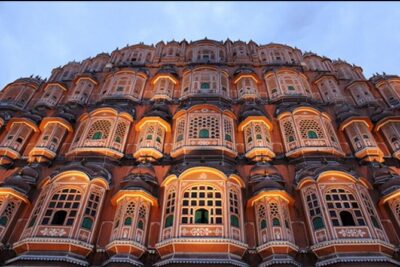
Private Golden Triangle Tour Delhi Agra Jaipur ( Top Rated )
Read our review →Browse the lists this tour appears in