
Reviewed · GOLDEN TRIANGLE TOURS
5 Days Golden Triangle Tour. Delhi-Agra-Jaipur-Delhi
India rewards a full schedule. This private Golden Triangle trip gives you Delhi’s Mughal landmarks, Jaipur’s Rajput palaces, Agra Fort, Chand Baori, and a sunrise visit to the Taj Mahal. I like the flexibility of a private car and the chance to adjust the pace, and I also like that guides such as Prashant and Vishal have earned praise for helping with safety, translation, photos, and day-to-day problems. The main concern is that the plan is packed, and the accommodation details conflict with the payment information.
I especially like the small private format, which suits a group of four to eight people better than a large coach. I also like the strong value at $300 per person if transport, guiding, taxes, water, and hotel stays are all handled as described. Before paying, confirm the hotel arrangement, monument fees, and exactly how the five days are divided between Delhi, Jaipur, Agra, and the return to Delhi.
In This Review
- Key points at a glance
- What this five-day Golden Triangle tour is really like
- Day 1: Six very different faces of Delhi
- Day 2: A very light schedule with one open question
- Day 3: Amber Palace and Jaipur’s royal center
- Day 4: Chand Baori and the Mughal power center
- Day 5: The Taj Mahal at sunrise
- Guides, drivers, and the human side of the trip
- What the $300 price includes, and what it may not
- Who should book this tour?
- FAQ
- How long is the Golden Triangle tour?
- Is this a private tour?
- Is hotel accommodation included?
- Are monument entrance tickets included?
- Is transportation provided?
- Is a guide included?
- What happens if bad weather cancels the tour?
- Can I cancel for a full refund?
- Should you book it?
Key points at a glance
- A sunrise Taj Mahal visit: The early start is worth it for softer light and fewer people around the monument.
- A private air-conditioned car: This matters on long road days between Delhi, Jaipur, and Agra, especially when you want stops adjusted.
- A useful first look at Delhi: Jama Masjid, Chandni Chowk, Humayun’s Tomb, Raj Ghat, Qutub Minar, and Lotus Temple cover several sides of the capital.
- Jaipur’s major sights in one day: Amber Palace, Jal Mahal, City Palace, and Jantar Mantar form a strong introduction to the Pink City.
- A worthwhile detour to Chand Baori: The 3,500-step stepwell at Abhaneri adds something different from the main palace circuit.
- Guides who help with more than dates: Prashant and Vishal are praised for personal care, translation, safety, smooth planning, and even arranging a Taj Mahal photo session.
What this five-day Golden Triangle tour is really like
This is a private road tour through India’s most popular northern circuit: Delhi, Agra, Jaipur, then Delhi again. You get a car, city guides, packaged drinking water, taxes, and private transport. The schedule is designed for first-time visitors who want the major monuments without arranging every transfer themselves.
The price is listed at $300 per person. That can be a fair deal for five days of private driving and guiding, particularly if three-star hotels and breakfast are truly included. Yet the details need checking because the overview says accommodation and breakfast are included, while the exclusions say accommodation is not included. Monument tickets are also not included, and neither are tips or personal expenses.
I would treat the price as a starting figure, not the final cost of the whole trip. Ask for a written breakdown covering hotels, breakfasts, monument entry, and any additional transport charges. If the hotel cost is extra, the $300 price becomes much less remarkable, though private transport and guides still provide useful value.
The private setup is the main advantage. You are not tied to a large group’s timetable, and the vehicle can make short photo stops, such as the ten-minute stop at Jal Mahal. The group size is limited to your own party, with group discounts offered. The stated customization range is somewhat unclear, since the tour can apparently be adjusted from four to eight days, while the advertised version lasts five days. Confirm the exact version you are buying.
More Golden Triangle Tours in New Delhi:
- 3-Days Private Golden Triangle Tour: Delhi, Agra & Jaipur by Car
★ 5.0 · 1,107 reviews - 3-Days Private Golden Triangle Tour: Delhi, Agra & Jaipur by Car
★ 5.0 · 1,098 reviews - 3-Day Delhi, Agra and Jaipur Private Tour – India Golden Triangle
★ 5.0 · 812 reviews
Day 1: Six very different faces of Delhi
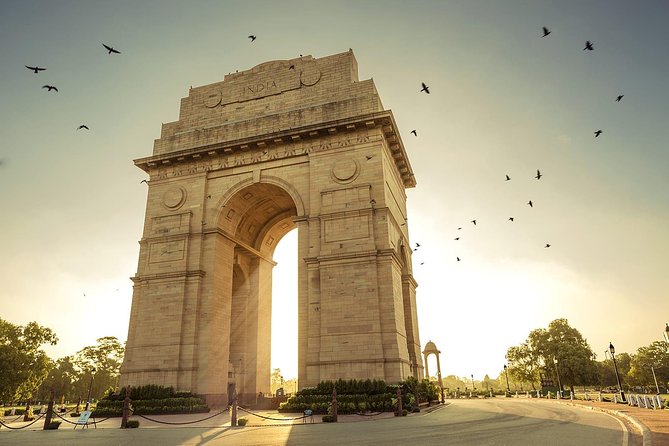
The first day covers a lot of ground. It begins in Old Delhi at Jama Masjid, continues through Chandni Chowk, then moves to Humayun’s Tomb, Raj Ghat, Qutub Minar, and Lotus Temple.
Jama Masjid is a fitting first stop. Built during the Mughal period, its broad courtyard can hold more than 25,000 people. You get a sense of scale here that photographs do not quite convey. The visit is listed at 45 minutes, which should allow time to look across the courtyard and take in the mosque’s position within Old Delhi.
Next comes a rickshaw ride through Chandni Chowk. This is one of the oldest and busiest market areas in the capital, created under Shah Jahan, the Mughal emperor associated with the Taj Mahal. The 30-minute ride is short, but it gives you a close view of Old Delhi’s crowded lanes and commercial energy without asking you to navigate them alone.
I like this pairing of Jama Masjid and Chandni Chowk. One gives you monumental architecture, while the other shows daily city life. The rickshaw ride is included, but you should expect a quick taste rather than a slow market visit.
Humayun’s Tomb brings a calmer change of pace. It was the first garden tomb on the Indian subcontinent and is now a UNESCO World Heritage Site. The plan allows 45 minutes, enough for an overview and photographs, though the entry ticket costs extra. This is an important stop for understanding the Mughal design ideas that later reached their grandest expression at the Taj Mahal.
At Raj Ghat, you visit the memorial to Mahatma Gandhi. The stop lasts 30 minutes and admission is free. It is a quieter and more reflective part of the day, giving the itinerary a modern historical note after the Mughal monuments.
Qutub Minar is another major Delhi sight. The tour describes it as the tallest brick minaret in the world and allows 45 minutes. The entry ticket is not included. With its soaring height and surrounding historic complex, it gives you a very different architectural experience from Jama Masjid and Humayun’s Tomb.
The final stop is Lotus Temple, a Bahá’í House of Worship open to people of all religions and backgrounds. Admission is free, and 45 minutes is scheduled. I like ending the day here because it broadens the picture of Delhi beyond imperial and political history.
This first day is also the most demanding. Six stops involve traffic, security, walking, and repeated changes of setting. The private car helps, but you should not expect a leisurely afternoon. The schedule works best if you want breadth and a strong first look at Delhi rather than long, unhurried visits.
Day 2: A very light schedule with one open question
The listed second day includes Birla Mandir Temple, with an evening visit to attend a ceremony. The temple is dedicated to Lord Vishnu and Lakshmi, and admission is free.
This can be a pleasant cultural stop because it focuses on worship rather than only on grand monuments. The planned visit lasts 45 minutes, and an evening ceremony may give the stop a stronger sense of place than a daytime walk-through.
Still, the day needs clarification. Only Birla Mandir is specified, and no other sightseeing or transfer details are given. Since the overall route includes Delhi, Jaipur, Agra, and Delhi, this is likely connected to a travel or flexible day, but the exact plan is not stated. Ask the operator where you will sleep that night, when you leave Delhi, and whether Jaipur sightseeing begins on Day 2 or Day 3.
This matters because Day 3 contains a full Jaipur program, while Day 4 takes you toward Agra. The five-day structure may work well, but you should know how much road time is hidden between the named stops.
Day 3: Amber Palace and Jaipur’s royal center
Jaipur receives its full treatment on Day 3. The schedule includes Amber Palace, Jal Mahal, City Palace, Jantar Mantar, and a ten-minute picture stop.
Amber Palace is the day’s major visit, with 90 minutes allowed. It was the residence of Rajput maharajas and their families, and Mughal design influenced many parts of its architecture. You will want time here for courtyards, palace rooms, defensive walls, and the hill setting.
Ninety minutes is enough for a guided overview, but not for every corner. If palace architecture interests you, ask your guide which sections are included and keep an eye on the clock. The admission ticket is extra.
Jal Mahal is mainly a photo stop. The palace sits in the water, and the plan allows about ten minutes if you wish to stop. That is enough for pictures from the roadside, not a full visit. The short pause works well after Amber Palace because it breaks up the driving without pretending to offer an extended attraction.
City Palace follows, with one hour scheduled. The complex was established at the same time as Jaipur by Maharaja Sawai Jai Singh II, the city’s founder. It includes courtyards, buildings, galleries, and resting areas. The site gives you a closer look at royal life and Jaipur’s planned urban identity.
Jantar Mantar is one of the most unusual stops. It contains huge astronomical instruments, including a giant triangular sundial whose angled structure is aligned with the Earth’s axis. The shapes can look abstract at first, so a guide adds real value here. Ask for a simple explanation of how the instruments worked, rather than rushing through for photographs.
The entry fees for Amber Palace, City Palace, and Jantar Mantar are not included. These costs can add up, so budget for them before departure. The day is also fairly full, with 90 minutes at Amber Palace, an hour at City Palace, and 45 minutes at Jantar Mantar, plus road time and the photo stop.
I like the Jaipur day because it mixes grand royal buildings with a genuinely curious scientific site. The drawback is that it leaves little room for wandering the city on your own. If you want markets, local food, or time around Jaipur’s streets, discuss that in advance rather than assuming it will fit.
A few more options to weigh up in New Delhi
- Old & New Delhi City Tour – Half or Full Day Options Available
★ 5.0 · 4,811 reviews - Same Day Taj Mahal, Agra Fort & Baby Taj Tour from Delhi by Car
★ 5.0 · 4,304 reviews - Taj Mahal Day Tour from Delhi by Superfast Train – TOP RATED TOUR
★ 5.0 · 4,166 reviews - Full Day Taj Mahal, Agra Fort & Baby Taj Tour from Delhi by Car
★ 5.0 · 3,647 reviews
Day 4: Chand Baori and the Mughal power center
Day 4 begins at Chand Baori in Abhaneri, then continues to Agra Fort. This is a good contrast: an architectural curiosity in a village setting followed by one of India’s most important imperial forts.
Chand Baori is a stepwell with about 3,500 narrow steps arranged over 13 stories. It reaches roughly 30 meters into the ground, making it one of the deepest and largest structures of its type. The visit lasts 30 minutes and the entrance ticket is extra.
Thirty minutes is enough to look down into the geometric tiers and take photographs, but it will feel short if you want to study the structure closely. The stepwell is worth keeping because it adds a different kind of Indian architecture to a route otherwise dominated by tombs, palaces, temples, and forts.
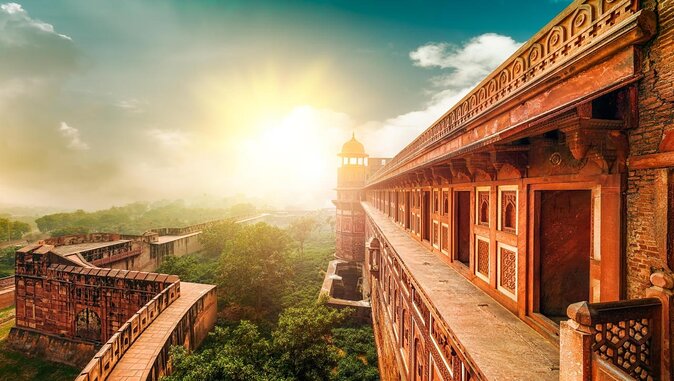
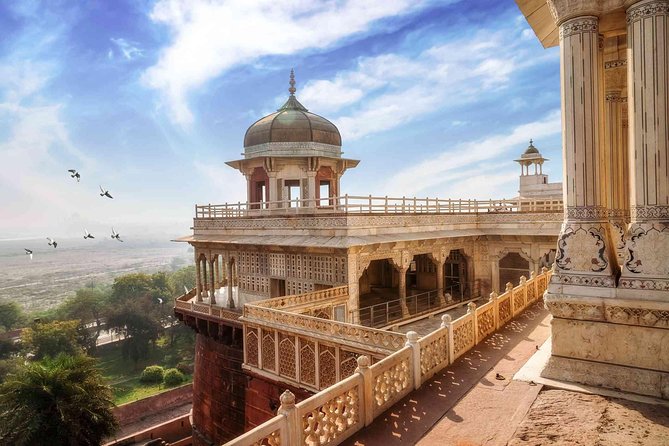
Agra Fort receives 90 minutes. Built from 1565 to 1573 for Emperor Akbar, it later became a major Mughal stronghold and royal residence. It was inscribed as a UNESCO World Heritage Site in 1983. You can expect massive walls, formal spaces, and a clear sense of how power was organized behind the fortifications.
The guide is especially useful here because Agra Fort can feel like a sequence of courtyards unless someone explains how the complex developed. The entry ticket is not included. I would keep some energy for this visit, even though the Taj Mahal is the next day’s headline attraction.
Day 5: The Taj Mahal at sunrise
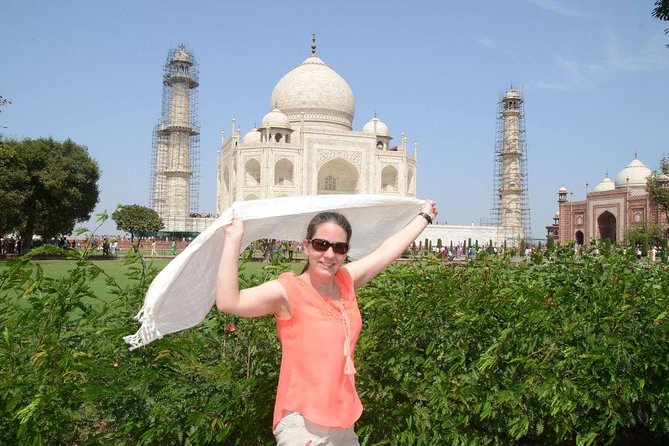
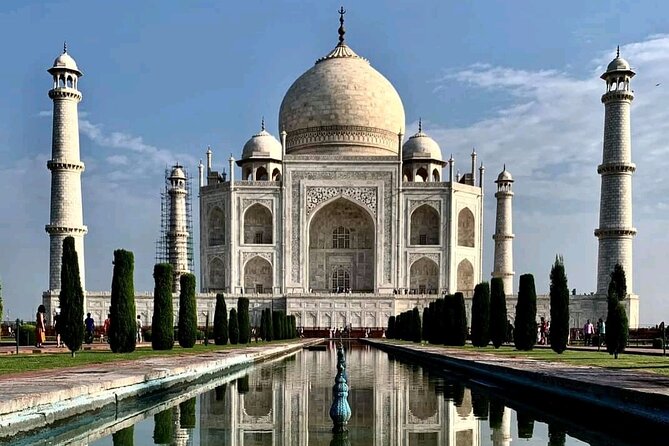
The final morning is built around the Taj Mahal. The scheduled visit lasts two hours, and sunrise is described as the best time to go.
That early timing is one of the strongest choices in the whole tour. Morning light can soften the white marble, and the grounds are generally less crowded at the start of the day than later on. The Taj Mahal is not simply a box to tick, so two hours gives you time to approach it, see the changing views, and take photographs without sprinting through.
The monument ticket is extra. Confirm the meeting time and entry arrangements before the evening before, since sunrise visits depend on precise timing. The tour information also says the experience requires good weather, so poor conditions may lead to a different date or a full refund.
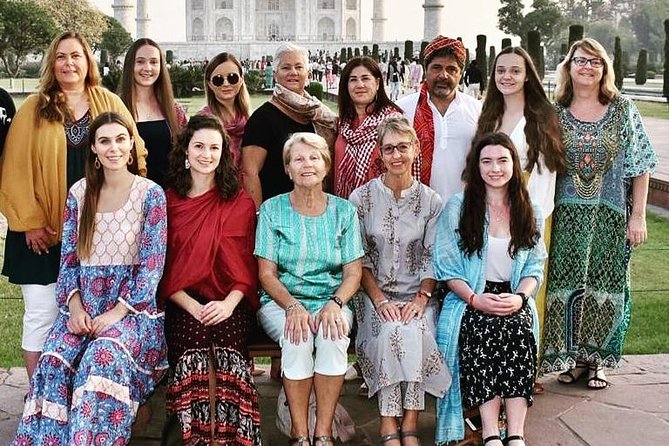
A memorable detail from the guiding service is the effort made to arrange a Taj Mahal photo session. If personal photographs matter to you, ask whether this can be included for your group and if there is any additional charge. Do not assume every special arrangement is part of the base price.
The itinerary ends with the Taj Mahal, but the tour is described as Delhi to Agra to Jaipur to Delhi. The final return timing is not stated. Ask whether you are driven back to Delhi on Day 5 and what time you are expected to arrive. That answer matters if you have a flight, train, or separate hotel booking.
Guides, drivers, and the human side of the trip
The most praised part of this experience is the personal help provided by the guides. Prashant is singled out for making sure people felt safe, included, and cared for. He is also associated with arranging a Taj Mahal photo session and helping with the practical work that can make a busy trip easier.
Vishal receives similar praise for translating, explaining sights clearly, helping with local situations, and keeping the operation running smoothly. One specific example describes him helping the group cross Delhi traffic, a small act that says a lot about the value of having someone attentive beside you in an unfamiliar city.
These details matter more than polished commentary alone. A guide who can handle questions, translation, health concerns, and sudden changes may save time and reduce stress. The reported overall rating is 4.9 from 57 reviews, with 100 percent recommending the experience, so the guide service is clearly a major reason people value it.
That said, guides can vary by date. If you particularly want Prashant or Vishal, request a named guide before booking instead of assuming one will be assigned. The tour includes a city tour guide, but it does not promise a specific person.
What the $300 price includes, and what it may not
The stated inclusions are an air-conditioned vehicle, private transportation, all fees and taxes, a city tour guide, and packaged drinking water. Those basics cover the main framework of a road-based Golden Triangle trip.
The exclusions list monument tickets, tips, personal expenses, and accommodation. This conflicts with the overview, which says three-star hotels and breakfast are included. I would not ignore that difference. Ask for confirmation in writing before you pay, including the hotel names or at least the hotel category and number of nights.
If accommodation is included, $300 per person is attractive for a private five-day itinerary, particularly for a group sharing the vehicle. If accommodation is separate, your total cost could rise considerably once hotels, monument tickets, tips, and meals are added.
The free cancellation rule is useful: you can cancel at least 24 hours before the start time for a full refund. Changes made within 24 hours are not accepted, and cancellations caused by poor weather should result in either another date or a full refund.
Who should book this tour?
I would choose this trip if you are visiting North India for the first time and want the major sights organized in one package. It suits a family, two couples, or a small group of friends who value a private car and a guide who can handle translation and practical details.
It also suits you if architecture and history are your main interests. The route covers Mughal, Rajput, religious, political, and scientific sites rather than repeating the same kind of monument every day.
I would hesitate if you want slow travel. Day 1 is packed, Jaipur’s schedule is full, and the road transfers are not fully explained. Independent visitors who prefer long meals, unplanned market walks, or several hours at one monument may find the pace restrictive.
I would also hesitate until the accommodation issue is settled. That single contradiction affects the real value of the package more than any other detail.
FAQ
How long is the Golden Triangle tour?
The advertised experience lasts approximately five days and follows a Delhi, Agra, Jaipur, Delhi route.
Is this a private tour?
Yes. Only your group participates, and the private format is designed for a minimum of four and a maximum of eight people.
Is hotel accommodation included?
The overview says three-star accommodation with breakfast is included, but the exclusions say accommodation is not included. You should confirm this directly before booking.
Are monument entrance tickets included?
No. Monument tickets for places such as Humayun’s Tomb, Qutub Minar, Amber Palace, City Palace, Jantar Mantar, Chand Baori, Agra Fort, and the Taj Mahal are listed as extra.
Is transportation provided?
Yes. The tour includes private transportation in an air-conditioned vehicle, along with packaged drinking water.
Is a guide included?
Yes. A city tour guide is included. Prashant and Vishal are named in connection with the guiding service, but a specific guide is not guaranteed in the tour details.
What happens if bad weather cancels the tour?
The experience requires good weather. If it is canceled because of poor weather, you should be offered another date or a full refund.
Can I cancel for a full refund?
Yes, if you cancel at least 24 hours before the experience start time. Cancellations or changes made less than 24 hours in advance are not accepted for a refund.
Should you book it?
Book this tour if you want a well-supported first visit to Delhi, Jaipur, and Agra, and if you are happy to trade a little free time for private transport and guide assistance. The sunrise Taj Mahal visit, Chand Baori stop, and strong record of personal help from guides such as Prashant and Vishal make it more useful than a simple monument checklist.
Before booking, confirm three things: the hotel cost, the full Day 2 and final Day 5 schedule, and the expected total for monument tickets and tips. If those answers are clear, the tour offers a practical way to see the Golden Triangle without managing every road transfer yourself.
Just added in New Delhi
- Yoga class in Delhi★ 5.0 · 29 reviews
- Old Town Delhi Walking Tour (2 Hours Guided Tour with Local)★ 4.5 · 22 reviews
- Unveil Old Delhi’s Food, Spice Market & Heritage Walk★ 5.0 · 26 reviews
- Vegetarian : Private Cooking Class in Delhi home ( Learn 7 meal)★ 5.0 · 58 reviews
- Private Taj Mahal & Agra Fort Tour, Dine with a View★ 5.0 · 27 reviews
- Tour to Akshardham temple with Guide and Delhi Transfer★ 5.0 · 26 reviews
- Private Tour of Taj mahal from Delhi by Train in 90 Min★ 5.0 · 46 reviews
- Private 2-Day Agra & Delhi Tour by Car–Includes Taj Mahal Sunrise★ 5.0 · 11 reviews
Golden Triangle Tours, compared.
3-Days Private Golden Triangle Tour: Delhi, Agra & Jaipur by Car
Read our review →3-Days Private Golden Triangle Tour: Delhi, Agra & Jaipur by Car
Read our review →
3-Day Delhi, Agra and Jaipur Private Tour – India Golden Triangle
Read our review →
Four-Day Private Luxury Golden Triangle Tour to Agra and Jaipur From New Delhi
Read our review →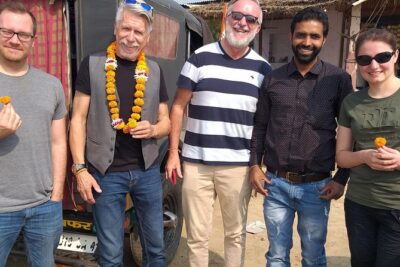
5 Nights 6 Days Private Golden Triangle Tour – Delhi Agra Jaipur
Read our review →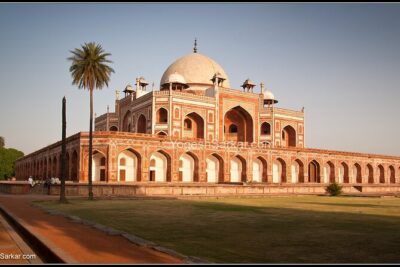

Private Car and Drive for Golden Triangle (4N/5D)
Read our review →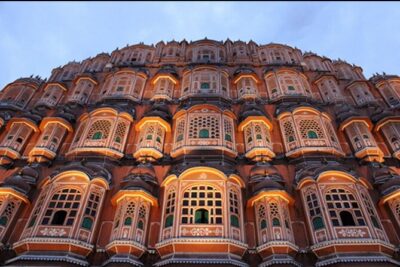
Private Golden Triangle Tour Delhi Agra Jaipur ( Top Rated )
Read our review →Browse the lists this tour appears in