
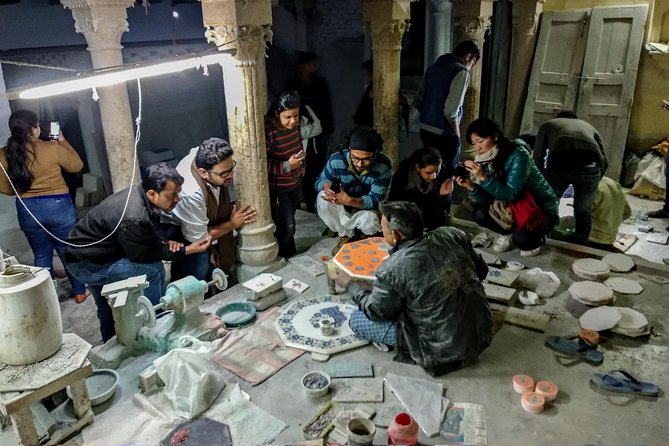
Reviewed · TAJ MAHAL TOURS
Taj Mahal Handicraft Walk: Explore True India with Artisans
The Taj Mahal has a working side. This two-hour walk takes you beyond the monument’s usual photo stops and into Agra’s craft quarters, where artisans still make zardozi, marble inlay, flower jewelry, and carpets by hand. I like the direct access to artisans’ homes and the chance to see how famous Taj-era skills continue today. I also like the flexible choice of tour times and the option to add a private car or tuk tuk pickup.
The main consideration is that private transportation costs extra, and the tour begins and ends at The Orchid Retreat near Taj East Gate Road. The walk is a private activity for your group, but the exact route and time spent at each workshop may vary. If you want a quiet look at local craft instead of another monument visit, this is a strong use of two hours.
In This Review
- Key points about the Taj Mahal Handicraft Walk
- Why this two-hour walk adds something to the Taj Mahal
- Starting near Taj East Gate Road
- Zardozi embroidery near the Taj Mahal
- Pietra Dura and the stonework linked to the Taj Mahal
- Flower garlands in the 17th-century lanes
- A three-generation marble Prachinkari workshop
- Carpetmaking at home
- What the $15.88 price really buys you
- Timing, comfort, and the shape of the experience
- Who should book this Agra craft walk?
- Should you book the Taj Mahal Handicraft Walk?
- FAQ
- How long does the Taj Mahal Handicraft Walk last?
- Where does the experience begin?
- Where does the tour end?
- Is transportation included?
- What crafts are included?
- Is this a private activity?
- Can I cancel for a full refund?
Key points about the Taj Mahal Handicraft Walk

- Meet artisans in working homes and workshops, not just in a shop designed for quick purchases.
- See five traditional crafts, including zardozi, Pietra Dura marble inlay, marble Prachinkari, flower garlands, body jewelry, and carpetmaking.
- Learn about Taj Mahal connections, including the claim that some marble artisans descend from craftspeople who worked on the monument.
- Walk through 17th-century lanes around the Taj Mahal and see a more ordinary side of Agra.
- Choose tour-only access or add pickup, with private car and tuk tuk options available.
- Book with modest financial risk, thanks to free cancellation up to 24 hours before the start time.
Why this two-hour walk adds something to the Taj Mahal
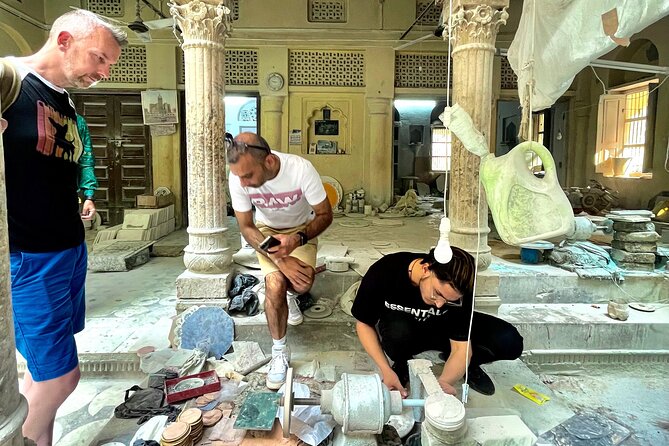
The Taj Mahal is easy to admire as a finished building. It is harder to picture the years of handwork behind its marble screens, floral patterns, embroidery, and decorative surfaces. This walk helps fill in that missing part of the story.
I like it best as a companion to a Taj Mahal visit. The monument gives you the grand result. The workshops show you the tools, materials, patience, and family skills that keep related arts alive in Agra.
The tour is not a second sightseeing circuit around the Taj Mahal. It is a local craft visit with short walks between stops. You will be close to one of India’s most famous sights, but the focus shifts from imperial architecture to homes, workshops, and working people.
The walk lasts about two hours, which is long enough for several stops without taking over your day. You can schedule it at different times, so it can fit before or after the Taj Mahal, depending on your plans. I would place it after seeing the monument if possible. The connection between the building and the crafts will be easier to understand then.
More Taj Mahal Tours in Agra
- Agra: Skip-the-Line Taj Mahal & Agra Fort Private Tour
★ 4.9 · 1,546 reviews - Agra: Taj Mahal Express Entry Tickets
★ 4.8 · 684 reviews - Agra: Taj Mahal and Mausoleum Guided Tour with Skip-the-Line
★ 4.8 · 631 reviews
Starting near Taj East Gate Road
The meeting point is The Orchid Retreat, Plot No. 28, Taj Nagri Phase 1, on Taj East Gate Road near Shilpgram Road. The tour returns to this same meeting point at the end.
That detail matters. The experience includes a guide and entry to artisans’ homes, but private transportation is not included in the base price. You can choose the tour without transport, or select pickup by private car or tuk tuk. Confirm your selected option when booking so you know how you will reach the starting point.
The location is near public transportation, and pickup is offered. The supplied details do not give a precise pickup radius or a separate transport price, so you should check those points before paying if you are staying outside the Taj Nagri area.
The tour is private, meaning only your own group participates. That makes it easier to ask questions and pause at a workshop when something catches your eye. It also avoids the stop-and-go feel that can come with a large group.
A guide named Arhaan is specifically praised for clear contact before the experience and for arriving on time. That is useful in Agra, where a clear meeting plan can save you from wasting part of a short tour. Extra stops may also be added when they help explain the area, though you should not assume a fixed number beyond the listed craft visits.
Zardozi embroidery near the Taj Mahal
The first major craft stop is one of the oldest zardozi workshops around the Taj Mahal. Zardozi is gold embroidery, a decorative art built from metallic thread and detailed handwork.
This stop gives you a close look at the difference between a finished souvenir and the labor behind it. The guide explains the craft’s background, then points out the details and fine work involved. Even a small embroidered piece can require careful placement and repeated hand movements.
For you, the value is visual. After seeing the broad stone surfaces of the Taj Mahal, you get a much smaller art form that depends on precision. The change of scale keeps the walk interesting.
This is also one of the places where buying something may make sense. The tour offers access to craft workshops rather than only conventional retail stores, and the supplied details suggest that souvenirs may be available at better prices than in regular shops. Still, bargain advice should be treated sensibly. Ask about the material, the amount of handwork, and the final price before agreeing to buy.
The visit is not only a shopping stop. You can look, ask questions, and learn how the craft is made. If you dislike sales pressure, tell your guide early that you want to understand the work before making any purchase.
Pietra Dura and the stonework linked to the Taj Mahal
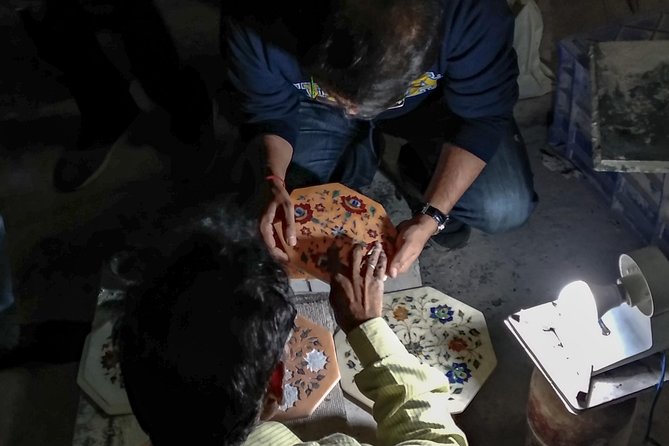
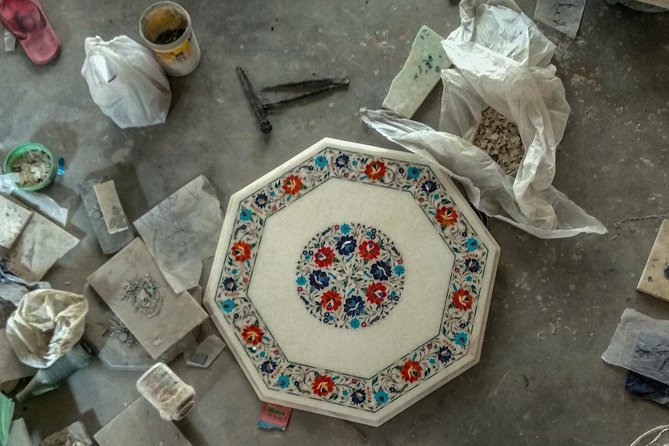
The marble inlay visit is likely the strongest stop for anyone interested in the Taj Mahal itself. Pietra Dura is the technique of setting carefully shaped pieces of colored stone into marble to create decorative designs.
The workshop explains how this craft began in connection with the Taj Mahal and how it continued to develop afterward. The artisans are described as descendants of craftspeople who made the monument, giving the visit a direct family connection to Agra’s best-known building.
You should treat that connection as part of the workshop’s local account, not as a reason to buy something. The useful part is seeing the method and hearing how the skill passed through generations. The craft makes the Taj Mahal easier to understand because you can connect the monument’s decoration with a living practice.
The marble pieces are shaped and fitted into larger designs. The work calls for patience and control, and the small scale can be easy to miss when you only see the completed monument. Here, you can focus on the individual pieces and the handwork that gives an inlay panel its pattern.
This stop may be especially good after a morning at the Taj Mahal. You will have seen marble in place, then get a more practical explanation of how decorative stonework can be produced.
A completely different kind of day out:
- Private Guided Taj Mahal Tour with Skip The Line Entry Ticket
★ 5.0 · 562 reviews - Agra: Taj Mahal & Mausoleum Skip-the-Line Tour with Options
★ 4.9 · 456 reviews - Private Guided Tour of Agra
★ 5.0 · 420 reviews - Taj Mahal, Agra Fort, Baby Taj & Mehtab Bagh Private City Tour
★ 5.0 · 391 reviews
Flower garlands in the 17th-century lanes
The walk then moves through old lanes around the Taj Mahal to households where people make garlands and other body jewelry from fresh flowers. This is a welcome change from stone, metal thread, and polished marble.
The flower work connects craft with daily life. Garlands are not simply decorative objects for display. The visit explains how fresh flowers have been used over time and how changes in their use have affected the trade.
This is also the part of the route most likely to feel like ordinary Agra rather than a formal workshop visit. You are walking through old lanes and seeing work done at home. The setting may be less polished than a showroom, but that is the point.
I would keep your expectations practical. You are not signing up for a long flower-making class, and the provided details promise a brief explanation rather than a hands-on lesson. The value comes from seeing a household craft in its setting and understanding how changing habits affect the people who make these items.
Fresh flowers also bring a different sensory note to the walk. The tour does not promise a specific flower, garland, or season, so the exact display may vary. You can take photographs, but ask before photographing people or private work.
A three-generation marble Prachinkari workshop
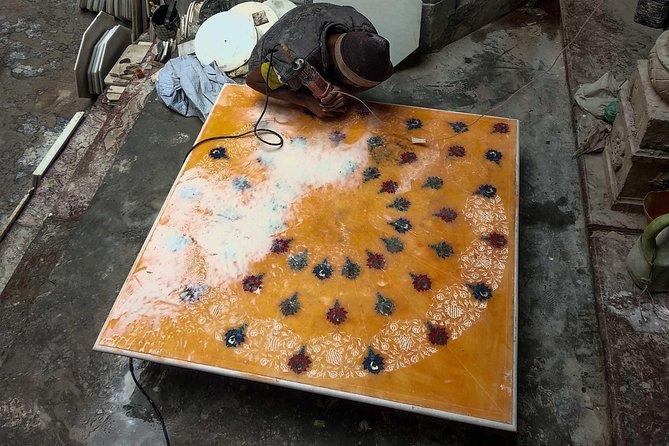
Another stop visits a three-generation-old workshop making marble Prachinkari work. The tour explains its connection to Pietra Dura, giving you a chance to compare two related forms of marble decoration.
The family history is important here. A craft passed through three generations is not just a product line. It is a body of practical skills, design choices, and working habits carried from one generation to the next.
You may find this stop more useful after the earlier Pietra Dura visit. The guide can help you see where the methods overlap and where the workshop’s approach differs. Without that context, marble crafts can blur together into one long sequence of white stone and colored shapes.
The stop also gives you another chance to judge handmade work before shopping. Look closely at the joins, the design, and the finish. Ask what is made by hand and what is done with tools. The walk is a good setting for learning how to look at a craft item, not just for finding the cheapest object.
As with the other workshops, buying is optional. You are not required to purchase anything to take part in the tour.
Carpetmaking at home
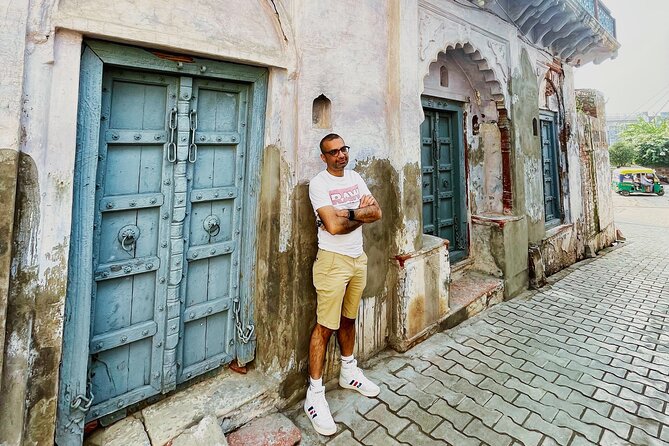
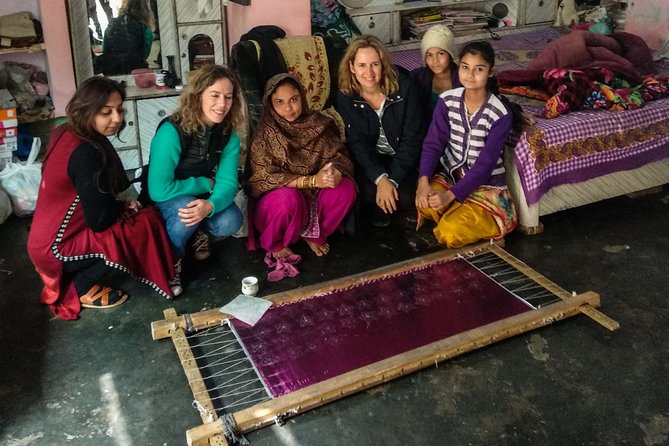
The final craft area focuses on carpetmaking in a household setting. You learn how present-day designs have changed through cross-community influence, which gives the visit a wider social angle than a simple display of rugs.
Carpet designs are not frozen in the past. Styles shift as makers respond to new tastes and ideas from different communities. That makes this stop useful for understanding how traditional work can continue without staying exactly the same.
The word household matters. You are seeing an art connected to family work rather than only a finished carpet arranged for sale. The tour details do not promise a full demonstration of every stage, so expect an introduction to the craft and its changing designs rather than a long technical class.
If you are considering a carpet purchase, take your time. Ask about size, materials, handwork, and how the piece is made. The walk may give you a better starting point than buying a rug from the first shop you see near the monument, but it does not remove the need to compare prices and details.
What the $15.88 price really buys you
At $15.88 per person, the tour is priced as a relatively low-cost addition to a Taj Mahal day. The base price includes the guide and entry to artisans’ homes. It does not include private transportation.
For me, the value rests in access. You are paying to enter working craft spaces and receive explanations that would be difficult to arrange on your own during a short stay. Five craft themes in about two hours also give you a useful introduction to Agra’s handmade traditions.
The price is less attractive if you only want a shopping trip. You can visit stores without booking a walk, and you may not want to spend time learning about several crafts. The experience earns its cost when you care about the people, methods, and local setting behind the objects.
Group discounts are available, though the supplied information does not state the discount amount or the number of people required. Since the activity is private to your group, larger parties should ask how the discount applies and how transportation is handled.
The tour can also save you from spending money on the wrong souvenir. Even if you buy nothing, you gain a better sense of what you are looking at. That is a practical benefit in a city where marble, embroidery, carpets, and decorative goods are sold in many places.
Timing, comfort, and the shape of the experience
You can choose from several departure times throughout the day. That flexibility helps if you are arranging the walk around the Taj Mahal, hotel check-out, meals, or train plans.
The tour requires walking through old lanes and moving between homes and workshops. The information says most people can participate, but it does not give a precise walking distance or state whether every stop is step-free. If mobility is a concern, ask the provider about the route before booking.
The experience requires good weather. If poor weather causes cancellation, you will be offered another date or a full refund. The same applies if the minimum number of participants is not met, although the tour is described as private for your group.
Free cancellation is available up to 24 hours before the start time. Cancellations or changes made less than 24 hours ahead are not refunded or accepted. The cut-off uses local time in Agra, so check the clock carefully if you are booking from another country.
You should also allow a little breathing room after the activity. The stated duration is approximately two hours, and extra stops may sometimes be included. Do not schedule a train or timed entry immediately afterward without a buffer.
Who should book this Agra craft walk?
I would recommend it to you if you have already seen, or plan to see, the Taj Mahal and want more context about the work behind it. It suits people who enjoy local encounters, traditional skills, photography, and small-scale history.
It is also a good choice if you want souvenirs but prefer to understand how they are made before buying. The workshops provide a better setting for comparison than a quick stop at a shop.
Families may like the variety. Children who lose interest in monuments can watch flowers become garlands, see patterns built into marble, and observe embroidery or carpetmaking. The two-hour length is manageable, though interest will depend on the child.
I would skip it if your Agra schedule is already packed with forts, tombs, and monument visits. It is not a substitute for the Taj Mahal, Agra Fort, or other major sights. It is a quieter, craft-focused activity, and its rewards come from slowing down.
The experience is also not ideal if you want a fully fixed route with no shopping conversations. The workshops may offer items for sale, and the point of the walk is to connect you with working craftspeople. You can decline purchases, but you should expect shopping to be part of the setting.
Should you book the Taj Mahal Handicraft Walk?
Book it if you want to see how Agra’s famous decorative arts are made and you value access to homes and workshops over another formal attraction. The combination of zardozi, Pietra Dura, flower jewelry, Prachinkari, and carpetmaking gives you a broad look at local craft in a short time.
The strongest plan is to take it after the Taj Mahal, when the marble inlay and artisan connections will have more meaning. Add pickup if reaching The Orchid Retreat is inconvenient, and leave time for the walk to run slightly beyond its approximate two-hour length.
At $15.88, it offers good value for an introduction to Agra’s handmade arts, especially for first-time visitors. Just remember that transport and purchases are extra, and book it for the cultural learning, not only for bargain hunting.
FAQ
How long does the Taj Mahal Handicraft Walk last?
The walk lasts approximately two hours.
Where does the experience begin?
It begins at The Orchid Retreat, Plot No. 28, Taj Nagri Phase 1, Taj East Gate Road, near Shilpgram Road in Agra.
Where does the tour end?
The activity ends back at the same meeting point.
Is transportation included?
Private transportation is not included in the base experience. You can choose pickup by private car or tuk tuk, or select the tour-only option.
What crafts are included?
The walk includes visits related to zardozi gold embroidery, Pietra Dura marble inlay, fresh-flower garlands and body jewelry, marble Prachinkari, and carpetmaking.
Is this a private activity?
Yes. Only your group participates in the activity.
Can I cancel for a full refund?
Yes. You can cancel at least 24 hours before the start time for a full refund. Cancellations or changes made less than 24 hours before the start time are not accepted or refunded.
Just added in Agra
- Taj Mahal Half Day Tour by Tuk Tuk★ 5.0 · 16 reviews
- 3-Hour Unimaginable Beauty of Taj Private Guided Tour★ 5.0 · 13 reviews
- Private Tour Guide For Taj Mahal And Agra Fort★ 5.0 · 17 reviews
- Taj Mahal Virtual Tour with Local Guide(Online Experience )★ 5.0 · 24 reviews
- Taj mahal Private Tour with Entry Ticket and Guide★ 5.0 · 42 reviews
- From Agra: Skip-the-Line Taj Mahal & Agra Fort Private Day Tour★ 5.0 · 25 reviews
- Taj Mahal & Agra Fort Tour from Agra City★ 5.0 · 30 reviews
- Taj Mahal & Agra Fort Tour with Fatehpur Sikri from Agra★ 5.0 · 13 reviews
Taj Mahal Tours, compared.

Same Day Taj Mahal, Agra Fort & Baby Taj Tour from Delhi by Car
Read our review →
Taj Mahal Day Tour from Delhi by Superfast Train – TOP RATED TOUR
Read our review →
Full Day Taj Mahal, Agra Fort & Baby Taj Tour from Delhi by Car
Read our review →
Taj Mahal & Agra Private Day Trip with Transfers
Read our review →
Taj Mahal Tour from Delhi by Express Train (Viator Award Winner)
Read our review →
All Inclusive Private Taj Mahal Luxury Tour from Delhi by Car
Read our review →
Same Day Taj Mahal, Fort & Baby Taj Tour from Delhi by Car
Read our review →
Browse the lists this tour appears in